

Nordihydroguaiaretic acid (Synonyms: NDGA, NSC 4291) |
カタログ番号GC18089
 One-Click Copy Product Info
|

選択的でないLO阻害剤
Products are for research use only. Not for human use. We do not sell to patients.
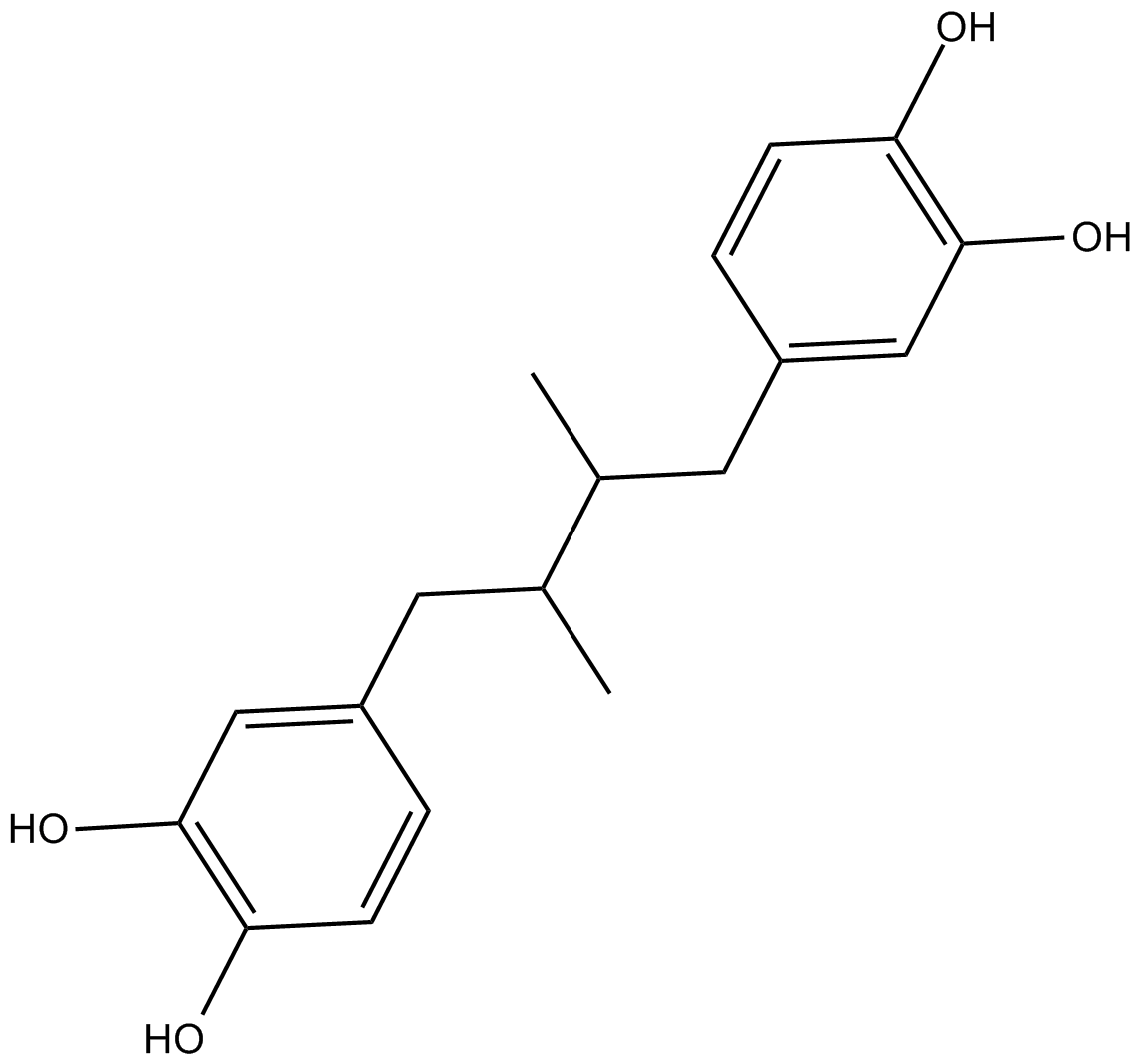
Cas No.: 500-38-9
Sample solution is provided at 25 µL, 10mM.
_1-3.$$$39978408@51.jpg');)
_1-9.$$$38538795@65.jpg');)
_1-9.$$$39112701@51.jpg');)
_1-7.$$$37316672@70.jpg');)
_366-372.$$$36198801@70.jpg');)
.$$$38565142@65.jpg');)
_1867-1883.$$$33248023@67.jpg');)
_eads6055.$$$39977546@45.jpg');)
_eadm9805.$$$40080571@45.jpg');)
_eadj3020.$$$39666821@45.jpg');)
_1-20.$$$39757301@28.jpg');)
_1-24.$$$38898113@28.jpg');)
_273-287.$$$36806353@46.jpg');)
_1-16.$$$37156877@44.jpg');)
_1-19.$$$37460805@44.jpg');)
_1291-1307.$$$34518654@46.jpg');)
Nordihydroguaiaretic acid is a potent 5-lipoxygenase (5-LOX) inhibitor with an IC50 value of 8μM [1]. Nordihydroguaiaretic acid blocks production of leukotriene B4, degranulation, phagocytosis, and the respiratory burst by exerting effects on the mitochondria and nonspecifically inhibiting NADPH oxidase and protein kinase C [2]. Nordihydroguaiaretic acid has been widely used as an antioxidant to prevent the harmful effects of reactive oxygen species (ROS)[3].
In vitro, Nordihydroguaiaretic acid treatment for 24 hours significantly inhibited the growth of HepG2 cells, with an IC50 value of 45.646μM[4]. Treatment with 20μM Nordihydroguaiaretic acid for 24 hours significantly inhibited the migration of PC3 cells and reduced the expression of NRP1[5]. 10μM of Nordihydroguaiaretic acid pre-incubation for 1 hour blocked the increase in junB expression in the TGF-β-induced ROS17/2.8 cells and inhibited the nuclear translocation of Smad proteins[6].
In vivo, Nordihydroguaiaretic acid treatment via oral administration at a dose of 2.5g/kg/day for 16 weeks resulted in a significant decrease in body weight and rectal temperature in ob/ob mice, and promoted a significant reduction in serum triglyceride (TG) and glucose levels[7]. Intraperitoneal injection of Nordihydroguaiaretic acid at a dose of 750μg five times a week for 3 weeks significantly inhibited tumor growth and promoted cancer cell apoptosis in SW 850 xenograft mice[8].
References:
[1] West M, Mhatre M, Ceballos A, et al. The arachidonic acid 5‐lipoxygenase inhibitor nordihydroguaiaretic acid inhibits tumor necrosis factor α activation of microglia and extends survival of G93A‐SOD1 transgenic mice[J]. Journal of neurochemistry, 2004, 91(1): 133-143.
[2] Lü J M, Nurko J, Weakley S M, et al. Molecular mechanisms and clinical applications of nordihydroguaiaretic acid (NDGA) and its derivatives: an update[J]. Medical science monitor: international medical journal of experimental and clinical research, 2010, 16(5): RA93.
[3] Chen Q. Nordihydroguaiaretic acid analogues: their chemical synthesis and biological activities[J]. Current topics in medicinal chemistry, 2009, 9(17): 1636-1659.
[4] Lu F, Luo G, Qiao L, et al. Virtual screening for potential allosteric inhibitors of cyclin-dependent kinase 2 from traditional chinese medicine[J]. Molecules, 2016, 21(9): 1259.
[5] Li X, Fan S, Pan X, et al. Nordihydroguaiaretic acid impairs prostate cancer cell migration and tumor metastasis by suppressing neuropilin 1[J]. Oncotarget, 2016, 7(52): 86225.
[6] Lee C H, Jang Y S, Her S J, et al. Nordihydroguaiaretic acid, an antioxidant, inhibits transforming growth factor-β activity through the inhibition of Smad signaling pathway[J]. Experimental cell research, 2003, 289(2): 335-341.
[7] Zhang H, Shen W J, Cortez Y, et al. Nordihydroguaiaretic acid improves metabolic dysregulation and aberrant hepatic lipid metabolism in mice by both PPARα-dependent and-independent pathways[J]. American Journal of Physiology-Gastrointestinal and Liver Physiology, 2013, 304(1): G72-G86.
[8] Seufferlein T, Seckl M J, Schwarz E, et al. Mechanisms of nordihydroguaiaretic acid-induced growth inhibition and apoptosis in human cancer cells[J]. British journal of cancer, 2002, 86(7): 1188-1196.
| Cell experiment [1]: | |
Cell lines | HepG2 cells |
Preparation Method | HepG2 cells were incubated in DMEM medium supplemented with 10% fetal calf serum (FCS) in a humidified atmosphere at 37°C with 5% CO2. Cells were cultured in a 96-well culture plate at 1×10⁴ cells/well. After 24h cultured at 37°C in the atmosphere of 5% CO2, cells were adhered to and treated with different concentrations of Nordihydroguaiaretic acid (0, 10, 30, 50, 80, 100, 120, and 150μM) and incubated for 24h. Cell proliferation was measured. |
Reaction Conditions | 0, 10, 30, 50, 80, 100, 120, and 150μM; 24h |
Applications | Nordihydroguaiaretic acid treatment significantly reduced the cell proliferation of HepG2 cells in a dose-dependent manner. |
| Animal experiment [2]: | |
Animal models | Male leptin-deficient (ob/ob) mice |
Preparation Method | Male ob/ob mice were fed a standard chow diet for 1 week to acclimatize to a controlled environment (25±2°C; 55±5% relative humidity with a 12h light-dark cycle). Subsequently, one group of ob/ob mice was switched to a chow diet supplemented with 2.5g/kg/day Nordihydroguaiaretic acid and maintained on the diet for 16 weeks. Food intake and body weight were measured once a week throughout the experiment. Liver samples were collected from mice for analysis. |
Dosage form | 2.5g/kg/day for 16 weeks; i.p. |
Applications | Nordihydroguaiaretic acid treatment significantly decreased the body weight of ob/ob mice and improved aberrant hepatic lipid metabolism in ob/ob mice. |
References: | |
| Cas No. | 500-38-9 | SDF | |
| 同義語 | NDGA, NSC 4291 | ||
| Chemical Name | 4,4'-(2,3-dimethylbutane-1,4-diyl)bis(benzene-1,2-diol) | ||
| Canonical SMILES | CC(C(CC1=CC(O)=C(O)C=C1)C)CC2=CC(O)=C(O)C=C2 | ||
| Formula | C18H22O4 | M.Wt | 302.36 |
| 溶解度 | ≥ 121 mg/mL in DMSO, ≥ 107 mg/mL in EtOH | Storage | Store at -20°C |
| General tips | Please select the appropriate solvent to prepare the stock solution according to the
solubility of the product in different solvents; once the solution is prepared, please store it in
separate packages to avoid product failure caused by repeated freezing and thawing.Storage method
and period of the stock solution: When stored at -80°C, please use it within 6 months; when stored
at -20°C, please use it within 1 month. To increase solubility, heat the tube to 37°C and then oscillate in an ultrasonic bath for some time. |
||
| Shipping Condition | Evaluation sample solution: shipped with blue ice. All other sizes available: with RT, or with Blue Ice upon request. | ||
| Prepare stock solution | |||

|
1 mg | 5 mg | 10 mg |
| 1 mM | 3.3073 mL | 16.5366 mL | 33.0732 mL |
| 5 mM | 661.5 μL | 3.3073 mL | 6.6146 mL |
| 10 mM | 330.7 μL | 1.6537 mL | 3.3073 mL |
Step 1: Enter information below (Recommended: An additional animal making an allowance for loss during the experiment)
 g
μL
g
μL
Step 2: Enter the in vivo formulation (This is only the calculator, not formulation. Please contact us first if there is no in vivo formulation at the solubility Section.)
Calculation results:
Working concentration: mg/ml;
Method for preparing DMSO master liquid: mg drug pre-dissolved in μL DMSO ( Master liquid concentration mg/mL, Please contact us first if the concentration exceeds the DMSO solubility of the batch of drug. )
Method for preparing in vivo formulation: Take μL DMSO master liquid, next addμL PEG300, mix and clarify, next addμL Tween 80, mix and clarify, next add μL saline, mix and clarify.
Method for preparing in vivo formulation: Take μL DMSO master liquid, next add μL Corn oil, mix and clarify.
Note: 1. Please make sure the liquid is clear before adding the next solvent.
2. Be sure to add the solvent(s) in order. You must ensure that the solution obtained, in the previous addition, is a clear solution before proceeding to add the next solvent. Physical methods such as vortex, ultrasound or hot water bath can be used to aid dissolving.
3. All of the above co-solvents are available for purchase on the GlpBio website.
Quality Control & SDS
- View current batch:
- Purity: >97.00% Appearance: A solid
- COA (Certificate of Analysis)
- SDS (Safety Data Sheet)
- Datasheet
Average Rating: 5 (Based on Reviews and 30 reference(s) in Google Scholar.)