

Oxyntomodulin |
カタログ番号GC16969
 One-Click Copy Product Info
|

Oxyntomodulinは、37のアミノ酸で構成されたペプチドホルモンであり、同時にグルカゴン様のペプチド-1受容体とグルカゴン受容体の両方を活性化し、よって食欲、エネルギーの消耗と血糖値を調節する。
Products are for research use only. Not for human use. We do not sell to patients.
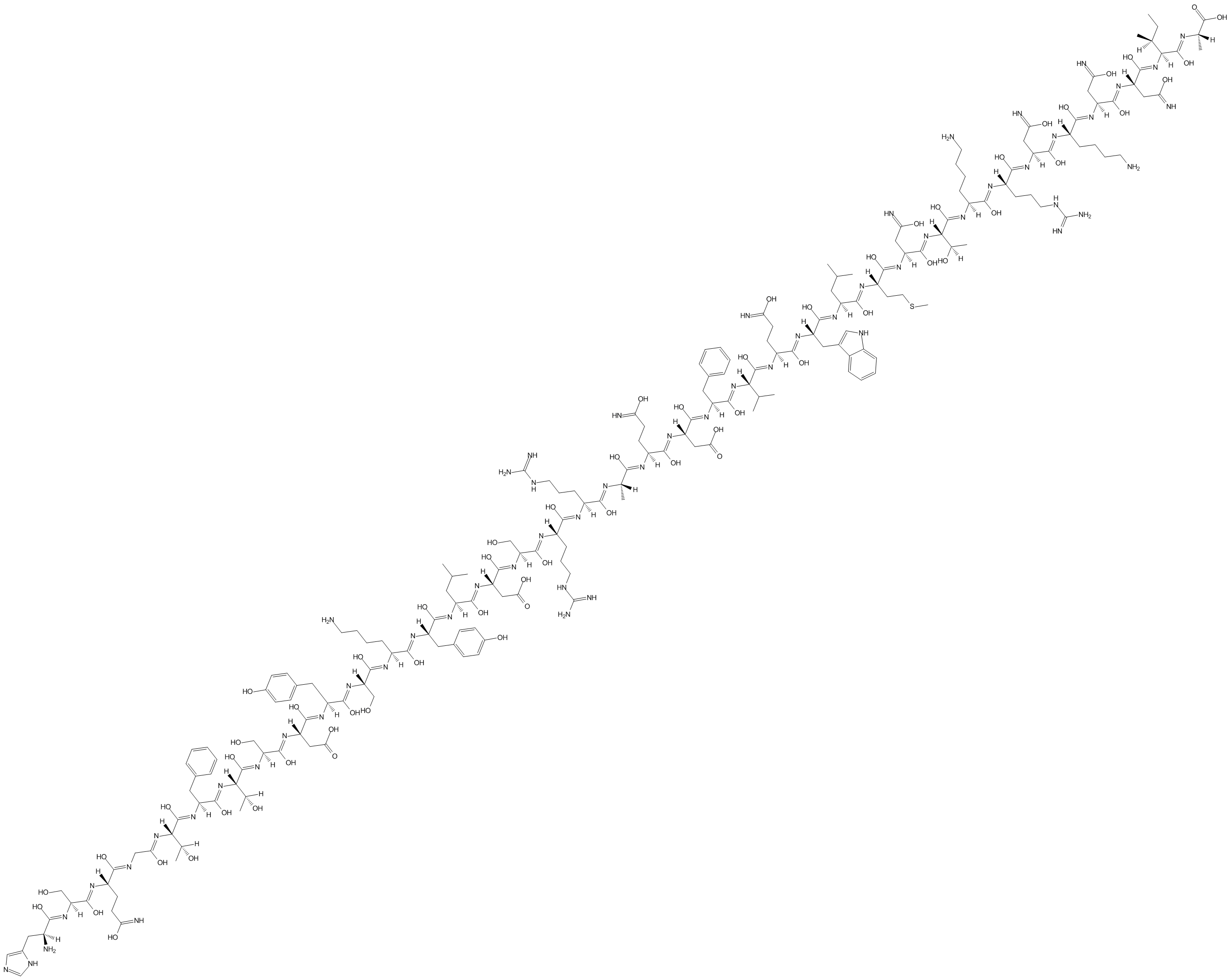
Cas No.: 62340-29-8
Sample solution is provided at 25 µL, 10mM.
_1-3.$$$39978408@51.jpg');)
_1-9.$$$38538795@65.jpg');)
_1-9.$$$39112701@51.jpg');)
_1-7.$$$37316672@70.jpg');)
_366-372.$$$36198801@70.jpg');)
.$$$38565142@65.jpg');)
_1867-1883.$$$33248023@67.jpg');)
_eads6055.$$$39977546@45.jpg');)
_eadm9805.$$$40080571@45.jpg');)
_eadj3020.$$$39666821@45.jpg');)
_1-20.$$$39757301@28.jpg');)
_1-24.$$$38898113@28.jpg');)
_273-287.$$$36806353@46.jpg');)
_1-16.$$$37156877@44.jpg');)
_1-19.$$$37460805@44.jpg');)
_1291-1307.$$$34518654@46.jpg');)
Oxyntomodulinは、37のアミノ酸で構成されたペプチドホルモンであり、同時にグルカゴン様のペプチド-1受容体とグルカゴン受容体の両方を活性化し、よって食欲、エネルギーの消耗と血糖値を調節する[1]。Oxyntomodulinは、グルカゴンの前駆体プログルカゴンの産物であり、プロホルモン転換酵素で処理された後は、腸管L細胞で産生され放出される[2]。Oxyntomodulinは、糖尿病と肥満の治療に潜在的な能力を持つ[3-4]。
体外で、Oxyntomodulin (10–1000nM)でSH-SY5Y細胞を1時間事前処理し、続いてグルタミン酸(100–150μM)または過酸化水素(150μM)で24時間刺激した結果、細胞の生存率を著しく増やし、グルタミン酸興奮毒性と酸化ストレスによる細胞死を減らした[5]。
体内で、8–24週齢のC57BL/6Jマウスに、Oxyntomodulin (4–25μg/マウス)を静脈内または腹腔内注射し、食物摂取による肝臓概日リズムを模擬した。概日周期で早期に投与した時、Oxyntomodulinは、コア時計遺伝子Per1/2の発見を急速に誘発し、肝臓時計遺伝子(Per2、Dbp)と代謝関連の遺伝子(Foxo1、Pdk4、Slc2a2)のリズム表現をリセットし、位相遅延または振幅減少を起こした[6]。体重が180–400gのWistarラットで、Oxyntomodulin (3–100nmol/kg)の腹腔内注射は、胃の内容排出を遅延させずに、断食誘発性再摂食と暗期摂食を用量依存的に阻害した。更に、Oxyntomodulinの末梢注射は、飢餓血漿グレリンのレベルを著しく減らし、視床下部弓状核(ARC)でc-fosの免疫反応性を増やし、それがARCニューロンを活性化することで食欲を抑制することを示唆した[7]。
References:
[1] Holst JJ, Rosenkilde MM. Oxyntomodulin - past, present and future. Peptides. 2025 Jun;188:171393.
[2] Holst JJ, Albrechtsen NJW, Gabe MBN, et al. Oxyntomodulin: Actions and role in diabetes. Peptides. 2018 Feb;100:48-53.
[3] Zhihong Y, Chen W, Qianqian Z, et al. Emerging roles of oxyntomodulin-based glucagon-like peptide-1/glucagon co-agonist analogs in diabetes and obesity. Peptides. 2023 Apr;162:170955.
[4] Wynne K, Field BC, Bloom SR. The mechanism of action for oxyntomodulin in the regulation of obesity. Curr Opin Investig Drugs. 2010 Oct;11(10):1151-7.
[5] Li Y, Wu KJ, Yu SJ, et al. Neurotrophic and neuroprotective effects of oxyntomodulin in neuronal cells and a rat model of stroke. Exp Neurol. 2017 Feb;288:104-113.
[6] Landgraf D, Tsang AH, Leliavski A, et al. Oxyntomodulin regulates resetting of the liver circadian clock by food. Elife. 2015 Mar 30;4:e06253.
[7] Dakin CL, Small CJ, Batterham RL, et al. Peripheral oxyntomodulin reduces food intake and body weight gain in rats. Endocrinology. 2004 Jun;145(6):2687-95.
| 細胞実験[1]: | |
細胞株 | SH-SY5Y細胞(ヒト神経芽腫細胞株) |
準備方法 | SH-SY5Y細胞を一晩中血清飢餓(0.5%の血清を含有)して、様々な濃度のOxyntomodulin (1–1000nM)で1時間事前処理した。その後、細胞をグルタミン酸(100–150μM)またはH₂O₂ (150μM)に24時間暴露した。 |
反応条件 | 1–1000nM;1時間 |
アプリケーション | Oxyntomodulinは用量依存的に細胞の生存率を増やし、グルタミン酸誘発の興奮毒性と酸化ストレスから保護した。SH-SY5Y細胞で、Oxyntomodulin (1–1000nM)はグルタミン酸(100mM)媒介の細胞死を効果的に減らし、より高い濃度(100nM)では、グルタミン酸(150mM)の毒性を打ち消す必要がある。 |
| 動物実験 [2]: | |
動物モデル | 成体した雄のWistarラット |
準備方法 | 3-100nmol/kgのOxyntomodulinをラットに腹腔内(i.p.)注射した。急性研究では、食物の摂取量を24時間の飢餓後、または暗期中に測定した。慢性研究では、ラットには7日間、Oxyntomodulin (50nmol/kg)を毎日二回腹腔内注射した。 |
投与形態 | 3-100nmol/kg;腹腔内注射 |
アプリケーション | Oxyntomodulinの末梢投与は、断食誘発性摂食と暗期摂食を用量依存的に阻害した。Oxyntomodulin(30-100nmol/kg)は最大24時間、累積食物摂取量を著しく減らした。7日間の慢性投与は、ペアで飼育された対照群と比べて、体重の増加と肥満を減らし(白色脂肪組織と褐色脂肪組織の量が減少)、カロリー摂取の減少を超えた効果を示唆した。 |
References: | |
| Cas No. | 62340-29-8 | SDF | |
| Canonical SMILES | CC[C@]([C@@](/N=C(O)/[C@](/N=C(O)/[C@](/N=C(O)/[C@](/N=C(O)/[C@](/N=C(O)/[C@](/N=C(O)/[C@](/N=C(O)/[C@](/N=C(O)/[C@](/N=C(O)/[C@](/N=C(O)/[C@](/N=C(O)/[C@](/N=C(O)/[C@](/N=C(O)/[C@](/N=C(O)/[C@](/N=C(O)/[C@](/N=C(O)/[C@](/N=C(O)/[C@](/N=C(O)/[C@](/N=C(O)/ | ||
| Formula | C192H295N59O60S | M.Wt | 4421.86 |
| 溶解度 | Soluble to 1 mg/ml in Water | Storage | Desiccate at -20°C |
| General tips | Please select the appropriate solvent to prepare the stock solution according to the
solubility of the product in different solvents; once the solution is prepared, please store it in
separate packages to avoid product failure caused by repeated freezing and thawing.Storage method
and period of the stock solution: When stored at -80°C, please use it within 6 months; when stored
at -20°C, please use it within 1 month. To increase solubility, heat the tube to 37°C and then oscillate in an ultrasonic bath for some time. |
||
| Shipping Condition | Evaluation sample solution: shipped with blue ice. All other sizes available: with RT, or with Blue Ice upon request. | ||
| Prepare stock solution | |||

|
1 mg | 5 mg | 10 mg |
| 1 mM | 226.1 μL | 1.1307 mL | 2.2615 mL |
| 5 mM | 45.2 μL | 226.1 μL | 452.3 μL |
| 10 mM | 22.6 μL | 113.1 μL | 226.1 μL |
Step 1: Enter information below (Recommended: An additional animal making an allowance for loss during the experiment)
 g
μL
g
μL
Step 2: Enter the in vivo formulation (This is only the calculator, not formulation. Please contact us first if there is no in vivo formulation at the solubility Section.)
Calculation results:
Working concentration: mg/ml;
Method for preparing DMSO master liquid: mg drug pre-dissolved in μL DMSO ( Master liquid concentration mg/mL, Please contact us first if the concentration exceeds the DMSO solubility of the batch of drug. )
Method for preparing in vivo formulation: Take μL DMSO master liquid, next addμL PEG300, mix and clarify, next addμL Tween 80, mix and clarify, next add μL saline, mix and clarify.
Method for preparing in vivo formulation: Take μL DMSO master liquid, next add μL Corn oil, mix and clarify.
Note: 1. Please make sure the liquid is clear before adding the next solvent.
2. Be sure to add the solvent(s) in order. You must ensure that the solution obtained, in the previous addition, is a clear solution before proceeding to add the next solvent. Physical methods such as vortex, ultrasound or hot water bath can be used to aid dissolving.
3. All of the above co-solvents are available for purchase on the GlpBio website.
Quality Control & SDS
- View current batch:
- Purity: >98.00% Appearance: A solid
- COA (Certificate of Analysis)
- SDS (Safety Data Sheet)
- Datasheet
Average Rating: 5 (Based on Reviews and 6 reference(s) in Google Scholar.)