

SC 66 |
カタログ番号GC11985
 One-Click Copy Product Info
|

SC 66 は Akt 阻害剤であり、用量および時間依存的に細胞生存率を低下させ、コロニー形成を阻害し、肝細胞癌 (HCC) 細胞のアポトーシスを誘導します。
Products are for research use only. Not for human use. We do not sell to patients.
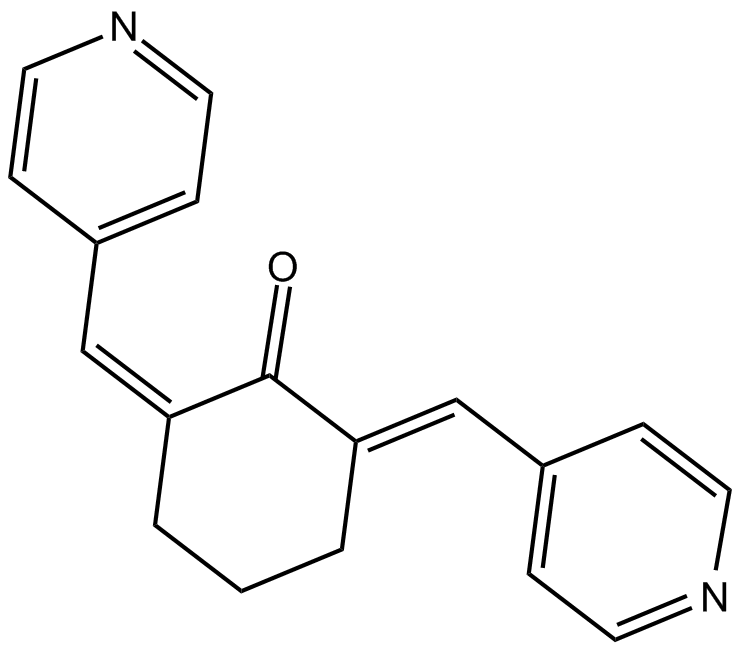
Cas No.: 871361-88-5
Sample solution is provided at 25 µL, 10mM.
_1-3.$$$39978408@51.jpg');)
_1-9.$$$38538795@65.jpg');)
_1-9.$$$39112701@51.jpg');)
_1-7.$$$37316672@70.jpg');)
_366-372.$$$36198801@70.jpg');)
.$$$38565142@65.jpg');)
_1867-1883.$$$33248023@67.jpg');)
_eads6055.$$$39977546@45.jpg');)
_eadm9805.$$$40080571@45.jpg');)
_eadj3020.$$$39666821@45.jpg');)
_1-20.$$$39757301@28.jpg');)
_1-24.$$$38898113@28.jpg');)
_273-287.$$$36806353@46.jpg');)
_1-16.$$$37156877@44.jpg');)
_1-19.$$$37460805@44.jpg');)
_1291-1307.$$$34518654@46.jpg');)
SC66 is an Akt inhibitor, reduces cell viability in a dose- and time-dependent manner, inhibits colony formation and induces apoptosis in hepatocellular carcinoma (HCC) cells.
SC66 inhibits cell viability and colony forming capacity of HCC cells with IC50s of 0.77,0.47,0.92,0.75 and 2.85 μg/mL at 72 hours for HepG2, Hep3B, PLC/PRF/5,HA22T/VGH and Huh7 cells. HepG2, HA22T/VGH and PLC/PRF/5 cells have similar IC50s of approximately 0.85 and 0.75 μg/mL at 48 and 72 hours, respectively. To determine whether the decrease in cell viability is related to apoptosis induction, TUNEL assays are performed in Hep3B and Huh7 cells treated with 1, 2 and 4 μg/mL of SC66 for 24 hours. In Hep3B cells the number of TUNEL-positive cells increased with increasing concentrations of SC66, whereas in Huh7 cells very few light brown-colored cells are observed only after treatment with 4 μg/mL SC66[1].
To demonstrate the effectiveness in vivo of SC66 on HCC, a mouse xenograft tumor model of Hep3B cells is used. When tumors became palpable, at a size of about 150 mm3, mice are randomized into three groups of 6 animals each. The treated group receive SC66 at 15 and 25 mg/kg twice a week via i.p. injection, while the untreated group receive the vehicle alone. Treatment with 25 mg/Kg SC66 significantly reduces tumor volume to 37% on day 17 when compared with tumors of the untreated group[1].
Reference:
[1]. Cusimano A, et al. Cytotoxic activity of the novel small molecule AKT inhibitor SC66 in hepatocellular carcinoma cells. Oncotarget. 2015 Jan 30;6(3):1707-22.
Cell experiment: | Cells (5 ×10³/well) are distributed into each well of 96-well microtiter plates and then incubated overnight. At time 0, the medium is replaced with fresh complete medium and different doses of SC66 are added. Cells are cultured for 24, 48 and 72 hours. At the end of treatment, MTS assays are performed using the CellTiter Aqueous OneSolution kit. Cell viability is expressed as a percentage of the absorbance measured in the control cells. Values are expressed as means±SD of three separate experiments, each performed in triplicate[1]. |
Animal experiment: | Mice[1] Male nude athymic mice (Fox1 nu/nu) aged 4 weeks are used. Suspensions of 1×10⁷ Hep3B cells in 0.2 mL of PBS are inoculated into the right flank of the animal. When tumors became palpable (around 150 mm3), the mice are randomly divided into three groups of 6 animals each, with the various tumor volumes equally distributed among the three groups. Two groups of mice are treated twice a week with 15 and 25 mg/kg SC66 suspended in DMSO, further diluted in a solution of 25% ethanol and administered via i.p. injection. The control group receive the vehicle alone. Tumor volumes are determined twice a week using calipers. Primary tumor volumes are calculated. |
References: [1]. Cusimano A, et al. Cytotoxic activity of the novel small molecule AKT inhibitor SC66 in hepatocellular carcinoma cells. Oncotarget. 2015 Jan 30;6(3):1707-22. | |
| Cas No. | 871361-88-5 | SDF | |
| Chemical Name | (2Z,6E)-2,6-bis(pyridin-4-ylmethylene)cyclohexanone | ||
| Canonical SMILES | O=C1/C(CCC/C1=C/C2=CC=NC=C2)=C/C3=CC=NC=C3 | ||
| Formula | C18H16N2O | M.Wt | 276.33 |
| 溶解度 | DMF: 0.5 mg/ml,DMSO: 0.25 mg/ml,Ethanol: 0.3 mg/ml | Storage | Store at -20°C |
| General tips | Please select the appropriate solvent to prepare the stock solution according to the
solubility of the product in different solvents; once the solution is prepared, please store it in
separate packages to avoid product failure caused by repeated freezing and thawing.Storage method
and period of the stock solution: When stored at -80°C, please use it within 6 months; when stored
at -20°C, please use it within 1 month. To increase solubility, heat the tube to 37°C and then oscillate in an ultrasonic bath for some time. |
||
| Shipping Condition | Evaluation sample solution: shipped with blue ice. All other sizes available: with RT, or with Blue Ice upon request. | ||
| Prepare stock solution | |||

|
1 mg | 5 mg | 10 mg |
| 1 mM | 3.6189 mL | 18.0943 mL | 36.1886 mL |
| 5 mM | 723.8 μL | 3.6189 mL | 7.2377 mL |
| 10 mM | 361.9 μL | 1.8094 mL | 3.6189 mL |
Step 1: Enter information below (Recommended: An additional animal making an allowance for loss during the experiment)
 g
μL
g
μL
Step 2: Enter the in vivo formulation (This is only the calculator, not formulation. Please contact us first if there is no in vivo formulation at the solubility Section.)
Calculation results:
Working concentration: mg/ml;
Method for preparing DMSO master liquid: mg drug pre-dissolved in μL DMSO ( Master liquid concentration mg/mL, Please contact us first if the concentration exceeds the DMSO solubility of the batch of drug. )
Method for preparing in vivo formulation: Take μL DMSO master liquid, next addμL PEG300, mix and clarify, next addμL Tween 80, mix and clarify, next add μL saline, mix and clarify.
Method for preparing in vivo formulation: Take μL DMSO master liquid, next add μL Corn oil, mix and clarify.
Note: 1. Please make sure the liquid is clear before adding the next solvent.
2. Be sure to add the solvent(s) in order. You must ensure that the solution obtained, in the previous addition, is a clear solution before proceeding to add the next solvent. Physical methods such as vortex, ultrasound or hot water bath can be used to aid dissolving.
3. All of the above co-solvents are available for purchase on the GlpBio website.
Quality Control & SDS
- View current batch:
- Purity: >99.50% Appearance: A solid
- COA (Certificate of Analysis)
- SDS (Safety Data Sheet)
- Datasheet
Average Rating: 5 (Based on Reviews and 16 reference(s) in Google Scholar.)