

V-9302 hydrochloride |
カタログ番号GC39253
 One-Click Copy Product Info
|

V-9302 hydrochlorideは、膜貫通型グルタミン輸送の競合的な低分子拮抗剤であり、アミノ酸トランスポーターASCT2(SLC1A5)を選択的に、効果的に標的にする。
Products are for research use only. Not for human use. We do not sell to patients.
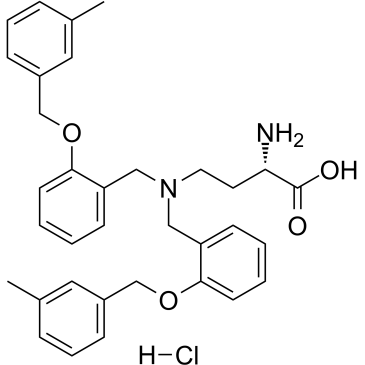
Cas No.: 2416138-42-4
Sample solution is provided at 25 µL, 10mM.
_1-3.$$$39978408@51.jpg');)
_1-9.$$$38538795@65.jpg');)
_1-9.$$$39112701@51.jpg');)
_1-7.$$$37316672@70.jpg');)
_366-372.$$$36198801@70.jpg');)
.$$$38565142@65.jpg');)
_1867-1883.$$$33248023@67.jpg');)
_eads6055.$$$39977546@45.jpg');)
_eadm9805.$$$40080571@45.jpg');)
_eadj3020.$$$39666821@45.jpg');)
_1-20.$$$39757301@28.jpg');)
_1-24.$$$38898113@28.jpg');)
_273-287.$$$36806353@46.jpg');)
_1-16.$$$37156877@44.jpg');)
_1-19.$$$37460805@44.jpg');)
_1291-1307.$$$34518654@46.jpg');)
V-9302 hydrochlorideは、膜貫通型グルタミン輸送の競合的な低分子拮抗剤であり、アミノ酸トランスポーターASCT2(SLC1A5)を選択的に、効果的に標的にする。V-9302によるASCT2の薬理学的な遮断は、癌細胞成長と増殖の減少を起こし、細胞死を増強し、酸化ストレスを上昇させた。これらの作用は、 in vitroとin vivoの両方で観察された強力な抗腫瘍反応に共同に寄与する[1-3]。
V-9302 hydrochloride(10μM;24時間)は、FBSまたはPDGFのどちらかで刺激されたVSMCでミトコンドリア呼吸を減らす。これで、V-9302 hydrochlorideによるグルタミン酸輸送の薬理学的な阻害が、増殖因子に刺激されて増殖するVSMCで、ミトコンドリア呼吸を抑制することが示唆される[4]。NCI-Meso-17細胞をV-9302 hydrochloride(5-15 μM)で処理したところ、細胞の増殖が減少し、スフェロイドの形成が阻害され、細胞の浸潤が減少した[5]。
V-9302 hydrochloride(75mg/kg;腹腔内注射;21日間)は、マウスHCT-116とHT29異種移植モデルで、腫瘍の増殖を効果的に阻害した[1]。V-9302 hydrochloride(12.5mg/kg/日;腹腔内注射;3週間、週に5日間)はマウスで新生内膜の形成を著しく阻害した[4]。CB-839とV-9302 hydrochloride(30mg/kg、腹腔内注射;15または20日間)は、SNU398とMHCC97H細胞を持つBALB/cヌードマウスで、異種移植片の増殖を阻害し、アポトーシスを促進した[6]。V-9302 hydrochloride(50mg/kg;腹腔内注射;5日間、毎日)はマウスで著しい腫瘍抑制効果を示した[7]。
| 細胞実験 [1]: | |
|
細胞株 |
血管平滑筋細胞(VSMC) |
|
調製方法 |
初代血管平滑筋細胞(VSMC)を、血清飢餓条件下で18時間培養した。その後、10% FBSまたはPDGF-BB(20ng/mL)の存在する/しない条件下、10μM V-9302のある/ない条件下で、それらを24時間インキュベーターした。 |
|
反応条件 |
10μM;24時間 |
|
応用 |
V-9302 hydrochlorideは、FBSまたはPDGFで刺激したVSMCでミトコンドリア呼吸を減らす。 |
| 動物実験 [1]: | |
|
動物モデル |
雄のC57BL/6 Jマウス(頚動脈結紮モデル) |
|
調製方法 |
頚動脈結紮による新生内膜の過形成はマウスで作製され、その結果、術後の3週目までに、著しい閉塞による新生内膜の過形成が起きていた。マウスには、殺処分までにV-9302 hydrochlorideを腹腔内注射した。 |
|
剤形 |
12.5mg/kg/日;腹腔内注射;3週間、週に5日間 |
|
応用 |
V-9302 hydrochlorideは、マウスで新生内膜の形成を著しく抑制する。 |
| Cas No. | 2416138-42-4 | SDF | |
| Canonical SMILES | O=C(O)[C@@H](N)CCN(CC1=CC=CC=C1OCC2=CC=CC(C)=C2)CC3=CC=CC=C3OCC4=CC=CC(C)=C4.[H]Cl | ||
| Formula | C34H39ClN2O4 | M.Wt | 575.14 |
| 溶解度 | DMSO : 125 mg/mL (217.34 mM; Need ultrasonic); H2O : 50 mg/mL (86.94 mM; Need ultrasonic); Ethanol : 100 mg/mL (185.63 mM) | Storage | Store at -20°C |
| Shipping Condition | Evaluation sample solution: shipped with blue ice. All other sizes available: with RT, or with Blue Ice upon request. | ||
| Prepare stock solution | |||

|
1 mg | 5 mg | 10 mg |
| 1 mM | 1.7387 mL | 8.6935 mL | 17.3871 mL |
| 5 mM | 347.7 μL | 1.7387 mL | 3.4774 mL |
| 10 mM | 173.9 μL | 869.4 μL | 1.7387 mL |
Step 1: Enter information below (Recommended: An additional animal making an allowance for loss during the experiment)
 g
μL
g
μL
Step 2: Enter the in vivo formulation (This is only the calculator, not formulation. Please contact us first if there is no in vivo formulation at the solubility Section.)
Calculation results:
Working concentration: mg/ml;
Method for preparing DMSO master liquid: mg drug pre-dissolved in μL DMSO ( Master liquid concentration mg/mL, Please contact us first if the concentration exceeds the DMSO solubility of the batch of drug. )
Method for preparing in vivo formulation: Take μL DMSO master liquid, next addμL PEG300, mix and clarify, next addμL Tween 80, mix and clarify, next add μL saline, mix and clarify.
Method for preparing in vivo formulation: Take μL DMSO master liquid, next add μL Corn oil, mix and clarify.
Note: 1. Please make sure the liquid is clear before adding the next solvent.
2. Be sure to add the solvent(s) in order. You must ensure that the solution obtained, in the previous addition, is a clear solution before proceeding to add the next solvent. Physical methods such as vortex, ultrasound or hot water bath can be used to aid dissolving.
3. All of the above co-solvents are available for purchase on the GlpBio website.
Quality Control & SDS
- View current batch:
- Purity: >98.00% Appearance: A solid
- COA (Certificate of Analysis)
- SDS (Safety Data Sheet)
- Datasheet
Average Rating: 5 (Based on Reviews and 9 reference(s) in Google Scholar.)