

Xanthine (Synonyms: 2,6-Dihydroxypurine, NSC 14664) |
カタログ番号GC33846
 One-Click Copy Product Info
|

Xanthineは天然に存在するプリン塩基であり、茶やココアなどの植物で広く存在しており、Xanthineは生物体内のプリン代謝経路で肝心な中間体として機能する。
Products are for research use only. Not for human use. We do not sell to patients.
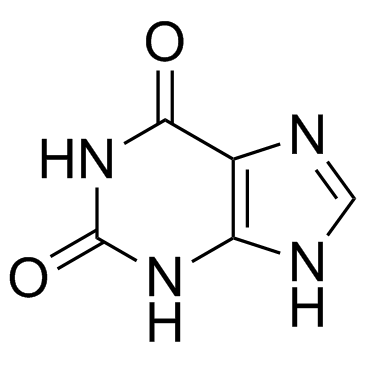
Cas No.: 69-89-6
Sample solution is provided at 25 µL, 10mM.
_1-3.$$$39978408@51.jpg');)
_1-9.$$$38538795@65.jpg');)
_1-9.$$$39112701@51.jpg');)
_1-7.$$$37316672@70.jpg');)
_366-372.$$$36198801@70.jpg');)
.$$$38565142@65.jpg');)
_1867-1883.$$$33248023@67.jpg');)
_eads6055.$$$39977546@45.jpg');)
_eadm9805.$$$40080571@45.jpg');)
_eadj3020.$$$39666821@45.jpg');)
_1-20.$$$39757301@28.jpg');)
_1-24.$$$38898113@28.jpg');)
_273-287.$$$36806353@46.jpg');)
_1-16.$$$37156877@44.jpg');)
_1-19.$$$37460805@44.jpg');)
_1291-1307.$$$34518654@46.jpg');)
Xanthineは天然に存在するプリン塩基であり、茶やココアなどの植物で広く存在しており、Xanthineは生物体内のプリン代謝経路で肝心な中間体として機能する[1-2]。Xanthineは主に、グアニンデアミナーゼに触媒される脱アミノ化を通じてグアニンから、またはキサンチン酸化還元酵素(XOR)に触媒される酸化を通じてヒポキサンチンから生成され、更に尿酸に代謝される[3-4]。
In vitro(体外)実験で、8日齢のSprague-Dawleyラットの小脳顆粒ニューロンをXanthine(100μM)とキサンチンオキシダーゼ(0.02U/ml)で1または6時間処理したところ、Xanthineは細胞の生存率を著しく減らし、細胞体とシナプス形態の萎縮を誘発した[5]。Xanthine(3-100μM)でヒト臍帯静脈内皮細胞(HUVEC)を15分間処理したところ、Xanthineはキサンチンオキシダーゼ由来の過酸化水素を通じて、血小板活性の因子経路を活性化し、好中球-内皮細胞の接着を増強した[6]。
In vivo(体内)実験で、C57BL/6JマウスにXanthine(500mg/kg)を腹腔内注射(20日間、三日ごと)したところ、Xanthineは、海馬体依存の空間記憶障害と不安様の行動の傾向を誘発し、同時に海馬体のニューロンでヘモグロビン遺伝子(Hba-a1やHBA2など)の発見を上方制御し、その結果、認知と行動異常を起こした[7]。
References:
[1] POMALES R, ELION GB, HITCHINGS GH. XANTHINE AS A PRECURSOR OF NUCLEIC ACID PURINES IN THE MOUSE. Biochim Biophys Acta. 1965 Mar 15;95:505-6.
[2] Kanemitsu H, Tamura A, Kirino T, et al. Xanthine and uric acid levels in rat brain following focal ischemia. J Neurochem. 1988 Dec;51(6):1882-5.
[3] Zhang A, Ai L. Xanthine negatively regulates c-MYC through the PI3K/AKT signaling pathway and inhibits the proliferation, invasion, and migration of breast cancer cells. Asia Pac J Clin Oncol. 2025 Feb;21(1):3-11.
[4] Fan KQ, Li YY, Wang HL, et al. Stress-Induced Metabolic Disorder in Peripheral CD4+ T Cells Leads to Anxiety-like Behavior. Cell. 2019 Oct 31;179(4):864-879.e19.
[5] Fatokun AA, Stone TW, Smith RA. Hydrogen peroxide mediates damage by xanthine and xanthine oxidase in cerebellar granule neuronal cultures. Neurosci Lett. 2007 Apr 6;416(1):34-8.
[6] Ichikawa H, Wolf RE, Aw TY, et al. Exogenous xanthine promotes neutrophil adherence to cultured endothelial cells. Am J Physiol. 1997 Aug;273(2 Pt 1):G342-7.
[7] Kambe J, Miyata S, Li C, et al. Xanthine-induced deficits in hippocampal behavior and abnormal expression of hemoglobin genes. Behav Brain Res. 2023 Jul 9;449:114476.
| 細胞実験[1]: | |
細胞株 | ヒト臍帯静脈内皮細胞(HUVEC) |
準備方法 | 37°C、5% CO₂で、20%のFBS、2mMのL-グルタミン、100U/mLのペニシリンと100μg/mLのストレプトマイシンを添加したM199培地でHUVECを培養した。細胞をXanthine(3-100μM)で15分間処理した。 |
反応条件 | 3-100μM;15分間 |
アプリケーション | Xanthineは、キサンチンオキシダーゼ由来の過酸化水素を通じて、血小板活性化因子(PAF)経路を活性化し、内皮細胞への好中球の接着を増強した。この効果は、内皮細胞P-セレクチンと細胞内接着分子-1(ICAM-1)の発現の上方制御と関連している。接着のプロセスは細胞表面のキサンチンオキシダーゼに依存しており、カタラーゼ阻害剤、キサンチンオキシダーゼ阻害剤、またはPAF受容体拮抗剤で阻害できた。 |
| 動物実験 [2]: | |
動物モデル | C57BL/6マウス |
準備方法 | マウスにXanthine(500mg/kg)を3日ごとに腹腔内投与した。処理期に行動試験(オープンフィールドテスト、高架式十字迷路テストと物体位置テスト)を行った。経心臓灌流の後、海馬体の組織をトランスクリプトーム解析のために採取した。 |
投与形態 | 500mg/kg;腹腔内注射;20日間、3日ごと |
アプリケーション | Xanthineの投与は、物体位置テストで海馬体依存の空間記憶障害を誘発し、高架式十字迷路テストで不安様の行動の傾向を誘発した。 |
References: | |
| Cas No. | 69-89-6 | SDF | |
| 同義語 | 2,6-Dihydroxypurine, NSC 14664 | ||
| Canonical SMILES | O=C(N1)NC2=C(N=CN2)C1=O | ||
| Formula | C5H4N4O2 | M.Wt | 152.11 |
| 溶解度 | 5 mg/mL in Water (ultrasonic and warming and adjust pH to 10 with 1M NaOH and heat to 60°C);8 mg/mL in 1M NaOH (ultrasonic and adjust pH to 11 with NaOH) | Storage | Store at 2-8°C |
| General tips | Please select the appropriate solvent to prepare the stock solution according to the
solubility of the product in different solvents; once the solution is prepared, please store it in
separate packages to avoid product failure caused by repeated freezing and thawing.Storage method
and period of the stock solution: When stored at -80°C, please use it within 6 months; when stored
at -20°C, please use it within 1 month. To increase solubility, heat the tube to 37°C and then oscillate in an ultrasonic bath for some time. |
||
| Shipping Condition | Evaluation sample solution: shipped with blue ice. All other sizes available: with RT, or with Blue Ice upon request. | ||
| Prepare stock solution | |||

|
1 mg | 5 mg | 10 mg |
| 1 mM | 6.5742 mL | 32.8709 mL | 65.7419 mL |
| 5 mM | 1.3148 mL | 6.5742 mL | 13.1484 mL |
| 10 mM | 657.4 μL | 3.2871 mL | 6.5742 mL |
Step 1: Enter information below (Recommended: An additional animal making an allowance for loss during the experiment)
 g
μL
g
μL
Step 2: Enter the in vivo formulation (This is only the calculator, not formulation. Please contact us first if there is no in vivo formulation at the solubility Section.)
Calculation results:
Working concentration: mg/ml;
Method for preparing DMSO master liquid: mg drug pre-dissolved in μL DMSO ( Master liquid concentration mg/mL, Please contact us first if the concentration exceeds the DMSO solubility of the batch of drug. )
Method for preparing in vivo formulation: Take μL DMSO master liquid, next addμL PEG300, mix and clarify, next addμL Tween 80, mix and clarify, next add μL saline, mix and clarify.
Method for preparing in vivo formulation: Take μL DMSO master liquid, next add μL Corn oil, mix and clarify.
Note: 1. Please make sure the liquid is clear before adding the next solvent.
2. Be sure to add the solvent(s) in order. You must ensure that the solution obtained, in the previous addition, is a clear solution before proceeding to add the next solvent. Physical methods such as vortex, ultrasound or hot water bath can be used to aid dissolving.
3. All of the above co-solvents are available for purchase on the GlpBio website.
Quality Control & SDS
- View current batch:
- Purity: >98.00% Appearance: A solid
- COA (Certificate of Analysis)
- SDS (Safety Data Sheet)
- Datasheet
Average Rating: 5 (Based on Reviews and 11 reference(s) in Google Scholar.)