

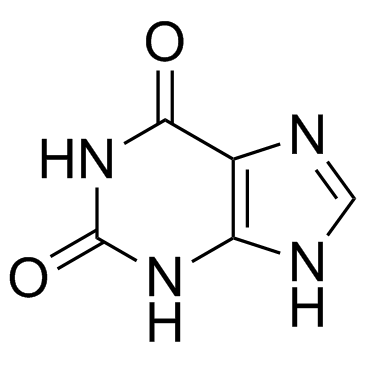
Xanthine (Synonyms: 2,6-Dihydroxypurine, NSC 14664) |
Katalog-Nr.GC33846
 One-Click Copy Product Info
|

Xanthin, ein pflanzliches Alkaloid, das in Tee, Kaffee und Kakao vorkommt, ist ein mildes Stimulans des zentralen Nervensystems.
Products are for research use only. Not for human use. We do not sell to patients.
Cas No.: 69-89-6
Sample solution is provided at 25 µL, 10mM.
_1-3.$$$39978408@51.jpg');)
_1-9.$$$38538795@65.jpg');)
_1-9.$$$39112701@51.jpg');)
_1-7.$$$37316672@70.jpg');)
_366-372.$$$36198801@70.jpg');)
.$$$38565142@65.jpg');)
_1867-1883.$$$33248023@67.jpg');)
_eads6055.$$$39977546@45.jpg');)
_eadm9805.$$$40080571@45.jpg');)
_eadj3020.$$$39666821@45.jpg');)
_1-20.$$$39757301@28.jpg');)
_1-24.$$$38898113@28.jpg');)
_273-287.$$$36806353@46.jpg');)
_1-16.$$$37156877@44.jpg');)
_1-19.$$$37460805@44.jpg');)
_1291-1307.$$$34518654@46.jpg');)
Xanthine is a naturally occurring purine base widely found in plants such as tea and cocoa, and Xanthine serves as a key intermediate in the purine metabolic pathway within living organisms[1-2]. Xanthine is primarily generated from guanine through deamination catalyzed by guanine deaminase or from hypoxanthine via oxidation catalyzed by Xanthine oxidoreductase (XOR), and is further metabolized to uric acid[3-4].
In vitro, treatment of 8-day-old Sprague-Dawley rat cerebellar granule neurons with Xanthine (100μM) combined with Xanthine oxidase (0.02U/ml) for 1 or 6 hours, Xanthine significantly reduced cell viability and induced atrophy of cell bodies and synaptic morphology[5]. Treatment of human umbilical vein endothelial cells (HUVECs) with Xanthine (3-100μM) for 15 minutes, Xanthine activated the platelet-activating factor pathway via Xanthine oxidase-derived hydrogen peroxide, leading to enhanced neutrophil-endothelial adhesion[6].
In vivo, intraperitoneal administration of Xanthine (500mg/kg) to C57BL/6J mice (every three days for 20 days), Xanthine induced hippocampus-dependent spatial memory deficits and a tendency toward anxiety-like behavior, while upregulating the expression of hemoglobin genes (such as Hba-a1 and HBA2) in hippocampal neurons, resulting in cognitive and behavioral abnormalities[7].
References:
[1] POMALES R, ELION GB, HITCHINGS GH. XANTHINE AS A PRECURSOR OF NUCLEIC ACID PURINES IN THE MOUSE. Biochim Biophys Acta. 1965 Mar 15;95:505-6.
[2] Kanemitsu H, Tamura A, Kirino T, et al. Xanthine and uric acid levels in rat brain following focal ischemia. J Neurochem. 1988 Dec;51(6):1882-5.
[3] Zhang A, Ai L. Xanthine negatively regulates c-MYC through the PI3K/AKT signaling pathway and inhibits the proliferation, invasion, and migration of breast cancer cells. Asia Pac J Clin Oncol. 2025 Feb;21(1):3-11.
[4] Fan KQ, Li YY, Wang HL, et al. Stress-Induced Metabolic Disorder in Peripheral CD4+ T Cells Leads to Anxiety-like Behavior. Cell. 2019 Oct 31;179(4):864-879.e19.
[5] Fatokun AA, Stone TW, Smith RA. Hydrogen peroxide mediates damage by xanthine and xanthine oxidase in cerebellar granule neuronal cultures. Neurosci Lett. 2007 Apr 6;416(1):34-8.
[6] Ichikawa H, Wolf RE, Aw TY, et al. Exogenous xanthine promotes neutrophil adherence to cultured endothelial cells. Am J Physiol. 1997 Aug;273(2 Pt 1):G342-7.
[7] Kambe J, Miyata S, Li C, et al. Xanthine-induced deficits in hippocampal behavior and abnormal expression of hemoglobin genes. Behav Brain Res. 2023 Jul 9;449:114476.
| Cell experiment [1]: | |
Cell lines | Human umbilical vein endothelial cells (HUVECs) |
Preparation Method | HUVECs were cultured in M199 medium supplemented with 20% FBS, 2mM L-glutamine, 100U/mL penicillin, and 100μg/mL streptomycin at 37°C, 5% CO₂. Cells were treated with Xanthine (3-100μM) for 15 minutes. |
Reaction Conditions | 3-100μM; 15min |
Applications | Xanthine, through Xanthine oxidase-derived hydrogen peroxide, activated the platelet-activating factor (PAF) pathway, leading to enhanced neutrophil adhesion to endothelial cells. This effect was associated with upregulation of endothelial P-selectin and intercellular adhesion molecule-1 (ICAM-1) expression. The adhesion process was dependent on cell surface Xanthine oxidase and could be inhibited by catalase, Xanthine oxidase inhibitors, or PAF receptor antagonists. |
| Animal experiment [2]: | |
Animal models | C57BL/6 mice |
Preparation Method | Mice were intraperitoneally administered Xanthine (500mg/kg) every three days. Behavioral tests (open field test, elevated plus maze test, and object location test) were conducted during the treatment period. Hippocampal tissues were collected after transcardial perfusion for transcriptomic analysis. |
Dosage form | 500mg/kg; i.p.; every three days for 20 days. |
Applications | Xanthine administration induced hippocampus-dependent spatial memory deficits in the object location test and a tendency toward anxiety-like behavior in the elevated plus maze test. |
References: | |
| Cas No. | 69-89-6 | SDF | |
| Überlieferungen | 2,6-Dihydroxypurine, NSC 14664 | ||
| Canonical SMILES | O=C(N1)NC2=C(N=CN2)C1=O | ||
| Formula | C5H4N4O2 | M.Wt | 152.11 |
| Löslichkeit | 5 mg/mL in Water (ultrasonic and warming and adjust pH to 10 with 1M NaOH and heat to 60°C);8 mg/mL in 1M NaOH (ultrasonic and adjust pH to 11 with NaOH) | Storage | Store at 2-8°C |
| General tips | Please select the appropriate solvent to prepare the stock solution according to the
solubility of the product in different solvents; once the solution is prepared, please store it in
separate packages to avoid product failure caused by repeated freezing and thawing.Storage method
and period of the stock solution: When stored at -80°C, please use it within 6 months; when stored
at -20°C, please use it within 1 month. To increase solubility, heat the tube to 37°C and then oscillate in an ultrasonic bath for some time. |
||
| Shipping Condition | Evaluation sample solution: shipped with blue ice. All other sizes available: with RT, or with Blue Ice upon request. | ||
| Prepare stock solution | |||

|
1 mg | 5 mg | 10 mg |
| 1 mM | 6.5742 mL | 32.8709 mL | 65.7419 mL |
| 5 mM | 1.3148 mL | 6.5742 mL | 13.1484 mL |
| 10 mM | 657.4 μL | 3.2871 mL | 6.5742 mL |
Step 1: Enter information below (Recommended: An additional animal making an allowance for loss during the experiment)
 g
μL
g
μL
Step 2: Enter the in vivo formulation (This is only the calculator, not formulation. Please contact us first if there is no in vivo formulation at the solubility Section.)
Calculation results:
Working concentration: mg/ml;
Method for preparing DMSO master liquid: mg drug pre-dissolved in μL DMSO ( Master liquid concentration mg/mL, Please contact us first if the concentration exceeds the DMSO solubility of the batch of drug. )
Method for preparing in vivo formulation: Take μL DMSO master liquid, next addμL PEG300, mix and clarify, next addμL Tween 80, mix and clarify, next add μL saline, mix and clarify.
Method for preparing in vivo formulation: Take μL DMSO master liquid, next add μL Corn oil, mix and clarify.
Note: 1. Please make sure the liquid is clear before adding the next solvent.
2. Be sure to add the solvent(s) in order. You must ensure that the solution obtained, in the previous addition, is a clear solution before proceeding to add the next solvent. Physical methods such as vortex, ultrasound or hot water bath can be used to aid dissolving.
3. All of the above co-solvents are available for purchase on the GlpBio website.
Quality Control & SDS
- View current batch:
- Purity: >98.00% Appearance: A solid
- COA (Certificate of Analysis)
- SDS (Safety Data Sheet)
- Datasheet
Average Rating: 5 (Based on Reviews and 11 reference(s) in Google Scholar.)