

Apigenin (Synonyms: Chamomile, Flavone, NSC 83244, Versulin) |
Catalog No.GN10150
 One-Click Copy Product Info
|

Apigenin (API), 또는 4',5,7-트리히드록시플라본, 많은 식물에 존재하는 생물 활성 플라보노이드로, 항염증, 항산화 및 항암 특성을 가지고 있다.
Products are for research use only. Not for human use. We do not sell to patients.
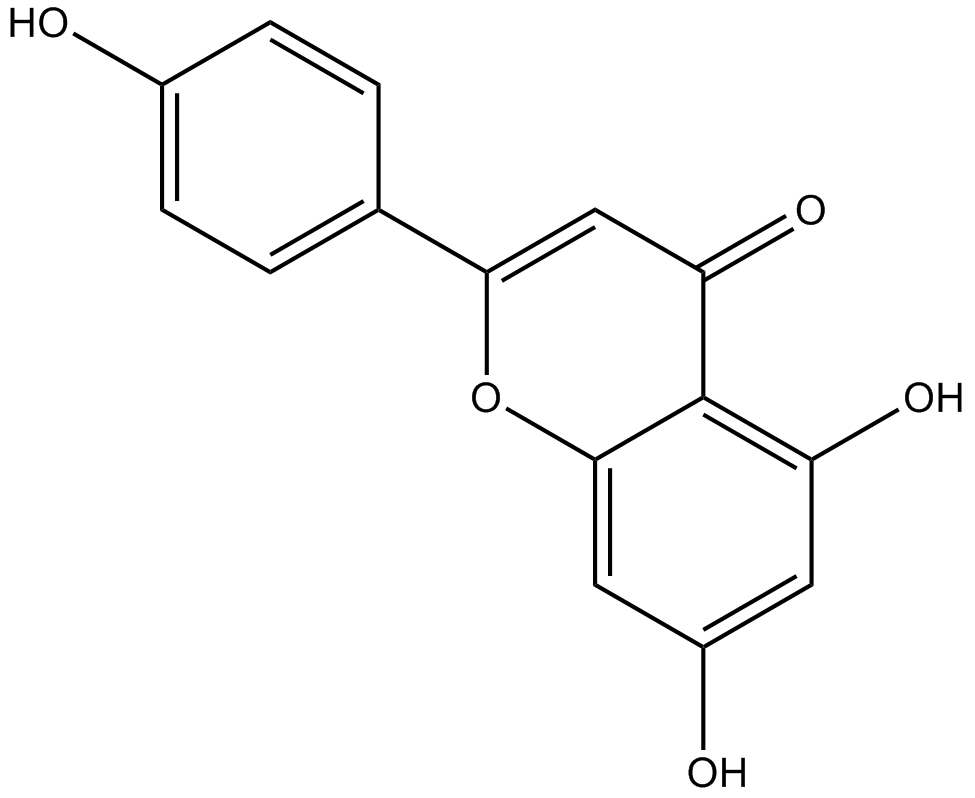
Cas No.: 520-36-5
Sample solution is provided at 25 µL, 10mM.
_1-3.$$$39978408@51.jpg');)
_1-9.$$$38538795@65.jpg');)
_1-9.$$$39112701@51.jpg');)
_1-7.$$$37316672@70.jpg');)
_366-372.$$$36198801@70.jpg');)
.$$$38565142@65.jpg');)
_1867-1883.$$$33248023@67.jpg');)
_eads6055.$$$39977546@45.jpg');)
_eadm9805.$$$40080571@45.jpg');)
_eadj3020.$$$39666821@45.jpg');)
_1-20.$$$39757301@28.jpg');)
_1-24.$$$38898113@28.jpg');)
_273-287.$$$36806353@46.jpg');)
_1-16.$$$37156877@44.jpg');)
_1-19.$$$37460805@44.jpg');)
_1291-1307.$$$34518654@46.jpg');)
Apigenin (API), 또는 4',5,7-트리히드록시플라본, 많은 식물에 존재하는 생물 활성 플라보노이드로, 항염증, 항산화 및 항암 특성을 가지고 있다. Apigenin은 CYP2C9의 경쟁성 억제제로서, Ki값이 2 µM [1]이다. 이것은 Wnt/β-카테닌 신호 전달 경로의 활성화와 NF-κB의 활동을 억제하고, c-Met 및 그 하류 효과자들의 인산화를 차단한다[2].
체외 실험에서 Apigenin (6.25-100 µM)은 악성 간피종 (MM) 세포 계열에 대한 용량 및 시간에 따라 세포 독성 효과를 보인다[2]. Apigenin 치료 72시간 후, MM-B1, MM-F1, H-Meso-1 세포의 IC50 값은 각각 49.16 ± 2.52µM, 46.95 ± 1.69µM, 34.31 ± 1.55µM였다[2]. 20, 40, 80µM 농도로 엡이진으로 처리된 SGC-7901 세포에 대한 48시간 치료로 인한 세포 사멸률은 각각 5.76%, 19.17%, 29.30%였다. Apigenin은 SGC-7901 세포의 성장, 콜로니 형성 및 증식에 대한 용량에 따라 효과를 보여준다[3]. 엡이진 (0-50 µg/ml))은 T-24 세포의 증식을 용량에 따라 억제하고 12시간 후에 T-24 세포의 활성산소 (ROS) 수준을 증가시키고 GSH를 고갈시켰다[4].
체내 실험에서 C57BL/6 쥐에 Apigenin (20mg/kg, 복강 내 투여) 치료를 통해 심장 내에 이식된 악성 간피종 MM 세포 계열의 성장을 감소시켰다[2]. ADR 유발 심근병의 쥐에서 위관 경유로 Apigenin을 125mg/kg 또는 250mg/kg의 용량으로 17일 동안 투여하여 심장 세포에서 AKT와 mTOR의 인산화를 증가시켰으며, PI3K의 표현을 증가시키고 심장 세포의 세포 사멸과 자질내식을 감소시켰다[5].
References:
[1] Si D, Wang Y, et al. Mechanism of CYP2C9 inhibition by flavones and flavonols. Drug Metab Dispos. 2009 Mar;37(3):629-34.
[2] Laura M , Monica B , Rosanna M ,et al. In Vitro and In Vivo Anti-tumoral Effects of the Flavonoid Apigenin in Malignant Mesothelioma[J].Frontiers in Pharmacology, 2017.8:373.
[3] Wu K, et al. Inhibitory effects of apigenin on the growth of gastric carcinoma SGC-7901 cells. World J Gastroenterol. 2005 Aug 7;11(29):4461-4.
[4] Shi M D , Shiao C K , Lee Y C ,et al.Apigenin, a dietary flavonoid, inhibits proliferation of human bladder cancer T-24 cells via blocking cell cycle progression and inducing apoptosis[J].BioMed Central, 2015(1).
[5] Wei Y , Huirong S , Wenliang Z ,et al.Apigenin Attenuates Adriamycin-Induced Cardiomyocyte Apoptosis via the PI3K/AKT/mTOR Pathway[J].Evidence-based Complementary and Alternative Medicine, 2017, 2017:1-9.
| 세포 실험 [1]: | |
세포 라인 | |
제조 방법 | 세포는 다양한 엡이진 농도(20, 40, 그리고 80 µ mol/L)로 48시간 동안 노출되었습니다. 그런 다음 EDTA로 수확되어 PBS로 두 번 세척되었습니다. |
반응 조건 | 20, 40,및80 µmol/L; 48 시간 |
응용 분야 | Apigenin으로 처리된 후 48시간, 20, 40, 80 µmol/L그룹의 세포 사멸률은 각각 5.76%, 19.17%, 29.30%였습니다. |
| 동물 실험 [2]: | |
동물 모형 | C57BL/6 쥐 |
제조 방법 | 6~8주령 C57BL/6 쥐 (한 그룹당 6마리)는 pristane 주사 (250 µl) 후 1주일째에 PBS에 1×10⁶ #40a 세포가 포함된 0.2 ml 의 현탁액을 복강내 (i.p.)주입했습니다. 쥐는 매주 20mg/kg의 Apigenin (DMSO에 녹이고 그 후 400 µl PBS에 희석됨)을 복강내 (i.p.)로 치료했습니다. 대조군은 매주 동일량의 차량 용액을 주사했습니다. |
제형 | 20mg/kg; i.p. |
응용 분야 | Apigenin의 복강 내 투여는 C57 BL/6 쥐의 복강 내에 이식된 악성 간피종 MM 세포 계열의 성장을 감소시킵니다. |
참고문헌: [1] Wu K, et al. Inhibitory effects of apigenin on the growth of gastric carcinoma SGC-7901 cells. World J Gastroenterol. 2005 Aug 7;11(29):4461-4. | |
| Cas No. | 520-36-5 | SDF | |
| Synonyms | Chamomile, Flavone, NSC 83244, Versulin | ||
| Chemical Name | 5,7-dihydroxy-2-(4-hydroxyphenyl)chromen-4-one | ||
| Canonical SMILES | C1=CC(=CC=C1C2=CC(=O)C3=C(C=C(C=C3O2)O)O)O | ||
| Formula | C15H10O5 | M.Wt | 270.24 |
| Solubility | ≥ 9.8mg/mL in DMSO | Storage | Store at -20°C |
| General tips | Please select the appropriate solvent to prepare the stock solution according to the
solubility of the product in different solvents; once the solution is prepared, please store it in
separate packages to avoid product failure caused by repeated freezing and thawing.Storage method
and period of the stock solution: When stored at -80°C, please use it within 6 months; when stored
at -20°C, please use it within 1 month. To increase solubility, heat the tube to 37°C and then oscillate in an ultrasonic bath for some time. |
||
| Shipping Condition | Evaluation sample solution: shipped with blue ice. All other sizes available: with RT, or with Blue Ice upon request. | ||
| Prepare stock solution | |||

|
1 mg | 5 mg | 10 mg |
| 1 mM | 3.7004 mL | 18.5021 mL | 37.0041 mL |
| 5 mM | 740.1 μL | 3.7004 mL | 7.4008 mL |
| 10 mM | 370 μL | 1.8502 mL | 3.7004 mL |
Step 1: Enter information below (Recommended: An additional animal making an allowance for loss during the experiment)
 g
μL
g
μL
Step 2: Enter the in vivo formulation (This is only the calculator, not formulation. Please contact us first if there is no in vivo formulation at the solubility Section.)
Calculation results:
Working concentration: mg/ml;
Method for preparing DMSO master liquid: mg drug pre-dissolved in μL DMSO ( Master liquid concentration mg/mL, Please contact us first if the concentration exceeds the DMSO solubility of the batch of drug. )
Method for preparing in vivo formulation: Take μL DMSO master liquid, next addμL PEG300, mix and clarify, next addμL Tween 80, mix and clarify, next add μL saline, mix and clarify.
Method for preparing in vivo formulation: Take μL DMSO master liquid, next add μL Corn oil, mix and clarify.
Note: 1. Please make sure the liquid is clear before adding the next solvent.
2. Be sure to add the solvent(s) in order. You must ensure that the solution obtained, in the previous addition, is a clear solution before proceeding to add the next solvent. Physical methods such as vortex, ultrasound or hot water bath can be used to aid dissolving.
3. All of the above co-solvents are available for purchase on the GlpBio website.
Quality Control & SDS
- View current batch:
- Purity: >99.00% Appearance: A solid
- COA (Certificate of Analysis)
- SDS (Safety Data Sheet)
- Datasheet
Average Rating: 5 (Based on Reviews and 30 reference(s) in Google Scholar.)