

MIM1 |
Catalog No.GC15400
 One-Click Copy Product Info
|

An Mcl-1 inhibiting molecule
Products are for research use only. Not for human use. We do not sell to patients.
Cas No.: 509102-00-5
Sample solution is provided at 25 µL, 10mM.
_1-3.$$$39978408@51.jpg');)
_1-9.$$$38538795@65.jpg');)
_1-9.$$$39112701@51.jpg');)
_1-7.$$$37316672@70.jpg');)
_366-372.$$$36198801@70.jpg');)
.$$$38565142@65.jpg');)
_1867-1883.$$$33248023@67.jpg');)
_eads6055.$$$39977546@45.jpg');)
_eadm9805.$$$40080571@45.jpg');)
_eadj3020.$$$39666821@45.jpg');)
_1-20.$$$39757301@28.jpg');)
_1-24.$$$38898113@28.jpg');)
_273-287.$$$36806353@46.jpg');)
_1-16.$$$37156877@44.jpg');)
_1-19.$$$37460805@44.jpg');)
_1291-1307.$$$34518654@46.jpg');)
MIM1 effectively competed with FITC-MCL-1 SAHBA and FITC-BID BH3 for MCL-1ΔNΔC binding with IC50 values of 4.7 and 4.8 mM, respectively. And MIN1 shows a combination of favorable biophysical and biological properties including its solubility, stability, nonreactivity, MCL-1 binding potency and selectivity, compatibility with and activity in a BAX-mediated liposomal release assay and relatively little to no toxicity in Bax-/-Bak-/- MEFs [1].
As an MCL-1 inhibitor, MIM1 selectively targets the BH3-binding groove of MCL-1, neutralizes its biochemical lockhold on apoptosis, and induces caspase activation and leukemia cell death in the specific context of MCL-1 dependence.
The activity and specificity of MIM1 in cancer cells was dependable for assessing MCL-1 and BCL-XL dependence by employing murine BCRABL (p185)-transformed, Arf null, B-lineage acute lymphoblastic leukemia cells. Comparing to the effect of ABT-737 on p185+Arf-/-/Mcl-1-deleted B-ALL cells, MIM1 had the exact opposite effect, impacting the viability of the MCL-1-dependent cells (IC50, 4.2 mM), including dose-dependent induction of caspase 3/7 activity, but having no effect on the BCL-XL-dependent cells. A combination of MIM1 (IC50, 10.6 mM) and ABT-737 (IC50, 5.1 mM) resulted in synergistic cytotoxicity. Strikingly, when the MIM1/ABT-737 combination was applied to MCL-1-reconstituted p185+Arf-/-/Mcl-1-deleted B-ALL cells, the addition of ABT-737 had little effect [1].
MIM1 emerged as a potent and selective small molecule inhibitor of MCL-1 DNDC, capable of targeting the canonical BH3-binding point of MCL-1 and blocking MCL-1-mediated suppression of tBID-induced BAX activation in vitro. MIM1 may serve as a prototype for the development of next generation small molecules that effectively reduce the apoptotic threshold in cancers specifically driven by antiapoptotic MCL-1 [1].
Reference:
[1]. Cohen NA, Stewart ML, Gavathiotis E, et al. A Competitive Stapled Peptide Screen Identifies a Selective Small Molecule that Overcomes MCL-1-Dependent Leukemia Cell Survival. Chemistry & Biology, 2012, 19(9): 1175-1186.
| Cell experiment: [1] | |
|
Cell lines |
p185+Arf−/−Mcl-1-deleted B-ALL cells |
|
Preparation method |
The solubility of this compound in DMSO is >10 mM. General tips for obtaining a higher concentration: Please warm the tube at 37 °C for 10 minutes and/or shake it in the ultrasonic bath for a while.Stock solution can be stored below -20°C for several months. |
|
Reaction Conditions |
IC50: 4.2 μM, 24 hours for impairing the cell viability rescued by MCL-1 |
|
Applications |
MIM1 negatively impacted the viability of the MCL-1-dependent cells (p185+Arf−/−Mcl-1-deleted B-ALL cells) with IC50 value of 4.2 μM, including dose-dependent induction of caspase 3/7 activity, but having little to no effect on the BCL-XL-dependent cells. MIM1’s cytotoxic effect on the MCL-1-dependent cells likewise corresponded to dose-dependent dissociation of the inhibitory MCL-1/BAK complex, as assessed by co-immunoprecipitation analysis. |
| Animal experiment: | |
|
Animal models |
|
|
Dosage form |
|
|
Applications |
|
|
Other notes |
Please test the solubility of all compounds indoor, and the actual solubility may slightly differ with the theoretical value. This is caused by an experimental system error and it is normal. |
|
References: [1] Cohen N A, Stewart M L, Gavathiotis E, et al. A competitive stapled peptide screen identifies a selective small molecule that overcomes MCL-1-dependent leukemia cell survival. Chemistry & biology, 2012, 19(9): 1175-1186. | |
| Cas No. | 509102-00-5 | SDF | |
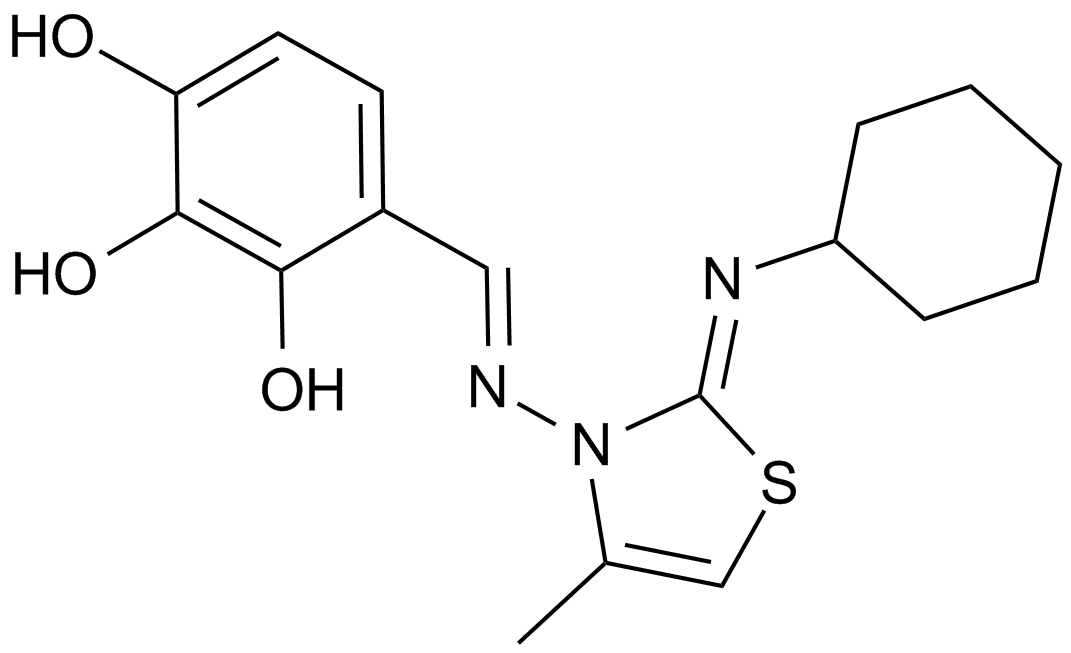
| Chemical Name | 4-((E)-(((Z)-2-(cyclohexylimino)-4-methylthiazol-3(2H)-yl)imino)methyl)benzene-1,2,3-triol | ||
| Canonical SMILES | OC1=CC=C(/C=N/N2C(C)=CS/C2=N\C3CCCCC3)C(O)=C1O | ||
| Formula | C17H21N3O3S | M.Wt | 347.43 |
| Solubility | ≥ 12.15mg/mL in DMSO | Storage | 4°C, protect from light |
| General tips | Please select the appropriate solvent to prepare the stock solution according to the
solubility of the product in different solvents; once the solution is prepared, please store it in
separate packages to avoid product failure caused by repeated freezing and thawing.Storage method
and period of the stock solution: When stored at -80°C, please use it within 6 months; when stored
at -20°C, please use it within 1 month. To increase solubility, heat the tube to 37°C and then oscillate in an ultrasonic bath for some time. |
||
| Shipping Condition | Evaluation sample solution: shipped with blue ice. All other sizes available: with RT, or with Blue Ice upon request. | ||
| Prepare stock solution | |||

|
1 mg | 5 mg | 10 mg |
| 1 mM | 2.8783 mL | 14.3914 mL | 28.7828 mL |
| 5 mM | 575.7 μL | 2.8783 mL | 5.7566 mL |
| 10 mM | 287.8 μL | 1.4391 mL | 2.8783 mL |
Step 1: Enter information below (Recommended: An additional animal making an allowance for loss during the experiment)
 g
μL
g
μL
Step 2: Enter the in vivo formulation (This is only the calculator, not formulation. Please contact us first if there is no in vivo formulation at the solubility Section.)
Calculation results:
Working concentration: mg/ml;
Method for preparing DMSO master liquid: mg drug pre-dissolved in μL DMSO ( Master liquid concentration mg/mL, Please contact us first if the concentration exceeds the DMSO solubility of the batch of drug. )
Method for preparing in vivo formulation: Take μL DMSO master liquid, next addμL PEG300, mix and clarify, next addμL Tween 80, mix and clarify, next add μL saline, mix and clarify.
Method for preparing in vivo formulation: Take μL DMSO master liquid, next add μL Corn oil, mix and clarify.
Note: 1. Please make sure the liquid is clear before adding the next solvent.
2. Be sure to add the solvent(s) in order. You must ensure that the solution obtained, in the previous addition, is a clear solution before proceeding to add the next solvent. Physical methods such as vortex, ultrasound or hot water bath can be used to aid dissolving.
3. All of the above co-solvents are available for purchase on the GlpBio website.
Quality Control & SDS
- View current batch:
- Purity: >98.00% Appearance: A solid
- COA (Certificate of Analysis)
- SDS (Safety Data Sheet)
- Datasheet
Average Rating: 5 (Based on Reviews and 30 reference(s) in Google Scholar.)