

Tranexamic Acid (Synonyms: AMCA, TXA) |
Catalog No.GC12905
 One-Click Copy Product Info
|

Tranexamic acid(Transamin)는 5mM의 IC50으로 플라스민 및 엘라스타제 유래 플라스미노겐 단편의 라이신 결합 부위를 차단하는 항섬유소 용해제입니다.
Products are for research use only. Not for human use. We do not sell to patients.
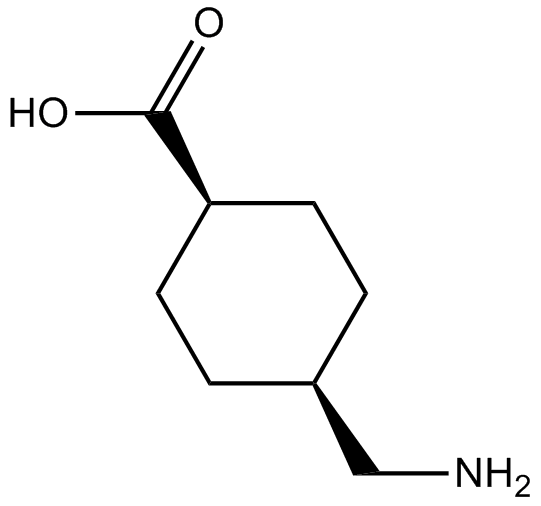
Cas No.: 1197-18-8
Sample solution is provided at 25 µL, 10mM.
_1-3.$$$39978408@51.jpg');)
_1-9.$$$38538795@65.jpg');)
_1-9.$$$39112701@51.jpg');)
_1-7.$$$37316672@70.jpg');)
_366-372.$$$36198801@70.jpg');)
.$$$38565142@65.jpg');)
_1867-1883.$$$33248023@67.jpg');)
_eads6055.$$$39977546@45.jpg');)
_eadm9805.$$$40080571@45.jpg');)
_eadj3020.$$$39666821@45.jpg');)
_1-20.$$$39757301@28.jpg');)
_1-24.$$$38898113@28.jpg');)
_273-287.$$$36806353@46.jpg');)
_1-16.$$$37156877@44.jpg');)
_1-19.$$$37460805@44.jpg');)
_1291-1307.$$$34518654@46.jpg');)
Tranexamic acid is a lysine analog and an antifibrinolytic agent. Tranexamic acid competitively inhibits the activation of plasminogen to plasmin and weakly noncompetitively inhibits plasmin itself. Tranexamic acid occupies the lysine receptor sites on plasmin that bind to fibrin. Tranexamic acid reduces plasmin-mediated lysis of hemostatic fibrin and stabilizes blood clots. Tranexamic acid can be used in studies related to traumatic hemorrhage, surgical bleeding, postpartum hemorrhage, and menorrhagia[1-4].
In vitro, treatment of B16-F1 cells with 0.1-4mg/mL Tranexamic Acid for 15-30 minutes upregulated phospho-ERK1/2, Beclin-1, Atg12, and LC3I-II protein expression, downregulated phospho-mTOR protein expression, and induced formation of LC3-positive autophagosomes[5]. Treatment of oxygen-glucose deprivation/reoxygenation (OGD/R)-induced Caco-2 cells with 6.3-24µg/mL Tranexamic Acid for 12 hours reversed the OGD/R-induced decrease in transepithelial electrical resistance and increase in FITC-dextran permeability, enhanced mitochondrial membrane potential, inhibited mitochondrial DNA release, and reduced IL-6 and IL-1β levels in the culture supernatant[6]. Treatment of YK, HR, NT, and KK human ovarian cancer cell lines with 10mg/mL Tranexamic Acid for 3 days inhibited cell proliferation and changed cell morphology into enlarged cells with abundant cytoplasm and prominent nucleoli[7].
In vivo, oral administration of approximately 12mg/kg Tranexamic Acid to ICR mice three times per week for 2 years. Tranexamic Acid ameliorated age-related decline in learning and memory ability, reduced the expression of plasmin and urokinase-type plasminogen activator in brain tissue, reduced the expression of amyloid precursor protein and amyloid-beta protein, reduced the expression of CCR7 and CD80 in Iba1-positive microglia, and increased the expression of CD163 and CD206[8]. Intraperitoneal injection of 100mg/kg Tranexamic Acid to C57BL/6J mice for 4 weeks after right knee anterior cruciate ligament transection. Tranexamic Acid attenuated cartilage degradation, improved the thickness ratio of hyaline cartilage to calcified cartilage, reversed subchondral bone loss, reduced bone erosion, decreased osteoclast number and surface area, inhibited tibial osteophyte formation, and alleviated synovitis[9]. Five minutes before a liver laceration, giving a single retro-orbital injection of 10mg/kg Tranexamic Acid to iron-deficient C57BL/6j mice. Tranexamic Acid can reduce blood loss, correct traumatic coagulopathy, and lower plasma IL-6 levels[10].
References:
[1] Wang K, Santiago R. Tranexamic acid - A narrative review for the emergency medicine clinician. Am J Emerg Med. 2022 Jun;56:33-44.
[2] Ng W, Jerath A, Wąsowicz M. Tranexamic acid: a clinical review. Anaesthesiol Intensive Ther. 2015;47(4):339-50.
[3] Bailey AM, Baker SN, Weant KA. Tranexamic acid for trauma-related hemorrhage. Adv Emerg Nurs J. 2014 Apr-Jun;36(2):123-31; quiz 132-3.
[4] Chen F, Zhang M, Song Z, et al. Melatonin partially rescues defects induced by tranexamic acid exposure during oocyte maturation in mice. Am J Physiol Cell Physiol. 2024;327(3):C778-89.
[5] Cho YH, Park JE, Lim DS, et al. Tranexamic acid inhibits melanogenesis by activating the autophagy system in cultured melanoma cells. J Dermatol Sci. 2017;87(3):253-60.
[6] Wang Z, Huo L, Liu H, et al. Tranexamic acid inhibits mitochondrial DNA release and reduces inflammatory response in an in vitro model of OGD/R-induced Caco-2 cell injury. BMC Pharmacol Toxicol. 2026;27:92.
[7] Kikuchi Y, Kizawa I, Oomori K, et al. The inhibitory effect of tranexamic acid on human ovarian carcinoma cell grown in vitro and in vivo. Gynecol Oncol. 1986;24(2):183-8.
[8] Hiramoto K, Yamate Y, Matsuda K, et al. Tranexamic acid improves memory and learning abilities in aging mice. J Exp Pharmacol. 2020;12:653-63.
[9] Xie W, Jiang S, Donat A, et al. Tranexamic Acid Attenuates the Progression of Posttraumatic Osteoarthritis in Mice. Am J Sports Med. 2024;52(3):766-78.
[10] Joseph BC, Sekayan T, Falah N, et al. Traumatic bleeding and mortality in mice are intensified by iron deficiency anemia and can be rescued with tranexamic acid. Res Pract Thromb Haemost. 2024;8:e102543.
| Cell experiment [1]: | |
|
Cell lines |
Caco-2 cells (human colorectal adenocarcinoma cell line) |
|
Preparation Method |
Caco-2 cells were maintained in RPMI 1640 medium supplemented with 10% fetal bovine serum (FBS) and 1% penicillin/streptomycin at 37°C, 5% CO2. Caco-2 cells were subjected to oxygen-glucose deprivation for 6h followed by reoxygenation for 12h (OGD/R), with Tranexamic Acid added at 6.3-24μg/mL at the start of reoxygenation; separate groups were treated with Tranexamic Acid 6.3-50μg/mL under normoxia for 24h for viability, or 24μg/mL under normoxia for 12h. After treatment, transepithelial electrical resistance and FITC-dextran permeability of monolayers, JC-1 mitochondrial membrane potential, qPCR of extracellular mtDNA (ND1 vs β-actin), and ELISA of IL-6 and IL-1β in supernatants were assessed. |
|
Reaction Conditions |
6.3-50μg/mL; 12-24h |
|
Applications |
Tranexamic Acid within 6.3-50μg/mL for 24h showed no cytotoxicity to Caco-2 cells. In OGD/R model, Tranexamic Acid reversed OGD/R-induced decrease in transepithelial electrical resistance and increase in FITC-dextran permeability, enhanced mitochondrial membrane potential, suppressed release of mtDNA, and reduced IL-6 and IL-1β levels in culture supernatant. |
| Animal experiment [2]: | |
|
Animal models |
8-week-old male ICR mice |
|
Preparation Method |
Mice were orally administered approximately 12mg/kg Tranexamic Acid in distilled water three times weekly for 2 years. After 2 years of treatment, blood and cerebrum samples were collected; memory and learning abilities were evaluated by open field test (15min) and Morris water maze (training blocks with 60s platform interval), brain plasmin/uPA by Western blot, amyloid precursor protein and amyloid-β by Western blot, Iba1/CCR7/CD80/CD163/CD206 by Western blot, and IL-1β/IL-10/TNF-α/TGF-β in brain by ELISA. |
|
Dosage form |
12mg/kg; oral gavage; three times weekly for 2 years |
|
Applications |
Tranexamic Acid administration ameliorated aging-induced decline in memory and learning abilities (shortened mean escape latency in Morris water maze, no change in open field motor distance). Tranexamic Acid decreased brain expression of plasmin, uPA, amyloid precursor protein, and amyloid-β. Tranexamic Acid decreased M1 macrophage markers CCR7 and CD80 while increasing M2 markers CD163 and CD206 in Iba1-positive microglia. Tranexamic Acid decreased brain IL-1β and TNF-α levels while increasing IL-10 and TGF-β levels. |
References: [1] Wang Z, Huo L, Liu H, et al. Tranexamic acid inhibits mitochondrial DNA release and reduces inflammatory response in an in vitro model of OGD/R-induced Caco-2 cell injury. BMC Pharmacol Toxicol. 2026;27:92. [2] Hiramoto K, Yamate Y, Matsuda K, et al. Tranexamic Acid Improves Memory and Learning Abilities in Aging Mice. J Exp Pharmacol. 2020;12:653-63. | |
| Cas No. | 1197-18-8 | SDF | |
| Synonyms | AMCA, TXA | ||
| Chemical Name | 4-(aminomethyl)cyclohexane-1-carboxylic acid | ||
| Canonical SMILES | C1CC(CCC1CN)C(=O)O | ||
| Formula | C8H15NO2 | M.Wt | 157.21 |
| Solubility | ≥ 6.6mg/mL in Water | Storage | Store at -20°C |
| General tips | Please select the appropriate solvent to prepare the stock solution according to the
solubility of the product in different solvents; once the solution is prepared, please store it in
separate packages to avoid product failure caused by repeated freezing and thawing.Storage method
and period of the stock solution: When stored at -80°C, please use it within 6 months; when stored
at -20°C, please use it within 1 month. To increase solubility, heat the tube to 37°C and then oscillate in an ultrasonic bath for some time. |
||
| Shipping Condition | Evaluation sample solution: shipped with blue ice. All other sizes available: with RT, or with Blue Ice upon request. | ||
| Prepare stock solution | |||

|
1 mg | 5 mg | 10 mg |
| 1 mM | 6.3609 mL | 31.8046 mL | 63.6092 mL |
| 5 mM | 1.2722 mL | 6.3609 mL | 12.7218 mL |
| 10 mM | 636.1 μL | 3.1805 mL | 6.3609 mL |
Step 1: Enter information below (Recommended: An additional animal making an allowance for loss during the experiment)
 g
μL
g
μL
Step 2: Enter the in vivo formulation (This is only the calculator, not formulation. Please contact us first if there is no in vivo formulation at the solubility Section.)
Calculation results:
Working concentration: mg/ml;
Method for preparing DMSO master liquid: mg drug pre-dissolved in μL DMSO ( Master liquid concentration mg/mL, Please contact us first if the concentration exceeds the DMSO solubility of the batch of drug. )
Method for preparing in vivo formulation: Take μL DMSO master liquid, next addμL PEG300, mix and clarify, next addμL Tween 80, mix and clarify, next add μL saline, mix and clarify.
Method for preparing in vivo formulation: Take μL DMSO master liquid, next add μL Corn oil, mix and clarify.
Note: 1. Please make sure the liquid is clear before adding the next solvent.
2. Be sure to add the solvent(s) in order. You must ensure that the solution obtained, in the previous addition, is a clear solution before proceeding to add the next solvent. Physical methods such as vortex, ultrasound or hot water bath can be used to aid dissolving.
3. All of the above co-solvents are available for purchase on the GlpBio website.
Quality Control & SDS
- View current batch:
- Purity: >98.00% Appearance: A solid
- COA (Certificate of Analysis)
- SDS (Safety Data Sheet)
- Datasheet
Average Rating: 5 (Based on Reviews and 27 reference(s) in Google Scholar.)