

Apatinib Mesylate (Synonyms: YN968D1) |
Catalog No.GC14292
 One-Click Copy Product Info
|

Apatinib Mesylate bloquea la transducción de señales aguas abajo de la vía VEGF para inhibir la neovascularización.
Products are for research use only. Not for human use. We do not sell to patients.
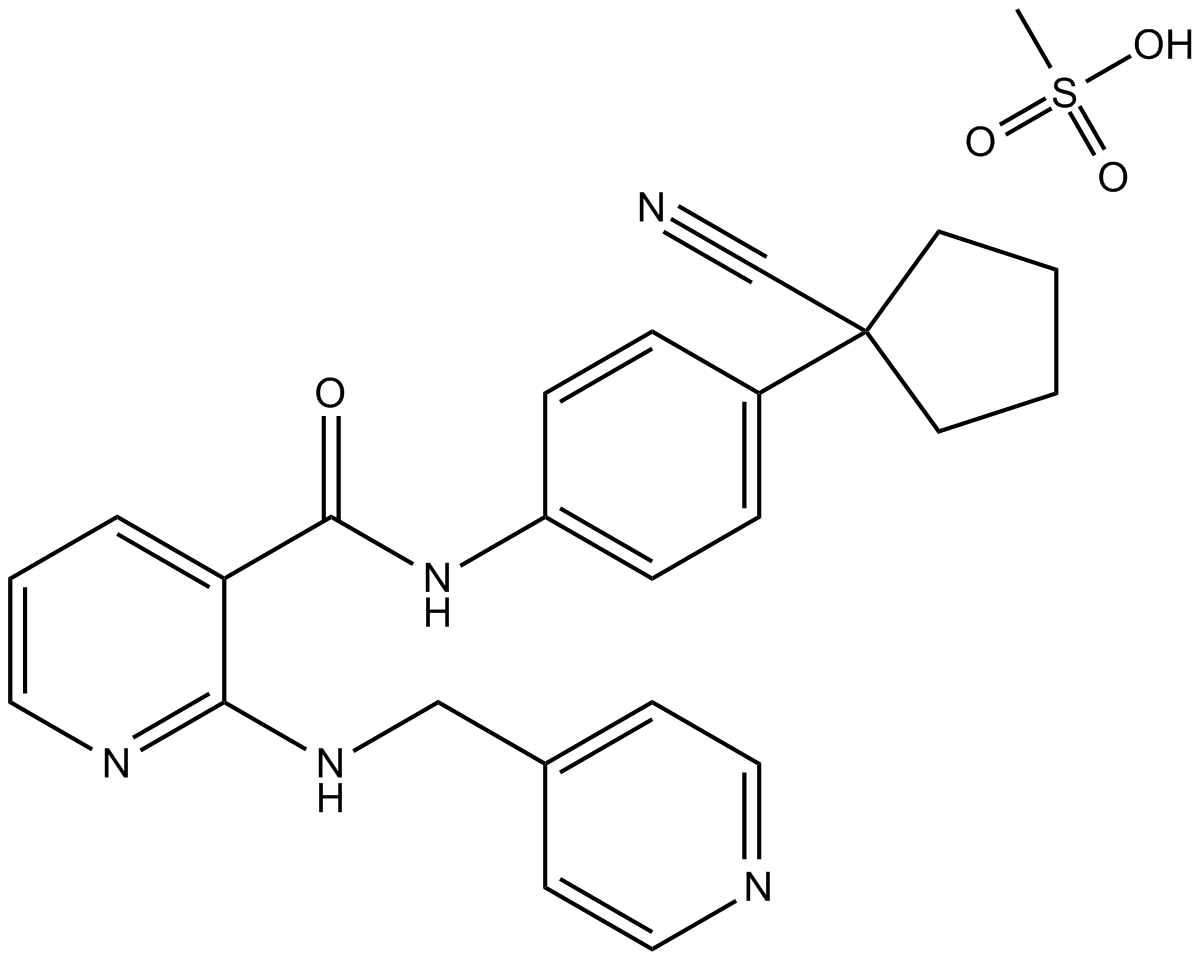
Cas No.: 811803-05-1
Sample solution is provided at 25 µL, 10mM.
Apatinib Mesylate bloquea la transducción de señales aguas abajo de la vía VEGF para inhibir la neovascularización. Apatinib ha mostrado efectos antitumorales en muchos tipos de tumores, como sarcoma, cáncer de mama, cáncer de ovario y leucemia linfoblástica aguda (LLA). Además, un reciente informe de caso proporcionó información de apoyo para el uso de apatinib en el tratamiento del mesotelioma maligno pleural epitelioide.[1]
Los experimentos in vitro indicaron que apatinib inhibía la proliferación celular de manera dependiente de la dosis y del tiempo. Los valores de IC50 de apatinib en células de MPM para tiempos de tratamiento de 24 h, 48 h, y 72 h fueron 46,34 μM, 45,14 μM, y 28,73 μM, respectivamente.[3]
Los experimentos in vivo demostraron que apatinib inhibe el crecimiento y la metástasis del tumor. La puntuación ePCI de los grupos de control en blanco, control de solvente y apatinib fueron 9,8 ± 0,9, 10,3 ± 0,9, y 7,3 ± 1,6, respectivamente. Las diferencias fueron estadísticamente significativas (P = 0.003 para todos; P = 0.008, control en blanco vs. grupo de apatinib; P = 0.001, control de solvente vs. grupo de apatinib; P = 0.394, control en blanco vs. control de solvente). La tasa de positividad de Ki-67 en el grupo de apatinib fue (17,0 ± 8,0)%, lo cual es significativamente más bajo que en el grupo de control (48,1 ± 11,5)% (P = 0.000); la tasa de positividad de VEGFR-2 en el grupo de apatinib fue ligeramente inferior a la del grupo de control, sin indicar significancia estadística.[1]
References:
[1]. Yang ZR, et al. Apatinib Mesylate Inhibits the Proliferation and Metastasis of Epithelioid Malignant Peritoneal Mesothelioma In Vitro and In Vivo. Front Oncol. 2020 Dec 7;10:585079.
| Experimento con células [1]: | |
Líneas celulares | Células primarias establecidas por tumores s.c. |
Método de preparación | Apatinib se disolvió en DMSO para obtener una solución madre de 151 mM, la cual luego se diluyó a la concentración especificada en el experimento subsecuente usando DMEM. |
Condiciones de reacción | Las células fueron tratadas con diferentes concentraciones de apatinib (0, 12.5, 25, 50 y 100 mM) durante 24, 48 y 72 horas, respectivamente. |
Aplicaciones | Esto podría utilizarse para probar la capacidad de apatinib en la inhibición de la viabilidad y proliferación de las células de MPM. Estas concentraciones graduales de apatinib inhibieron la proliferación celular; el efecto inhibidor de apatinib sobre las células de MPM mostró un comportamiento dependiente de la dosis y del tiempo. |
| Experimento con animales [2]: | |
Modelos animales | Ratones BALB/c nu/nu libres de patógenos específicos, de 4-5 semanas de edad, 16-18 g |
Método de preparación | Se utilizaron especímenes quirúrgicos de MPM para establecer modelos de xenoinjertos derivados de pacientes (PDX) en ratones desnudos. Dieciocho ratones desnudos se dividieron aleatoriamente en tres grupos: control en blanco, control de solvente y grupos de apatinib. El grupo de control en blanco no recibió ninguna intervención, el grupo de control de solvente fue administrado con 24 mg/g/día de 0.5% CMC, y el grupo de tratamiento fue tratado con 100 mg/g/día de apatinib administrado por gavage intragástrico. El proceso de tratamiento duró 2 semanas. |
Forma de dosificación | 100 mg/g/día; apatinib se diluyó en solución de Carboximetil Celulosa-Na al 0.5% |
Aplicaciones | Esto podría utilizarse para probar la eficacia y toxicidad de apatinib en el modelo PDX de MPM. Los resultados indicaron que apatinib no afectó el peso de los ratones desnudos, y no se observaron efectos adversos durante la construcción de los modelos de ratones. La tasa positiva de Ki-67 en el grupo de apatinib es significativamente menor que en el grupo de control. |
Referencias: [1]. Yang ZR, et al. Apatinib Mesylate Inhibits the Proliferation and Metastasis of Epithelioid Malignant Peritoneal Mesothelioma In Vitro and In Vivo. Front Oncol. 2020 Dec 7;10:585079. | |
| Cas No. | 811803-05-1 | SDF | |
| Sinónimos | YN968D1 | ||
| Chemical Name | N-[4-(1-cyanocyclopentyl)phenyl]-2-(pyridin-4-ylmethylamino)pyridine-3-carboxamide;methanesulfonic acid | ||
| Canonical SMILES | CS(=O)(=O)O.C1CCC(C1)(C#N)C2=CC=C(C=C2)NC(=O)C3=C(N=CC=C3)NCC4=CC=NC=C4 | ||
| Formula | C25H27N5O4S | M.Wt | 493.58 |
| Solubility | ≥ 49.4mg/mL in DMSO | Storage | Store at -20°C |
| Shipping Condition | Evaluation sample solution: shipped with blue ice. All other sizes available: with RT, or with Blue Ice upon request. | ||
| Prepare stock solution | |||

|
1 mg | 5 mg | 10 mg |
| 1 mM | 2.026 mL | 10.1301 mL | 20.2601 mL |
| 5 mM | 405.2 μL | 2.026 mL | 4.052 mL |
| 10 mM | 202.6 μL | 1.013 mL | 2.026 mL |
Step 1: Enter information below (Recommended: An additional animal making an allowance for loss during the experiment)
 g
μL
g
μL
Step 2: Enter the in vivo formulation (This is only the calculator, not formulation. Please contact us first if there is no in vivo formulation at the solubility Section.)
Calculation results:
Working concentration: mg/ml;
Method for preparing DMSO master liquid: mg drug pre-dissolved in μL DMSO ( Master liquid concentration mg/mL, Please contact us first if the concentration exceeds the DMSO solubility of the batch of drug. )
Method for preparing in vivo formulation: Take μL DMSO master liquid, next addμL PEG300, mix and clarify, next addμL Tween 80, mix and clarify, next add μL saline, mix and clarify.
Method for preparing in vivo formulation: Take μL DMSO master liquid, next add μL Corn oil, mix and clarify.
Note: 1. Please make sure the liquid is clear before adding the next solvent.
2. Be sure to add the solvent(s) in order. You must ensure that the solution obtained, in the previous addition, is a clear solution before proceeding to add the next solvent. Physical methods such as vortex, ultrasound or hot water bath can be used to aid dissolving.
3. All of the above co-solvents are available for purchase on the GlpBio website.
Quality Control & SDS
- View current batch:
- Purity: >98.00% Appearance: A solid
- COA (Certificate of Analysis)
- SDS (Safety Data Sheet)
- Datasheet
-
Related Biological Data

VEGFA derived from hypoxic PMCs facilitates GC cell adhesion and migration via VEGFR1. a The effect of exogenous VEGFA on cell migration was observed in the presence of Apatinib or Bevacizumab. Representative photographs of migratory cells are shown. Scale bar represents 100 μm.
Apatinib were obtained from GlpBio.
J Exp Clin Canc Res 39.1 (2020): 1-14. PMID: 33081836 IF: 11.163 -
Related Biological Data

Targeting SMYD2 synergistically increases the antiangiogenic activity of apatinib in CRC.IHC staining revealed that both BAY-598 and apatinib treatment reduced CD31 levels, but more satisfactory effects were achieved when the two treatments were combined.
Then, we treated CRC cells with DMSO, BAY-598, apatinib (10 μM), or BAY-598 (10 μM) combined with apatinib(GLPBIO) for 48 h, and prepared TCM according to the standard method.
Angiogenesis (2022): 1-18. PMID: 35503397 IF: 9.5957 -
Related Biological Data

Art-M improves the antitumor effect of apatinib in GC both in vivo and in vitro. (A) Total number of viable cells was counted after treatment of MGC803 and AGS cells with different concentrations of apatinib for 96 h.
Male nude mice carrying GC xenografts were randomly divided into four groups and given Art-M (2 mg/kg; i.p.; once daily), apatinib(GlpBio) (50 mg/kg; p.o.; once daily), or both for 24 days.
Chem-Biol Interact (2023): 110618. PMID: 37394161 IF: 5.1
Average Rating: 5 (Based on Reviews and 39 reference(s) in Google Scholar.)