

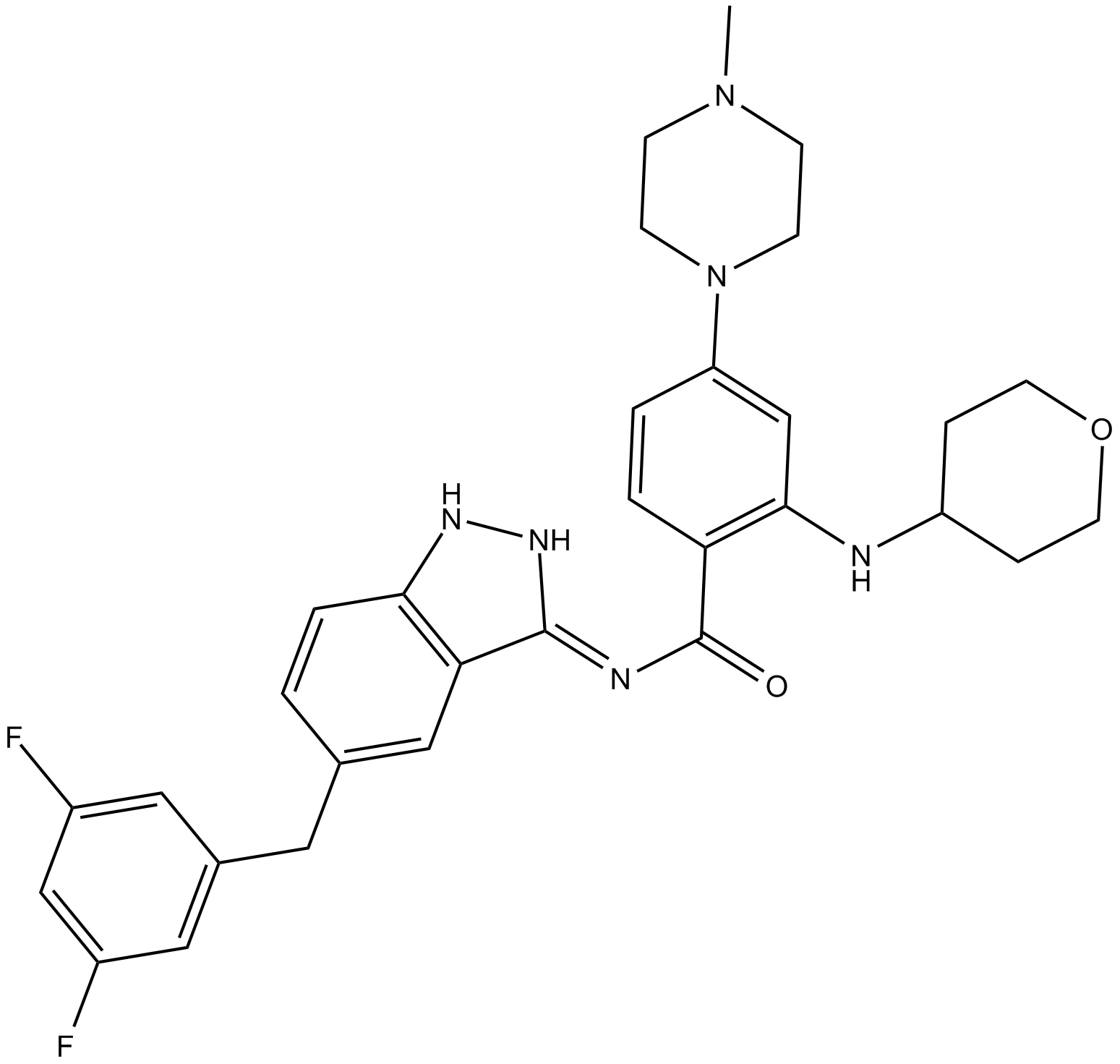
Entrectinib (Synonyms: NMS-E628, RXDX-101) |
Catalog No.GC14476
 One-Click Copy Product Info
|

Entrectinib es un inhibidor activo por vía oral, penetrado en la barrera hematoencefálica (BBB) y activo centralmente de TrkA/B/C, ROS1 y ALK, con valores de IC50 de 1, 3, 5, 12 y 7nM, respectivamente
Products are for research use only. Not for human use. We do not sell to patients.
Cas No.: 1108743-60-7
Sample solution is provided at 25 µL, 10mM.
_1-3.$$$39978408@51.jpg');)
_1-9.$$$38538795@65.jpg');)
_1-9.$$$39112701@51.jpg');)
_1-7.$$$37316672@70.jpg');)
_366-372.$$$36198801@70.jpg');)
.$$$38565142@65.jpg');)
_1867-1883.$$$33248023@67.jpg');)
_eads6055.$$$39977546@45.jpg');)
_eadm9805.$$$40080571@45.jpg');)
_eadj3020.$$$39666821@45.jpg');)
_1-20.$$$39757301@28.jpg');)
_1-24.$$$38898113@28.jpg');)
_273-287.$$$36806353@46.jpg');)
_1-16.$$$37156877@44.jpg');)
_1-19.$$$37460805@44.jpg');)
_1291-1307.$$$34518654@46.jpg');)
Entrectinib es un inhibidor activo por vía oral, penetrado en la barrera hematoencefálica (BBB) y activo centralmente de TrkA/B/C, ROS1 y ALK, con valores de IC50 de 1, 3, 5, 12 y 7nM, respectivamente[1]. TrkA/B/C son receptores de neurotrofina, ROS1 es una tirosina quinasa receptora huérfano y ALK es una quinasa de linfoma anaplásico; los tres impulsan la tumorigénesis a través de la fusión o la mutación [2]. Entrectinib se usa comúnmente en el estudio del cáncer de pulmón de células no pequeñas (NSCLC) reorganizado con ROS1 y tumores sólidos positivos para la fusión de NTRK[3].
In vitro, Entrectinib (2.3-4.3μM; 48h) redujo la viabilidad dependiente de la dosis, suprimió la formación de colonias y la incorporación de EdU, y elevó la necrosis en las células nerviosas PC12, HT22 y SK-N-SH, con valores celulares de IC50 de 2.3, 4.2 y 4.3μM, respectivamente[4]. Entrectinib (100-400nM; 24h) inhibió de forma dependiente de la cantidad la proliferación impulsada por TGF-β1, la migración y la activación de miofibroblastos de los fibroblastos pulmonares Mlg y HFL1 y bloqueó la transición epithelial-mesenchymal (EMT) inducida por TGF-β1 en células epiteliales MLE12[5].
In vivo, Entrectinib (60mg/kg; BID durante 7 semanas; p.o.) suprimió notablemente el crecimiento del xenoinjerto SY5Y-TrkB, prolongó la supervivencia libre de eventos del ratón y bloqueó la fosofrilación de TrkB, Akt y Erk en ratones nu/nu atímicos[6]. Entrectinib (10mg/kg; i.p.) bajó los niveles séricos de IL-1β y AST/ALT inducidos por LPS, y mejoró la superviencia en 24h en ratones C57BL/6J[7].
References:
[1] Ardini E, Menichincheri M, Banfi P, et al. Entrectinib, a Pan-TRK, ROS1, and ALK Inhibitor with Activity in Multiple Molecularly Defined Cancer Indications. Mol Cancer Ther. 2016;15(4):628-639.
[2] Drilon A, Siena S, Ou SI, et al. Safety and Antitumor Activity of the Multitargeted Pan-TRK, ROS1, and ALK Inhibitor Entrectinib: Combined Results from Two Phase I Trials (ALKA-372-001 and STARTRK-1). Cancer Discov. 2017;7(4):400-409.
[3] Osman HM, Tuncbilek M. Entrectinib: A New Selective Tyrosine Kinase Inhibitor Approved for the Treatment of Pediatric and Adult Patients with NTRK Fusionpositive, Recurrent or Advanced Solid Tumors. Curr Med Chem. 2022;29(15):2602-2616.
[4] Tang Q, Dong J, Zhang F, et al. Entrectinib can induce nerve cell damage by inhibiting PI3K-AKT and TGF-β signaling pathways. Front Pharmacol. 2025;16:1489210.
[5] Miao Y, Li X, Yang Y, et al. Entrectinib ameliorates bleomycin-induced pulmonary fibrosis in mice by inhibiting TGF-β1 signaling pathway. Int Immunopharmacol. 2022;113(Pt B):109427.
[6] Iyer R, Wehrmann L, Golden RL, et al. Entrectinib is a potent inhibitor of Trk-driven neuroblastomas in a xenograft mouse model. Cancer Lett. 2016;372(2):179-186.
[7] Jin X, Liu D, Zhou X, Luo X, Huang Q, Huang Y. Entrectinib inhibits NLRP3 inflammasome and inflammatory diseases by directly targeting NEK7. Cell Rep Med. 2023;4(12):101310.
| Experimentos celulares [1]: | |
Líneas celulares | Células PC12, HT22 y SK-N-SH |
Método de preparación | Las células de feocromocitoma suprarrenal de rata PC12(FH0415) se cultivaron en medio RPMI-1640 suplementado con 10% de suero bovino fetal y 1% de penicilina y estreptococina. Las células neuronales del hipocampo de ratón HT22 (FH1027) y las células de neuroblastoma humanos SK-N-SH (FH0164) se cultivaron en medio DMEM con 10% de FBS y 1% de penicilina y estreptomicina. Todas las células se incubaron en una atmósfera de 37 °C con un 5 % de CO2. Para explorar si el entrectinib influye en la capacidad de proliferación celular y la apoptosis, las células se trataron con entrectinib 2,3, 4,2 y 4,3 μM durante 48 horas, respectivamente. Después de la incubación, se añadió 10 μL de solución de CCK-8 en cada pozo y se incubó a 37 °C durante 2 horas en la oscuridad. Luego, se utilizó un lector de microplacas para medir la absorbancia a una longitud de onda de 450 nm. El kit de detección de proliferación celular EdU se utilizó para la detección de proliferación celular. El kit Annexin V-FITC/PI se utilizó para el análisis de apoptosis celular. |
Condiciones de reacción | 2,3-4,3 μM; 48 horas |
Áreas de aplicación | Entrectinib redujo la viabilidad dependiente de la dosis, suprimió la incorporación de EdU y elevó la apoptosis en las células nerviosas PC12, HT22 y SK-N-SH. |
| Experimentos con animales [2]: | |
Modelos animales | Ratones nu/nu atmimos |
Método de preparación | Se obtuvieron ratones nu/nu athímicos de seis semanas de edad en los Laboratorios Jackson. Los ratones se mantuvieron en cinco por jaula en condiciones de humedad y temperatura controladas en un ciclo de luz/oscuridad que se estableció a intervalos de 12 horas. Para los estudios de xenoinjerto, se inyectó a los animales por vía subcutánea en el flanco con 1×10⁷ células SY5Y-TrkB en 0,1 ml de Matrigel. Los tumores se midieron 2 veces por semana en 3 dimensiones, y el volumen se calculó de la siguiente manera: [(0,523xLxWxW)/1000]. Los pesos corporales se midieron al menos dos veces por semana, y la dosis del compuesto se ajustó en consecuencia. El tratamiento con Entrectinib, Irino y TMZ comenzó aproximadamente 15-17 días después de la inoculación del tumor, cuando el tamaño promedio del tumor era de 0,2 cm3. El entrectinib se dosificó a 60 mg/kg de BID por gavage durante toda la duración del estudio (7 semanas). Después de administrar la dosis final, las muestras de sangre se extrajeron de 4 ratones por punto de tiempo a través del sangrado retro-orbital y se recogieron en tubos heparinizados sobre hielo húmedo. Luego, el plasma se separó por centrifugación a 1200 g durante 10 minutos a 4 °C. El análisis farmacocinético se realizó utilizando el sistema Watson. Matones fueron sacrificados cuando el volumen del tumor alcanzó los 3 cm3. Los tumores se recogieron y se congelaron en hielo seco para el análisis de la expresión de proteínas utilizando Western blot. |
Forma de dosificación | 60 mg/kg; BID durante 7 semanas; p.o. |
Áreas de aplicación | Entrectinib suprimió notablemente el crecimiento del xenoinjerto SY5Y-TrkB, prolongó la supervivencia libre de eventos de ratón y bloqueó la fosforilación de TrkB, Akt y Erk en ratones nu/nu athímicos. |
References: | |
| Cas No. | 1108743-60-7 | SDF | |
| Sinónimos | NMS-E628, RXDX-101 | ||
| Chemical Name | (Z)-N-(5-(3,5-difluorobenzyl)-1H-indazol-3(2H)-ylidene)-4-(4-methylpiperazin-1-yl)-2-((tetrahydro-2H-pyran-4-yl)amino)benzamide | ||
| Canonical SMILES | CN1CCN(C2=CC(NC3CCOCC3)=C(C(/N=C4C5=C(NN/4)C=CC(CC6=CC(F)=CC(F)=C6)=C5)=O)C=C2)CC1 | ||
| Formula | C31H34F2N6O2 | M.Wt | 560.64 |
| Solubility | ≥ 28.05mg/mL in DMSO | Storage | Store at -20°C |
| General tips | Please select the appropriate solvent to prepare the stock solution according to the
solubility of the product in different solvents; once the solution is prepared, please store it in
separate packages to avoid product failure caused by repeated freezing and thawing.Storage method
and period of the stock solution: When stored at -80°C, please use it within 6 months; when stored
at -20°C, please use it within 1 month. To increase solubility, heat the tube to 37°C and then oscillate in an ultrasonic bath for some time. |
||
| Shipping Condition | Evaluation sample solution: shipped with blue ice. All other sizes available: with RT, or with Blue Ice upon request. | ||
| Prepare stock solution | |||

|
1 mg | 5 mg | 10 mg |
| 1 mM | 1.7837 mL | 8.9184 mL | 17.8368 mL |
| 5 mM | 356.7 μL | 1.7837 mL | 3.5674 mL |
| 10 mM | 178.4 μL | 891.8 μL | 1.7837 mL |
Step 1: Enter information below (Recommended: An additional animal making an allowance for loss during the experiment)
 g
μL
g
μL
Step 2: Enter the in vivo formulation (This is only the calculator, not formulation. Please contact us first if there is no in vivo formulation at the solubility Section.)
Calculation results:
Working concentration: mg/ml;
Method for preparing DMSO master liquid: mg drug pre-dissolved in μL DMSO ( Master liquid concentration mg/mL, Please contact us first if the concentration exceeds the DMSO solubility of the batch of drug. )
Method for preparing in vivo formulation: Take μL DMSO master liquid, next addμL PEG300, mix and clarify, next addμL Tween 80, mix and clarify, next add μL saline, mix and clarify.
Method for preparing in vivo formulation: Take μL DMSO master liquid, next add μL Corn oil, mix and clarify.
Note: 1. Please make sure the liquid is clear before adding the next solvent.
2. Be sure to add the solvent(s) in order. You must ensure that the solution obtained, in the previous addition, is a clear solution before proceeding to add the next solvent. Physical methods such as vortex, ultrasound or hot water bath can be used to aid dissolving.
3. All of the above co-solvents are available for purchase on the GlpBio website.
Quality Control & SDS
- View current batch:
- Purity: >99.00% Appearance: A solid
- COA (Certificate of Analysis)
- SDS (Safety Data Sheet)
- Datasheet
Average Rating: 5 (Based on Reviews and 32 reference(s) in Google Scholar.)