

3α-Aminocholestane (Synonyms: 3AC) |
Katalog-Nr.GC33059
 One-Click Copy Product Info
|

3α-Aminocholestan ist ein selektiver Inositol-5′-phosphatase 1 (SHIP1)-Inhibitor mit einer SH2-Domäne und einem IC50-Wert von ~2,5 μM.
Products are for research use only. Not for human use. We do not sell to patients.
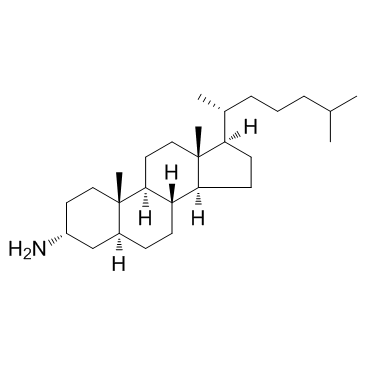
Cas No.: 2206-20-4
Sample solution is provided at 25 µL, 10mM.
_1-3.$$$39978408@51.jpg');)
_1-9.$$$38538795@65.jpg');)
_1-9.$$$39112701@51.jpg');)
_1-7.$$$37316672@70.jpg');)
_366-372.$$$36198801@70.jpg');)
.$$$38565142@65.jpg');)
_1867-1883.$$$33248023@67.jpg');)
_eads6055.$$$39977546@45.jpg');)
_eadm9805.$$$40080571@45.jpg');)
_eadj3020.$$$39666821@45.jpg');)
_1-20.$$$39757301@28.jpg');)
_1-24.$$$38898113@28.jpg');)
_273-287.$$$36806353@46.jpg');)
_1-16.$$$37156877@44.jpg');)
_1-19.$$$37460805@44.jpg');)
_1291-1307.$$$34518654@46.jpg');)
3α-Aminocholestane is an inhibitor of Src homology 2 domain-containing inositol 5'-phosphatase 1 (SHIP1) and a cholesterol derivative with an IC50 of approximately 10μM[1]. SHIP1 negatively regulates various intracellular signaling pathways. By inhibiting the activity of SHIP1, 3α-Aminocholestane interferes with related signal transduction and affects cellular physiological functions[2]. 3α-Aminocholestane has shown potential value in a variety of tumor-related studies, including liver cancer, lung cancer, and breast cancer[3].
In vitro, treatment of K562, KG1, and C14908 cells with 3α-Aminocholestane (0-15μM) for 36 hours reduced the viability of SHIP1-expressing human acute myeloid leukemia cell line KG-1 and mouse leukemia cell line C14908, inhibited their growth, and promoted apoptosis; however, it had no significant effect on K562 leukemia cells that do not express SHIP1[4]. Treatment of U266, RPMI8226, and OPM2 cells with 3α-Aminocholestane (0-12.5μM) for 48 hours resulted in differential responses such as cell cycle arrest, apoptosis, and autophagy in different multiple myeloma cells by affecting the PI3K-Akt signaling pathway[5].
In vivo, treatment of collagen-induced arthritis (CIA) model mice with 3α-Aminocholestane (60μM) via intraperitoneal injection reduced the infiltration of inflammatory cells in the joints of mice and alleviated cartilage damage and bone erosion[6]. Treatment of BALB/c mice with 3α-Aminocholestane (60μM/day) for seven days increased anti-leishmanial activity, but reduced the production of leishmanial precytokines and decreased the parasite load of L.major and L.donovani infections[7].
References:
[1] Pacherille AM, Viernes DR, Pedicone C, et al. Aminocholestane and Aminoandrostane Inhibitors of the SH2 Domain-Containing Inositol 5'-Phosphatase (SHIP). ChemMedChem 2025, 20(8):e202400597.
[2] Müller SM, Jücker M The Functional Roles of the Src Homology 2 Domain-Containing Inositol 5-Phosphatases SHIP1 and SHIP2 in the Pathogenesis of Human Diseases. Int J Mol Sci 2024, 25(10).
[3] Pedicone C, Meyer ST, Chisholm JD, et al. Targeting SHIP1 and SHIP2 in Cancer. Cancers (Basel) 2021, 13(4).
[4] Brooks R, Fuhler GM, Iyer S, et al. SHIP1 inhibition increases immunoregulatory capacity and triggers apoptosis of hematopoietic cancer cells. J Immunol 2010, 184(7):3582-3589.
[5] Fuhler GM, Brooks R, Toms B, et al. Therapeutic potential of SH2 domain-containing inositol-5'-phosphatase 1 (SHIP1) and SHIP2 inhibition in cancer. Mol Med 2012, 18(1):65-75.
[6] So EY, Sun C, Wu KQ, et al. Inhibition of lipid phosphatase SHIP1 expands myeloid-derived suppressor cells and attenuates rheumatoid arthritis in mice. Am J Physiol Cell Physiol 2021, 321(3):C569-c584.
[7] Chowdhury BP, Das S, Bodhale N, et al. SHIP1 inhibition via 3-alpha-amino-cholestane enhances protection against Leishmania infection. Cytokine 2023, 171:156373.
| Cell experiment [1]: | |
Cell lines | K562、KG1 and C14908 |
Preparation Method | Cells were treated in duplicate for 36h with increasing concentrations of 3α-Aminocholestane or vehicle. MTT (Sigma-Aldrich) was added at a concentration of 0.5mg/ml to the cells for 3h. Formed crystals were dissolved in dimethyl sulfoxide and OD was measured at 570nm. The OD of compound treated cells was divided by the OD of their vehicle control, and the viability was expressed as a percentage of untreated cells. Results are expressed as mean±SEM of three individual experiments. |
Reaction Conditions | 0, 2.5, 5.0, 7.5, 10.0, 12.5 and 15.0μM; 36h |
Applications | 3α-Aminocholestane can reduce the viability of KG1 and C14908 cells, but has no effect on K562. |
| Animal experiment [2]: | |
Animal models | Collagen-induced arthritis mice |
Preparation Method | In a prevention model, the mice were pretreated with 3α-Aminocholestane or vehicle control daily via intraperitoneal injection 7 days before the first immunization. In an intervention model, the mice were treated with 3AC or vehicle control daily via intraperitoneal injection 7 days after the second immunization. Each mouse was injected with 200μL of 3α-Aminocholestane (60μM) per administration. For histological analysis, mice were euthanized at designated timepoints. Limbs were collected, fixed, decalcified, and paraffin embedded. Sections were stained with hematoxylin/eosin (H&E), Safranin O/fast green, and toluidine blue to examine cellularity, cartilage damage, and bone erosion, respectively. For X-ray imaging, fixed limbs were scanned with Faxitron cabinet X-ray system (Tucson, AZ) before histological analysis. |
Dosage form | 60μM; once a day for 7 consecutive days |
Applications | 3α-Aminocholestane can reduce the infiltration of inflammatory cells in arthritic joints, alleviate cartilage damage and bone erosion. |
References: | |
| Cas No. | 2206-20-4 | SDF | |
| Überlieferungen | 3AC | ||
| Canonical SMILES | CC(C)CCC[C@@H](C)[C@@]1([H])CC[C@@]2([H])[C@]3([H])CC[C@@]4([H])C[C@H](N)CC[C@]4(C)[C@@]3([H])CC[C@@]21C | ||
| Formula | C27H49N | M.Wt | 387.68 |
| Löslichkeit | Ethanol : 50 mg/mL (128.97 mM);DMSO : < 1 mg/mL (insoluble or slightly soluble) | Storage | Store at -20°C |
| General tips | Please select the appropriate solvent to prepare the stock solution according to the
solubility of the product in different solvents; once the solution is prepared, please store it in
separate packages to avoid product failure caused by repeated freezing and thawing.Storage method
and period of the stock solution: When stored at -80°C, please use it within 6 months; when stored
at -20°C, please use it within 1 month. To increase solubility, heat the tube to 37°C and then oscillate in an ultrasonic bath for some time. |
||
| Shipping Condition | Evaluation sample solution: shipped with blue ice. All other sizes available: with RT, or with Blue Ice upon request. | ||
| Prepare stock solution | |||

|
1 mg | 5 mg | 10 mg |
| 1 mM | 2.5794 mL | 12.8972 mL | 25.7945 mL |
| 5 mM | 515.9 μL | 2.5794 mL | 5.1589 mL |
| 10 mM | 257.9 μL | 1.2897 mL | 2.5794 mL |
Step 1: Enter information below (Recommended: An additional animal making an allowance for loss during the experiment)
 g
μL
g
μL
Step 2: Enter the in vivo formulation (This is only the calculator, not formulation. Please contact us first if there is no in vivo formulation at the solubility Section.)
Calculation results:
Working concentration: mg/ml;
Method for preparing DMSO master liquid: mg drug pre-dissolved in μL DMSO ( Master liquid concentration mg/mL, Please contact us first if the concentration exceeds the DMSO solubility of the batch of drug. )
Method for preparing in vivo formulation: Take μL DMSO master liquid, next addμL PEG300, mix and clarify, next addμL Tween 80, mix and clarify, next add μL saline, mix and clarify.
Method for preparing in vivo formulation: Take μL DMSO master liquid, next add μL Corn oil, mix and clarify.
Note: 1. Please make sure the liquid is clear before adding the next solvent.
2. Be sure to add the solvent(s) in order. You must ensure that the solution obtained, in the previous addition, is a clear solution before proceeding to add the next solvent. Physical methods such as vortex, ultrasound or hot water bath can be used to aid dissolving.
3. All of the above co-solvents are available for purchase on the GlpBio website.
Quality Control & SDS
- View current batch:
- Purity: >98.00% Appearance: A solid
- COA (Certificate of Analysis)
- SDS (Safety Data Sheet)
- Datasheet
Average Rating: 5 (Based on Reviews and 3 reference(s) in Google Scholar.)