

AACOCF3 (Synonyms: ATK, AATFMK) |
Katalog-Nr.GC16115
 One-Click Copy Product Info
|

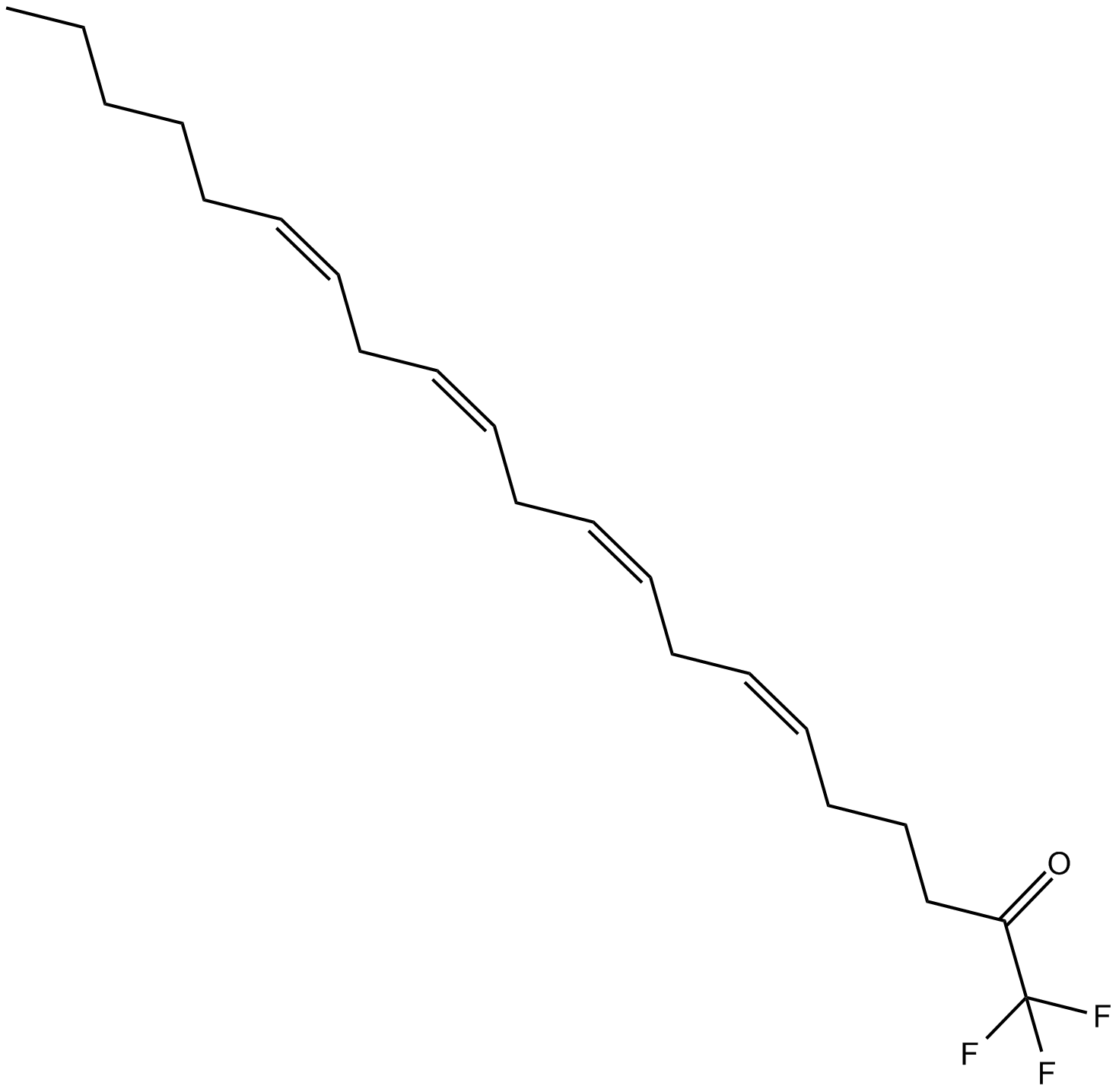
AACOCF3(arachidonyl trifluoromethyl ketone) ist ein potenter Inhibitor der cytosolischen Phospholipase A2(cPLA2) mit einem IC50-Wert von etwa 10 μM. Durch irreversible Alkylierung des aktiven Zentrums des Enzyms blockiert AACOCF3 die Freisetzung von Arachidonsäure und die nachfolgende Produktion proinflammatorischer Eicosanoide. AACOCF3 wird breit in der Erforschung von Entzündungsprozessen, Neuroinflammation und Lipid-Signalmechanismen verwendet.
Products are for research use only. Not for human use. We do not sell to patients.
Cas No.: 149301-79-1
Sample solution is provided at 25 µL, 10mM.
AACOCF3(arachidonyl trifluoromethyl ketone) ist ein potenter Inhibitor der cytosolischen Phospholipase A2(cPLA2) mit einem IC50-Wert von etwa 10 μM. Durch irreversible Alkylierung des aktiven Zentrums des Enzyms blockiert AACOCF3 die Freisetzung von Arachidonsäure und die nachfolgende Produktion proinflammatorischer Eicosanoide. AACOCF3 wird breit in der Erforschung von Entzündungsprozessen, Neuroinflammation und Lipid-Signalmechanismen verwendet[1]. Weil cPLA2 auch an der Aktivierung von Calpain in der Skelettmuskulatur beteiligt ist, kann AACOCF3 auch die Mitochondrienfunktion regulieren[2]. Kürzlich wurde cPLA2 eng mit der Entstehung verschiedener Krebsarten in Verbindung gebracht und AACOCF3 gilt als potenzieller Wirkstoff zur Bekämpfung der Krebsentwicklung[3, 4].
In vitro kann AACOCF3 (5μM) die Aktivierung von Prostaglandinen(PGs) durch epidermalen Wachstumsfaktor(EGF) über den MARK-Signalweg blockieren und dadurch die Mitose in Hornhaut-Epithelzellen hemmen[5]. AACOCF3 (1.3–10μM) hemmt die durch Lipopolysaccharid(LPS) induzierte Aktivierung von cPLA2, reduziert die Produktion reaktiver Sauerstoffspezies(ROS) und Stickstoffmonoxid in Mikrogliazellen und verhindert morphologische Veränderungen, die mit der Aktivierung primärer Mikrogliazellen einhergehen[6].
In vitro führte eine Behandlung mit intravenöser Injektion von AACOCF3 (4 mM, 50 μL) 30 Minuten nach der Verletzung, gefolgt von täglichen intraperitonealen Injektionen von AACOCF3 (4 mM, 200 μL), zu einer wichtigen Reduktion des Läsionsbereichs bei Mäusen mit Rückenmarksverletzung(SCI) und zu einer Verbesserung der Hinterbein-Motorik sowie des Gleichgewichts und der Koordination[7]. In einem Rattenmodell mit Rückenmarksverletzung erhöhte die intravenöse Injektion von AACOCF3 (7.13mg/kg) die Zahl überlebender Neuronen und Oligodendrozyten erheblich und wirkte neuroprotektiv[8].
References:
[1] Riendeau D, Guay J, Weech PK, et al. Arachidonyl trifluoromethyl ketone, a potent inhibitor of 85-kDa phospholipase A2, blocks production of arachidonate and 12-hydroxyeicosatetraenoic acid by calcium ionophore-challenged platelets. J Biol Chem. 1994 Jun 3;269(22):15619-24.
[2] Supinski GS, Alimov AP, Wang L, et al. Calcium-dependent phospholipase A2 modulates infection-induced diaphragm dysfunction. Am J Physiol Lung Cell Mol Physiol. 2016 May 15;310(10):L975-84.
[3] Pan P, Qin G, Wang B, et al. HDAC5 Loss Enhances Phospholipid-Derived Arachidonic Acid Generation and Confers Sensitivity to cPLA2 Inhibition in Pancreatic Cancer. Cancer Res. 2022 Dec 16;82(24):4542-4554.
[4] Li J, Zhang M, Sun Q, et al. CENPF interaction with PLA2G4A promotes glioma growth by modulating mTORC1 and NF-κB pathways. Cancer Cell Int. 2025 Mar 1;25(1):73.
[5] Kang SS, Li T, Xu D, et al. Inhibitory effect of PGE2 on EGF-induced MAP kinase activity and rabbit corneal epithelial proliferation. Invest Ophthalmol Vis Sci. 2000 Jul;41(8):2164-9.
[6] Chuang DY, Simonyi A, Kotzbauer PT, et al. Cytosolic phospholipase A2 plays a crucial role in ROS/NO signaling during microglial activation through the lipoxygenase pathway. J Neuroinflammation. 2015 Oct 31;12:199.
[7] Liu NK, Deng LX, Zhang YP, et al. Cytosolic phospholipase A2 protein as a novel therapeutic target for spinal cord injury. Ann Neurol. 2014 May;75(5):644-58.
[8] Huang W、Bhavsar A、Ward RE, et al. Arachidonyl trifluoromethyl ketone is neuroprotective after spinal cord injury. J Neurotrauma. 2009 Aug;26(8):1429-34.
| Zellexperiment [1]: | |
Zelllinien | BV-2-Zellen |
Vorbereitungsmethode | BV-2-Zellen wurden 3 Stunden lang in DMEM ohne Phenolrot serumfrei kultiviert und dann 1 Stunde lang mit AACOCF3 in der angegebenen Konzentration inkubiert. Danach wurden die Zellen 16 Stunden lang bei 37°C mit IFNγ oder LPS inkubiert. |
Reaktionsbedingungen | 1.3 μM, 2.5 μM, 5 μM, 10 μM, 1 Stunde |
Anwendungen | AACOCF3 reduziert die Produktion von ROS und Stickstoffmonoxid in BV-2-Zellen. |
| Tierversuch [2]: | |
Tiermodelle | Rückenmarksverletzung(SCI) C57BL/6-Mäuse |
Vorbereitungsmethode | AACOCF3 wird Mäusen mit Rückenmarksverletzung 30 Minuten nach der Verletzung intravenös verabreicht, dann werden über einen Zeitraum von 2 Wochen jeden zweiten Tag intraperitoneale Injektionen durchgeführt. |
Dosierungsform | 4 mM, 50 μl 30 Minuten nach der Verletzung i.v., 4 mM, 200 μl jeden zweiten Tag über 2 Wochen; i.p. |
Anwendungen | AACOCF3 reduzierte erheblich die Läsionsfläche bei SCI-Mäusen und verbessert die Lokomotionsfunktion ihrer Hinterbeine sowie ihr Gleichgewichts- und Koordinationsvermögen. |
References: | |
| Cas No. | 149301-79-1 | SDF | |
| Überlieferungen | ATK, AATFMK | ||
| Chemical Name | 1,1,1-trifluoro-6Z,9Z,12Z,15Z-heneicosatetraen-2-one | ||
| Canonical SMILES | FC(F)(C(CCC/C=C\C/C=C\C/C=C\C/C=C\CCCCC)=O)F | ||
| Formula | C21H31F3O | M.Wt | 356.47 |
| Löslichkeit | DMF: >25 mg/ml,DMSO: > 25 mg/ml,PBS pH 7.2: <50 µ g/ml | Storage | Store at -20°C, protect from light |
| General tips | Please select the appropriate solvent to prepare the stock solution according to the
solubility of the product in different solvents; once the solution is prepared, please store it in
separate packages to avoid product failure caused by repeated freezing and thawing.Storage method
and period of the stock solution: When stored at -80°C, please use it within 6 months; when stored
at -20°C, please use it within 1 month. To increase solubility, heat the tube to 37°C and then oscillate in an ultrasonic bath for some time. |
||
| Shipping Condition | Evaluation sample solution: shipped with blue ice. All other sizes available: with RT, or with Blue Ice upon request. | ||
| Prepare stock solution | |||

|
1 mg | 5 mg | 10 mg |
| 1 mM | 2.8053 mL | 14.0264 mL | 28.0529 mL |
| 5 mM | 561.1 μL | 2.8053 mL | 5.6106 mL |
| 10 mM | 280.5 μL | 1.4026 mL | 2.8053 mL |
Step 1: Enter information below (Recommended: An additional animal making an allowance for loss during the experiment)
 g
μL
g
μL
Step 2: Enter the in vivo formulation (This is only the calculator, not formulation. Please contact us first if there is no in vivo formulation at the solubility Section.)
Calculation results:
Working concentration: mg/ml;
Method for preparing DMSO master liquid: mg drug pre-dissolved in μL DMSO ( Master liquid concentration mg/mL, Please contact us first if the concentration exceeds the DMSO solubility of the batch of drug. )
Method for preparing in vivo formulation: Take μL DMSO master liquid, next addμL PEG300, mix and clarify, next addμL Tween 80, mix and clarify, next add μL saline, mix and clarify.
Method for preparing in vivo formulation: Take μL DMSO master liquid, next add μL Corn oil, mix and clarify.
Note: 1. Please make sure the liquid is clear before adding the next solvent.
2. Be sure to add the solvent(s) in order. You must ensure that the solution obtained, in the previous addition, is a clear solution before proceeding to add the next solvent. Physical methods such as vortex, ultrasound or hot water bath can be used to aid dissolving.
3. All of the above co-solvents are available for purchase on the GlpBio website.
Quality Control & SDS
- View current batch:
- Purity: >98.00% Appearance: A liquid
- COA (Certificate of Analysis)
- SDS (Safety Data Sheet)
- Datasheet
-
Related Biological Data

Inhibition of cPLA2 activity weakens the ability of MF to promote wound healing and cell migration. (A) Representative images (Left) and quantitation (Right) of colonic epithelial cells wound closure at baseline and after 24 h of MF and three subtypes of PLA2 inhibitor intervention.
AACOCF3 (Glpbio) (10 μM), VPLB (3 μM) and BEL (0.3 μM) were added to colonic epithelial cells for scratch wound and migration experiments.
Phytomedicine 119 (2023): 154985. PMID: 37516090 IF: 7.8996 -
Related Biological Data

Production of infectious SGIV progeny in cell culture was inhibited by the cPLA2 inhibitor AACOCF3 or iPLA2 inhibitor PACOCF3. (B) The severity of CPE induced by SGIV infection at 24 h p.i. in AACOCF3-treated or PACOCF3-treated cells.
AACOCF3 was purchased from Good Laboratory Practice bioscience (GLPBIO) and was dissolved in ethanol.
Int J Mol Sci 22.22 (2021): 12597. PMID: 34830477 IF: 5.922 -
Related Biological Data

PLA2G4A inhibition enhances NK cell-mediated cytotoxicity against AML cells. (M–O) Realtime PCR results show the expression of NKG2DL genes in leukemia cell lines treated with the PLA2G4A inhibitor AACOCF3.
After treatment with AACOCF3 (GC16115, GLPBIO) at 25mM for 48 hours, we evaluated cellular apoptosis with Annexin-V by flow cytometric analysis.
Frontiers in oncology 12 (2022). PMID: 36338749 IF: 5.7382
Average Rating: 5 (Based on Reviews and 8 reference(s) in Google Scholar.)