

ART558 |
Katalog-Nr.GC62553
 One-Click Copy Product Info
|

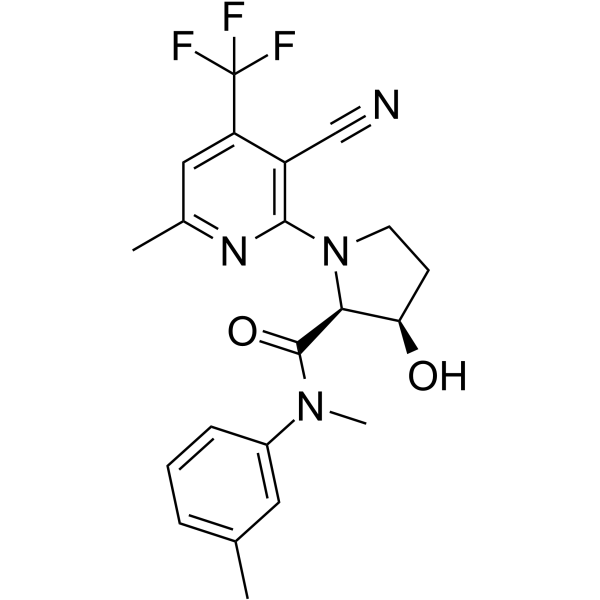
ART558 ist ein potenter und selektiver niedermolekularer allosterischer Inhibitor der DNA-Polymerase Polθ mit einem Molekulargewicht (MW) im nanomolaren Bereich und einem IC50 von 7,9 nM.
Products are for research use only. Not for human use. We do not sell to patients.
Cas No.: 2603528-97-6
Sample solution is provided at 25 µL, 10mM.
_1-3.$$$39978408@51.jpg');)
_1-9.$$$38538795@65.jpg');)
_1-9.$$$39112701@51.jpg');)
_1-7.$$$37316672@70.jpg');)
_366-372.$$$36198801@70.jpg');)
.$$$38565142@65.jpg');)
_1867-1883.$$$33248023@67.jpg');)
_eads6055.$$$39977546@45.jpg');)
_eadm9805.$$$40080571@45.jpg');)
_eadj3020.$$$39666821@45.jpg');)
_1-20.$$$39757301@28.jpg');)
_1-24.$$$38898113@28.jpg');)
_273-287.$$$36806353@46.jpg');)
_1-16.$$$37156877@44.jpg');)
_1-19.$$$37460805@44.jpg');)
_1291-1307.$$$34518654@46.jpg');)
ART558 ist ein potenter und selektiver niedermolekularer allosterischer Inhibitor der DNA-Polymerase Polθ mit einem Molekulargewicht (MW) im nanomolaren Bereich und einem IC50 von 7,9 nM. Es funktioniert, indem es die geschlossene Konformation von Polθ stabilisiert, während es an die DNA gebunden ist, wodurch seine Polymeraseaktvität effektiv blockiert wird. ART558 zielt speziell auf das Theta-vermittelte End-Joining ab, einen wichtigen DNA-Reparaturprozess, der durch Polθ vermittelt wird, während nicht-homologe End-Joining-Mechanismen verschont bleiben [1-3].
ART558 (0-50 μM; 2 Tage) zeigte eine maximale Reduktion der Cas9-induzierten Mutationshäufigkeit bei 10 μM in Wildzyp-Zellen. Darüber hinaus schwächt ART558(10 μM) die mutagene Reparatur an Cas9-induzierten Brüchen in embryonalen Stammzellen der Maus ab [3]. ART558 (1-3 μM) induziert eine Polθ-abhängige Radiosensibilisierung in Krebszelllinien. Die zellzyklusbedingten Effekte der Polθ-Hemmung durch ART558 in Kombination mit Strahlung werden ebenfalls beobachtet [4]. In Abwedenheit von Polθ unterdrücken RAD52-Akkumulationen die Lückenfüllung der einzelsträngigen DNA (ssDNA) während der G2/M-Phase und fördern die Akkumulation von fördern die Akkumulation von MRE11-Nuklease. Umgekehrt wird das Überleben von BRCA1-defizienten Zellen, die mit dem Polθ-Inhibitor ART558 (10 μM) behandelt wurden, nicht durch die RAD52-Suppression gerettet. Stattdessen wird das Füllen von ssDNA-Lücken durch die direkte Hemmung der Polymeraseaktivität selbst behindert [5]. Darüber hinaus sensibilisierte ART558 (0–25 μM; 2 Tage) beide Pankreaszellinien (Capan-1- und HTERT-HPNE-Zellen) für subletale Dosen von Cisplatin [6].
References:
[1]. Zatreanu, D., Robinson, et al. Polθ inhibitors elicit BRCA-gene synthetic lethality and target PARP inhibitor resistance. Nat Commun 12, 3636 (2021). https://doi.org/10.1038/s41467-021-23463-8
[2]. Stockley ML, Ferdinand A, et al. Discovery, Characterization, and Structure-Based Optimization of Small-Molecule In Vitro and In Vivo Probes for Human DNA Polymerase Theta. J Med Chem. 2022 Oct 27;65(20):13879-13891. doi: 10.1021/acs.jmedchem.2c01142. Epub 2022 Oct 6. Erratum in: J Med Chem. 2023 Feb 23. doi: 10.1021/acs.jmedchem.3c00204. PMID: 36200480.
[3]. Schimmel J, Muñoz-Subirana N, et al. Modulating mutational outcomes and improving precise gene editing at CRISPR-Cas9-induced breaks by chemical inhibition of end-joining pathways. Cell Rep. 2023 Feb 28;42(2):112019. doi: 10.1016/j.celrep.2023.112019. Epub 2023 Jan 25. PMID: 36701230
[4]. Rodriguez-Berriguete G, et al. Small-Molecule Polθ Inhibitors Provide Safe and Effective Tumor Radiosensitization in Preclinical Models. Clin Cancer Res. 2023 Apr 14;29(8):1631-1642. doi: 10.1158/1078-0432.CCR-22-2977. PMID: 36689546; PMCID: PMC10102842.
[5]. Ronson GE, Starowicz K, et al. Mechanisms of synthetic lethality between BRCA1/2 and 53BP1 deficiencies and DNA polymerase theta targeting. Nat Commun. 2023 Nov 29;14(1):7834. doi: 10.1038/s41467-023-43677-2. PMID: 38030626; PMCID: PMC10687250.
[6]. Bugbee T, Gathoni M, et al. Inhibition of p300 increases cytotoxicity of cisplatin in pancreatic cancer cells. Gene. 2023 Dec 20;888:147762. doi: 10.1016/j.gene.2023.147762. Epub 2023 Sep 2. PMID: 37666373; PMCID: PMC10563798.
| Zellexperiment [1]: | |
Zelllinien | Embryonale Stammzellen der Maus (mESC) |
Vorbereitungsmethode | Wildtyp- und Pol-θ-defiziente mESC wurden mit ART558 in unterschiedlichen Konzentrationen vorbehandelt und mit Cas9-Wildtyp (WT) und sgHPRT_ex3.1 transfiziert. |
Reaktionsbedingungen | 0-50μM;2 Tage |
Anwendungen | ART558 zeigte eine maximale Reduktion der Cas9-induzierten Mutationshäufigkeit bei einer Konzentration von 10 μM in Wildtyp-Zellen, ohne zusätzliche Effekte auf die bereits reduzierte Mutationshäufigkeit auszuüber, die in Polϴ-defizienten Zellen beobachtet wurde. |
References: | |
| Cas No. | 2603528-97-6 | SDF | |
| Formula | C21H21F3N4O2 | M.Wt | 418.41 |
| Löslichkeit | 85 mg/mL in DMSO(Need ultrasonic) | Storage | 4°C, away from moisture and light |
| General tips | Please select the appropriate solvent to prepare the stock solution according to the
solubility of the product in different solvents; once the solution is prepared, please store it in
separate packages to avoid product failure caused by repeated freezing and thawing.Storage method
and period of the stock solution: When stored at -80°C, please use it within 6 months; when stored
at -20°C, please use it within 1 month. To increase solubility, heat the tube to 37°C and then oscillate in an ultrasonic bath for some time. |
||
| Shipping Condition | Evaluation sample solution: shipped with blue ice. All other sizes available: with RT, or with Blue Ice upon request. | ||
| Prepare stock solution | |||

|
1 mg | 5 mg | 10 mg |
| 1 mM | 2.39 mL | 11.95 mL | 23.9 mL |
| 5 mM | 478 μL | 2.39 mL | 4.78 mL |
| 10 mM | 239 μL | 1.195 mL | 2.39 mL |
Step 1: Enter information below (Recommended: An additional animal making an allowance for loss during the experiment)
 g
μL
g
μL
Step 2: Enter the in vivo formulation (This is only the calculator, not formulation. Please contact us first if there is no in vivo formulation at the solubility Section.)
Calculation results:
Working concentration: mg/ml;
Method for preparing DMSO master liquid: mg drug pre-dissolved in μL DMSO ( Master liquid concentration mg/mL, Please contact us first if the concentration exceeds the DMSO solubility of the batch of drug. )
Method for preparing in vivo formulation: Take μL DMSO master liquid, next addμL PEG300, mix and clarify, next addμL Tween 80, mix and clarify, next add μL saline, mix and clarify.
Method for preparing in vivo formulation: Take μL DMSO master liquid, next add μL Corn oil, mix and clarify.
Note: 1. Please make sure the liquid is clear before adding the next solvent.
2. Be sure to add the solvent(s) in order. You must ensure that the solution obtained, in the previous addition, is a clear solution before proceeding to add the next solvent. Physical methods such as vortex, ultrasound or hot water bath can be used to aid dissolving.
3. All of the above co-solvents are available for purchase on the GlpBio website.
Quality Control & SDS
- View current batch:
- Purity: >98.00% Appearance: A solid
- COA (Certificate of Analysis)
- SDS (Safety Data Sheet)
- Datasheet
Average Rating: 5 (Based on Reviews and 19 reference(s) in Google Scholar.)