

BAY 80-6946 (Copanlisib) (Synonyms: BAY 80-6946) |
Katalog-Nr.GC17766
 One-Click Copy Product Info
|

BAY 80-6946 (Copanlisib) (BAY 80-6946) ist ein potenter, selektiver und ATP-kompetitiver Pan-Klasse-I-PI3K-Inhibitor mit IC50-Werten von 0,5 nM, 0,7 nM, 3,7 nM und 6,4 nM fÜr PI3Kα, PI3K&488;8,889 PI3Kβ bzw. PI3Kγ. BAY 80-6946 (Copanlisib) hat eine mehr als 2.000-fache SelektivitÄt gegenÜber anderen Lipid- und Proteinkinasen, mit Ausnahme von mTOR. BAY 80-6946 (Copanlisib) hat eine Überlegene AntitumoraktivitÄt.
Products are for research use only. Not for human use. We do not sell to patients.
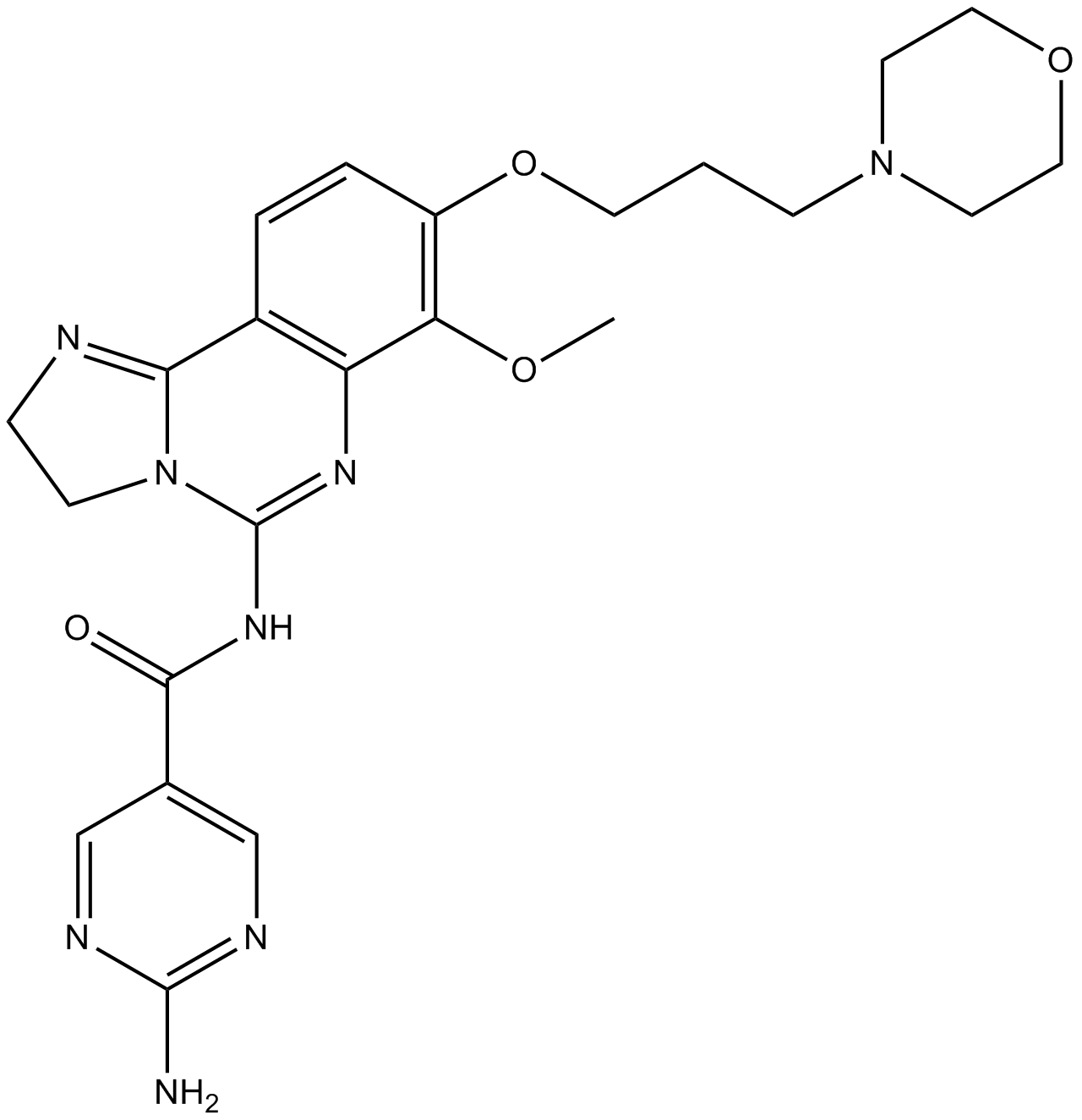
Cas No.: 1032568-63-0
Sample solution is provided at 25 µL, 10mM.
_1-3.$$$39978408@51.jpg');)
_1-9.$$$38538795@65.jpg');)
_1-9.$$$39112701@51.jpg');)
_1-7.$$$37316672@70.jpg');)
_366-372.$$$36198801@70.jpg');)
.$$$38565142@65.jpg');)
_1867-1883.$$$33248023@67.jpg');)
_eads6055.$$$39977546@45.jpg');)
_eadm9805.$$$40080571@45.jpg');)
_eadj3020.$$$39666821@45.jpg');)
_1-20.$$$39757301@28.jpg');)
_1-24.$$$38898113@28.jpg');)
_273-287.$$$36806353@46.jpg');)
_1-16.$$$37156877@44.jpg');)
_1-19.$$$37460805@44.jpg');)
_1291-1307.$$$34518654@46.jpg');)
Several phosphatidylinositol-3-kinase (PI3K) inhibitors are being investigated as a treatment for patients with B-cell malignancies. Such agents prevent activation of PI3K enzymes that are hyperactive in many B-cell malignancies and associated with tumor progression. Copanlisib is a novel pan-Class I phosphatidylinositol-3-kinase (PI3K) inhibitor with potent preclinical inhibitory activity against both PI3K-d and PI3K-α isoforms.
In vitro: BAY 80-6946 is a phosphoinositide 3-kinase (PI3K) inhibitor with potential antineoplastic activity, which inhibits proliferation with IC50 of 147 nM in HuCCT-1 (KRASG12D ) and 137 nM in EGI-1 (KRASG12D ) cell lines [1].
In vivo: BAY 80-6946 is generally well tolerated through the maximum tolerated dose (MTD) of 0.8 mg/kg. pharmacokinetics (PK) results support dosing weekly. Grade 2 or 3 hyperglycemia in the first 24 hrs after receiving a MTD dose. Pharmacokinetics, clinical SD as well as FDG-PET data are consistent with effective exposure and PI3K pathway inhibition. [2].
Clinical trial: Copanlisib (BAY 80-6946), developed by Bayer, is a selective Class I phosphoinositide 3-kinase inhibitor which has shown promise in Phase I/II clinical trials for the treatment of non-Hodgkin lymphoma and chronic lymphocytic leukemia. Phase II study shows that Copanlisib is active as a single-agent in heavily pretreated, advanced refractory/relapsed FL, MZL, , CLL and SLL. Copanlisib exhibited an acceptable toxicity profile, which was consistent with previous findings (https://ash.confex.com/ash/2014/webprogram/Paper70672.html).
References:
[1] Patnaik A, et al. J Clin Oncol, 29, 2011, (suppl, abstr 3035)
[2] Andrea H, et al. Cancer Res, 2012; 72(8), (suppl, Abstract 869)
| Kinase experiment [1]: | |
|
Biochemical lipid kinase assays |
The effect of BAY 80-6946 on PI3Kα, PI3Kβ and PI3Kγ activity was measured by the inhibition of 33P incorporation into phosphatidylinositol (PI) in 384-well MaxiSorp plates coated with 2 μg/well of PI and phosphatidylserine (PS) (1:1 molar ratio). In each PI3K isoform assay, 9 μL of reaction buffer (50 mM MOPSO, pH 7.0, 100 mM NaCl, 4 mM MgCl2, 0.1% BSA) containing 7.5 ng of His-tagged N-terminal truncated p110α or p110β protein or 25 ng of purified human p110γ protein was used. The reaction was started by adding 5 μL of 40 μM ATP solution containing 20 μCi/mL [γ-33P]-ATP. After 2-hr incubation at room temperature, the reaction was terminated by addition of 5 μL of 25 mM EDTA solution. The plates were washed and Ultima Gold scintillation cocktail (25 μL) was then added. The radioactivity incorporated into the immobilized PI substrate was determined with a BetaPlate Liquid Scintillation Counter. |
| Cell experiment [1]: | |
|
Cell lines |
A panel of cancer cell lines |
|
Preparation method |
The solubility of this compound in DMSO is limited. General tips for obtaining a higher concentration: Please warm the tube at 37 °C for 10 minutes and/or shake it in the ultrasonic bath for a while. Stock solution can be stored below - 20 °C for several months. |
|
Reacting condition |
5 μM; 72 hrs |
|
Applications |
BAY 80-6946 showed significant anti-proliferative activity in a series of cancers cells exhibiting constitutively activated PI3K signaling. Several breast cancer, endometrial cancer and hematologic tumor cell lines were extremely sensitive to BAY 80-6946 (IC50 values < 10 nM). |
| Animal experiment [1]: | |
|
Animal models |
A rat KPL4 tumor xenograft model |
|
Dosage form |
0.5 ~ 6 mg/kg; i.v.; every 2 days for a total of 5 doses starting on day 14 after tumor cell implantation |
|
Applications |
On day 25 (i.e. 3 days after the last dose), BAY 80-6946 at doses of 0.5, 1, 3 and 6 mg/kg showed TGI rates of 77%, 84%, 99% and 100%, respectively. In addition, BAY 80-6946 at doses of 3 and 6 mg/kg resulted in complete tumor regression. |
|
Other notes |
Please test the solubility of all compounds indoor, and the actual solubility may slightly differ with the theoretical value. This is caused by an experimental system error and it is normal. |
|
References: [1]. Liu N, Rowley BR, Bull CO, Schneider C, Haegebarth A, Schatz CA, Fracasso PR, Wilkie DP, Hentemann M, Wilhelm SM, Scott WJ, Mumberg D, Ziegelbauer K. BAY 80-6946 is a highly selective intravenous PI3K inhibitor with potent p110α and p110δ activities in tumor cell lines and xenograft models. Mol Cancer Ther. 2013 Nov;12(11):2319-30. | |
| Cas No. | 1032568-63-0 | SDF | |
| Überlieferungen | BAY 80-6946 | ||
| Chemical Name | 2-amino-N-[7-methoxy-8-(3-morpholin-4-ylpropoxy)-2,3-dihydroimidazo[1,2-c]quinazolin-5-yl]pyrimidine-5-carboxamide | ||
| Canonical SMILES | COC1=C(C=CC2=C1N=C(N3C2=NCC3)NC(=O)C4=CN=C(N=C4)N)OCCCN5CCOCC5 | ||
| Formula | C23H28N8O4 | M.Wt | 480.52 |
| Löslichkeit | <0.96mg/mL in DMSO, <1.022mg/mL in Water | Storage | Store at -20°C |
| General tips | Please select the appropriate solvent to prepare the stock solution according to the
solubility of the product in different solvents; once the solution is prepared, please store it in
separate packages to avoid product failure caused by repeated freezing and thawing.Storage method
and period of the stock solution: When stored at -80°C, please use it within 6 months; when stored
at -20°C, please use it within 1 month. To increase solubility, heat the tube to 37°C and then oscillate in an ultrasonic bath for some time. |
||
| Shipping Condition | Evaluation sample solution: shipped with blue ice. All other sizes available: with RT, or with Blue Ice upon request. | ||
| Prepare stock solution | |||

|
1 mg | 5 mg | 10 mg |
| 1 mM | 2.0811 mL | 10.4054 mL | 20.8108 mL |
| 5 mM | 416.2 μL | 2.0811 mL | 4.1622 mL |
| 10 mM | 208.1 μL | 1.0405 mL | 2.0811 mL |
Step 1: Enter information below (Recommended: An additional animal making an allowance for loss during the experiment)
 g
μL
g
μL
Step 2: Enter the in vivo formulation (This is only the calculator, not formulation. Please contact us first if there is no in vivo formulation at the solubility Section.)
Calculation results:
Working concentration: mg/ml;
Method for preparing DMSO master liquid: mg drug pre-dissolved in μL DMSO ( Master liquid concentration mg/mL, Please contact us first if the concentration exceeds the DMSO solubility of the batch of drug. )
Method for preparing in vivo formulation: Take μL DMSO master liquid, next addμL PEG300, mix and clarify, next addμL Tween 80, mix and clarify, next add μL saline, mix and clarify.
Method for preparing in vivo formulation: Take μL DMSO master liquid, next add μL Corn oil, mix and clarify.
Note: 1. Please make sure the liquid is clear before adding the next solvent.
2. Be sure to add the solvent(s) in order. You must ensure that the solution obtained, in the previous addition, is a clear solution before proceeding to add the next solvent. Physical methods such as vortex, ultrasound or hot water bath can be used to aid dissolving.
3. All of the above co-solvents are available for purchase on the GlpBio website.
Quality Control & SDS
- View current batch:
- Purity: >99.50% Appearance: A solid
- COA (Certificate of Analysis)
- SDS (Safety Data Sheet)
- Datasheet
Average Rating: 5 (Based on Reviews and 38 reference(s) in Google Scholar.)