

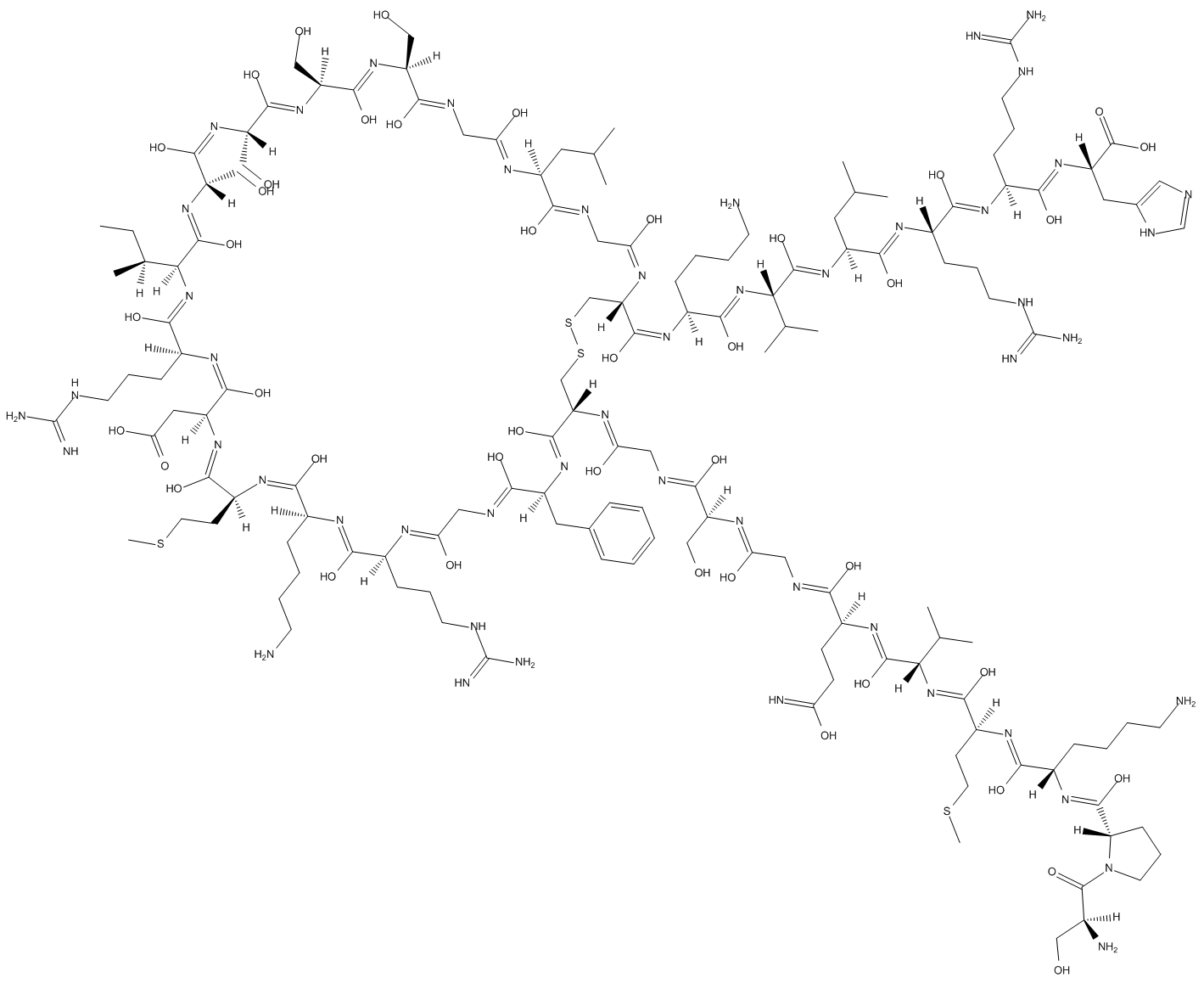
Brain natriuretic peptide (1-32) (human) |
Katalog-Nr.GC17895
 One-Click Copy Product Info
|

Brain natriuretic peptide (1-32) (human) ist ein kardiales Neurohormon, das von dem linken Ventrikel als Reaktion auf eine erhöhte Wandspannung ausgeschüttet wird.
Products are for research use only. Not for human use. We do not sell to patients.
Cas No.: 124584-08-3
Sample solution is provided at 25 µL, 10mM.
_1-3.$$$39978408@51.jpg');)
_1-9.$$$38538795@65.jpg');)
_1-9.$$$39112701@51.jpg');)
_1-7.$$$37316672@70.jpg');)
_366-372.$$$36198801@70.jpg');)
.$$$38565142@65.jpg');)
_1867-1883.$$$33248023@67.jpg');)
_eads6055.$$$39977546@45.jpg');)
_eadm9805.$$$40080571@45.jpg');)
_eadj3020.$$$39666821@45.jpg');)
_1-20.$$$39757301@28.jpg');)
_1-24.$$$38898113@28.jpg');)
_273-287.$$$36806353@46.jpg');)
_1-16.$$$37156877@44.jpg');)
_1-19.$$$37460805@44.jpg');)
_1291-1307.$$$34518654@46.jpg');)
Brain natriuretic peptide (1-32) (human) ist ein kardiales Neurohormon, das von dem linken Ventrikel als Reaktion auf eine erhöhte Wandspannung ausgeschüttet wird[2]. BNP hat sich als wichtiges kardiales Neurohormon mit vielfältigen potenziellen Funktionen in der Behandlung von Patienten mit Herzinsuffizienz etabliert. Brain natriuretic peptide (1-32) (human) ist der aktive Bestandteil von BNP[3,4].
Brain natriuretic peptide (1-32) (human) reguliert die Produktion wichtiger Entzündungsmoleküle wie reaktiver Sauerstoff- und Stickstoffspezies(ROS und RNS), Leukotriene B(4) (LTB(4)) und Prostaglandin E(2) (PGE(2)); moduliert das Zytokinprofil(TNF-alpha, IL-12 und IL-10) und beeinflusst die Zellmotilität[1].
In einer konsekutiven Reihe von 200 Patienten, die zur echokardiographischen Beurteilung der linksventrikulären Funktion überwiesen wurden, hatten diejenigen mit normaler Funktion erheblich niedrigere Brain natriuretic peptide (1-32) (human)-Werte als die jenigen mit linksventrikulärer Dysfunktion(systolisch, diastolisch oder kombiniert). In der Population mit einer sehr hohen Prävalenz linksventrikulärer Dysfunktion(47.5%) erwies sich ein Brain natriuretic peptide (1-32) (human)-Wert von 75 pg/ml oder höher als hochpräzise zur Identifizierung solcher Patieten. In der selektierten Gruppe scheint die BNP-32-Bestimmung ein sehr gutes Screening-Instrument zu sein[5].
In einer kleinen randomisierten Studie wurde der Nutzen einer ACE-Hemmer-Titration anhand Brain natriuretic peptide (1-32) (human) im Vergleich zu einer klinisch gesteuerten Titration untersucht. Eine umfassende hämodynamische Beurteilung erfolgte zu Studienbeginn und nach 8 Wochen Behandlung. Am Studienende war die ACE-Hemmer-Dosis in der BNP-32-Gruppe erheblich höher(p = 0.006) und die Herzfrequenz erheblich niedriger(p = 0.02) als in der klinisch gesteuerten Gruppe[6].
Die Eignung von Brain natriuretic peptide (1-32) (human)-Test zum Screening auf systolische oder diastolische Dysfunktion wurde in einer Substudie von „Heart and Soul study" untersucht. Bei der Gruppe stabiler ambulanter Patienten mit bekannter koronarer Herz-Krankheit war ein erhöhter BNP-32-Spiegel(>100 pg/ml) sowohl mit systolischer als auch mit diastolischer Dysfunktion assoziiert[7].
References:
[1]. ChiurchiÙ V, Izzi V, et,al. Brain Natriuretic Peptide (BNP) regulates the production of inflammatory mediators in human THP-1 macrophages. Regul Pept. 2008 Jun 5;148(1-3):26-32. doi: 10.1016/j.regpep.2008.02.009. Epub 2008 Mar 10. PMID: 18410972.
[2]. Wasywich CA, Whalley GA, et,al. Brain natriuretic peptide in the contemporary management of congestive heart failure. Expert Rev Cardiovasc Ther. 2005 Jan;3(1):71-84. doi: 10.1586/14779072.3.1.71. PMID: 15723576.
[3]. Sudoh T, Maekawa K, et,al. Cloning and sequence analysis of cDNA encoding a precursor for human brain natriuretic peptide. Biochem Biophys Res Commun. 1989 Mar 31;159(3):1427-34. doi: 10.1016/0006-291x(89)92269-9. PMID: 2522777.
[4]. Hunt PJ, Yandle TG, et,al. The amino-terminal portion of pro-brain natriuretic peptide (Pro-BNP) circulates in human plasma. Biochem Biophys Res Commun. 1995 Sep 25;214(3):1175-83. doi: 10.1006/bbrc.1995.2410. PMID: 7575527.
[5]. Maisel AS, Koon J, et,al. Utility of B-natriuretic peptide as a rapid, point-of-care test for screening patients undergoing echocardiography to determine left ventricular dysfunction. Am Heart J. 2001 Mar;141(3):367-74. doi: 10.1067/mhj.2001.113215. PMID: 11231433.
[6]. Murdoch DR, McDonagh TA, et,al. Titration of vasodilator therapy in chronic heart failure according to plasma brain natriuretic peptide concentration: randomized comparison of the hemodynamic and neuroendocrine effects of tailored versus empirical therapy. Am Heart J. 1999 Dec;138(6 Pt 1):1126-32. doi: 10.1016/s0002-8703(99)70079-7. PMID: 10577444.
[7]. Bibbins-Domingo K, Ansari M, et,al. Is B-type natriuretic peptide a useful screening test for systolic or diastolic dysfunction in patients with coronary disease? Data from the Heart and Soul Study. Am J Med. 2004 Apr 15;116(8):509-16. doi: 10.1016/j.amjmed.2003.08.037. PMID: 15063811; PMCID: PMC2776680.
| Cell experiment [1]: | |
Cell lines | THP-1 cells |
Preparation Method | THP-1 cells were cultured in RPMI-1640 medium supplemented with 10% fetal bovine serum, 100U/ml penicillin, and 100μg/ml streptomycin at 37°C with 5% CO2 and 95% saturated atmospheric humidity. Cells (1×10⁶ cells/well) were incubated in the dark with 10μM 2′,7′-dichlorofluorescein diacetate (DCF-DA) in serum-free medium for 30min at 37°C. After the incubation with the fluorescent dye, cells were then harvested, and the medium containing the unincorporated dye was eliminated by centrifugation. Cells were then stimulated in serum-free medium with Brain natriuretic peptide (1nM) for 3h. At end timepoint, cells were harvested, resuspended in PBS, and assessed for changes in fluorescence. |
Reaction Conditions | 1nM; 3h |
Applications | Brain natriuretic peptide treatment significantly promoted ROS production in THP-1 cells. |
| Animal experiment [2]: | |
Animal models | Male db/db mice of the C57BL/KsJ-leptdb-leptdb strain |
Preparation Method | Male db/db mice (10 weeks old) were housed under standard laboratory conditions on a 12-hour light/dark cycle (lights on at 7:00 am), constant temperature (23±2°C), and constant humidity (60±5), ad libitum food and water. Mice were randomly assigned (n =10/group) to receive chronic Brain natriuretic peptide treatment at a rate of 625ng/kg/h, or saline vehicle (veh). Treatment was started in 10-week-old mice and continued for 12 weeks using subcutaneous osmotic pumps. Analyze the blood sugar levels and body weight of mice. |
Dosage form | 625ng/kg/h; 12 weeks; s.c. |
Applications | Brain natriuretic peptide treatment reduced blood sugar and body weight in db/db mice. |
References: | |
| Cas No. | 124584-08-3 | SDF | |
| Chemical Name | (1E,3S,4Z,6S,7Z,9S,10Z,12S,13Z,15S,16Z,18S)-18-((1H-imidazol-5-yl)methyl)-1-((4R,5E,8Z,10S,11Z,14Z,16S,17Z,19S,20Z,22S,23E,25S,26Z,28S,29Z,31S,32E,34S,35Z,37S,38E,40S,41Z,43S,44Z,47Z,49S,50Z,52R)-52-((Z)-((1Z,3S,4Z,6S,7Z,9S,10Z,12S,13Z,16Z,18S,19Z)-1-((S) | ||
| Canonical SMILES | CC[C@]([C@@]1([H])/C(O)=N/[C@@](/C(O)=N\[C@@](/C(O)=N/[C@@](/C(O)=N/[C@@](/C(O)=N/C/C(O)=N/[C@@](/C(O)=N/C/C(O)=N\[C@@](/C(O)=N\[C@@](/C(O)=N/[C@@](/C(O)=N/[C@@](/C(O)=N/[C@@](/C(O)=N/[C@@](/C(O)=N/[C@@](C(O)=O)([H])CC2=CN=CN2)([H])CCCNC(N)=N)([H])CCCNC(N | ||
| Formula | C143H244N50O42S4 | M.Wt | 3464.05 |
| Löslichkeit | Soluble to 24mg/ml in sterile water | Storage | -20°C, protect from light |
| Shipping Condition | Evaluation sample solution: shipped with blue ice. All other sizes available: with RT, or with Blue Ice upon request. | ||
| Prepare stock solution | |||

|
1 mg | 5 mg | 10 mg |
| 1 mM | 288.7 μL | 1.4434 mL | 2.8868 mL |
| 5 mM | 57.7 μL | 288.7 μL | 577.4 μL |
| 10 mM | 28.9 μL | 144.3 μL | 288.7 μL |
Step 1: Enter information below (Recommended: An additional animal making an allowance for loss during the experiment)
 g
μL
g
μL
Step 2: Enter the in vivo formulation (This is only the calculator, not formulation. Please contact us first if there is no in vivo formulation at the solubility Section.)
Calculation results:
Working concentration: mg/ml;
Method for preparing DMSO master liquid: mg drug pre-dissolved in μL DMSO ( Master liquid concentration mg/mL, Please contact us first if the concentration exceeds the DMSO solubility of the batch of drug. )
Method for preparing in vivo formulation: Take μL DMSO master liquid, next addμL PEG300, mix and clarify, next addμL Tween 80, mix and clarify, next add μL saline, mix and clarify.
Method for preparing in vivo formulation: Take μL DMSO master liquid, next add μL Corn oil, mix and clarify.
Note: 1. Please make sure the liquid is clear before adding the next solvent.
2. Be sure to add the solvent(s) in order. You must ensure that the solution obtained, in the previous addition, is a clear solution before proceeding to add the next solvent. Physical methods such as vortex, ultrasound or hot water bath can be used to aid dissolving.
3. All of the above co-solvents are available for purchase on the GlpBio website.
Quality Control & SDS
- View current batch:
- Purity: >98.00% Appearance: A solid
- COA (Certificate of Analysis)
- SDS (Safety Data Sheet)
- Datasheet
Average Rating: 5 (Based on Reviews and 6 reference(s) in Google Scholar.)