

Carbenoxolone disodium |
Katalog-Nr.GC10624
 One-Click Copy Product Info
|

Carbenoxolon-Dinatrium ist der aktive Metabolit von GlycyrrhizinsÄure und der Inhibitor von menschlichem 11β-HSD und bakteriellem 3α, 20β-HSD.
Products are for research use only. Not for human use. We do not sell to patients.
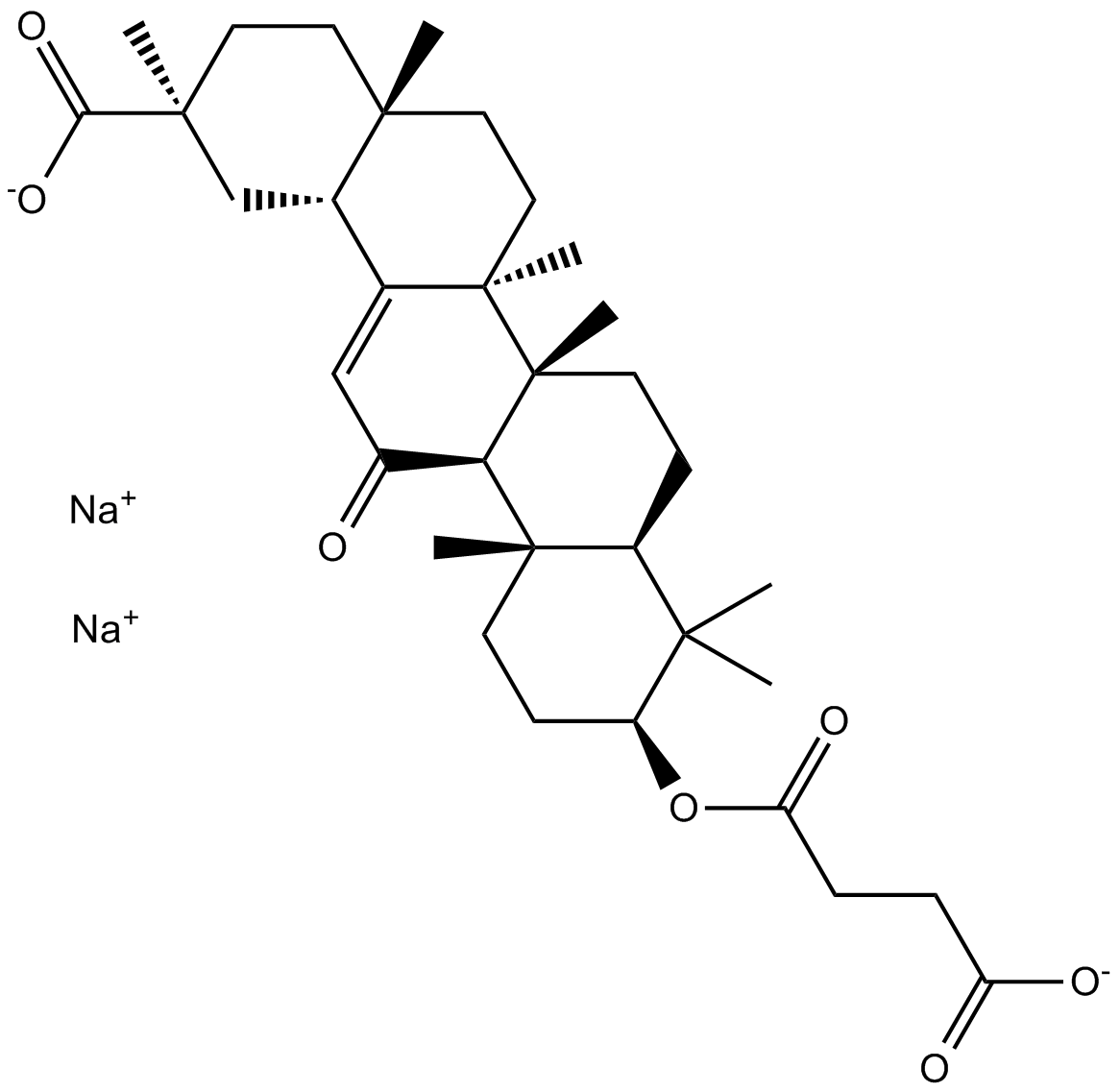
Cas No.: 7421-40-1
Sample solution is provided at 25 µL, 10mM.
Carbenoxolone disodium is a semi-synthetic derivative of glycyrrhetinic acid, an orally active gap junction/hemichannel inhibitor and a non-selective inhibitor of 11β-hydroxysteroid dehydrogenase type 1 (11β-HSD1). Carbenoxolone disodium inhibits connexin-mediated intercellular communication and Pannexin1 channel activity to block gap junction communication, while also modulating local glucocorticoid metabolism through inhibition of 11β-HSD1 to exert anti-inflammatory effects. Carbenoxolone disodium can be used in research on peptic ulcer, Alzheimer's disease, liver fibrosis, and metabolic diseases[1-4].
In vitro, Carbenoxolone disodium (50–100μM) was applied to human colorectal cancer cells (HCT116) and glioblastoma cells (U251 and U87) for 56 hours. Carbenoxolone disodium did not alter the proliferation rate of these cells, nor did it affect cell migration speed[5]. Carbenoxolone disodium (30μM) was used to pretreat HaCaT human keratinocytes and N2a mouse neuroblastoma cells for 1 hour, followed by infection with Vaccinia virus. Carbenoxolone disodium did not inhibit viral early protein expression, DNA replication, or late protein A27 synthesis. Carbenoxolone disodium blocked the formation of intracellular mature virus and extracellular enveloped virus[6].
In vivo, Carbenoxolone disodium (15mg/kg) was administered daily by oral gavage to obese model C57BL/6J male mice for 12 weeks. Carbenoxolone disodium improved insulin sensitivity, inhibited IκB-α/NF-κB pathway activation and NLRP3 inflammasome activation, downregulated p-IRS-1 expression, upregulated p-PI3K and p-AKT expression, and alleviated lipid accumulation in the liver and skeletal muscle[7]. Carbenoxolone disodium (15mg/kg) was administered daily by oral gavage to obese model C57BL/6J male mice for 12 weeks. Carbenoxolone disodium reduced serum triglycerides, total cholesterol, and low-density lipoprotein levels, increased high-density lipoprotein levels, attenuated body weight gain, alleviated hepatic lipid accumulation and hepatocyte ballooning, downregulated hepatic SOCS-3, SREBP-1c, and FAS expression, elevated phosphorylated JAK2 and phosphorylated STAT3 protein levels, and decreased hepatic inflammatory cytokine expression of IL-6 and TNF-α[8].
References:
[1] Ahmadpourmir H, Mohammadi Tabar H, Gholamnezhad Z, et al. Analgesic and anti-inflammatory properties of Carbenoxolone disodium: a review. Inflammopharmacology. 2025 Oct;33(10):5719-5733.
[2] Pinder RM, Brogden RN, Sawyer PR, et al. Carbenoxolone disodium: a review of its pharmacological properties and therapeutic efficacy in peptic ulcer disease. Drugs. 1976;11(4):245-307.
[3] Metcalfe MJ, Entrican JH. Carbenoxolone disodium and hypokalaemia. Lancet. 1987 Dec 26;2(8574):1525-6.
[4] Falk S. Carbenoxolone disodium as a novel therapy for attenuation of cancer-induced bone pain. Pain. 2018 Jun;159(6):1127-1136.
[5] Liu T, Stauber T. The Volume-Regulated Anion Channel LRRC8/VRAC Is Dispensable for Cell Proliferation and Migration. Int J Mol Sci. 2019 May 30;20(11):2663.
[6] Haga IR, Simpson JL, Hawes PC, et al. Carbenoxolone disodium-mediated cytotoxicity inhibits Vaccinia virus replication in a human keratinocyte cell line. Sci Rep. 2018 Nov 16;8(1):16956.
[7] Chen Y, Qian Q, Yu J. Carbenoxolone disodium ameliorates insulin sensitivity in obese mice induced by high fat diet via regulating the IκB-α/NF-κB pathway and NLRP3 inflammasome. Biomed Pharmacother. 2019 Jul;115:108868.
[8] Chen Y, Lu W, Jin Z, et al. Carbenoxolone disodium ameliorates hepatic lipid metabolism and inflammation in obese mice induced by high fat diet via regulating the JAK2/STAT3 signaling pathway. Int Immunopharmacol. 2019 Sep;74:105498.
| Cell experiment [1]: | |
Cell lines | HaCaT cells (spontaneously immortalised human keratinocyte cell line), N2a cells (murine neuroblastoma cell line) |
Preparation Method | HaCaT and N2a cells were maintained in Dulbecco's modified Eagle's medium (DMEM) supplemented with 10% foetal bovine serum, 50IU/ml penicillin and 50μg/ml streptomycin at 37°C, 5% CO₂. HaCaT and N2a cells were pretreated with Carbenoxolone disodium at 30μM Carbenoxolone disodium for 1h prior to Vaccinia virus infection, and Carbenoxolone disodium was retained in the overlay medium throughout the infection period. |
Reaction Conditions | 30μM; 1h pretreatment followed by Vaccinia virus infection |
Applications | Carbenoxolone disodium inhibited Vaccinia virus replication in HaCaT and N2a cells, with the inhibitory effect independent of gap junction function and PP2A upregulation. Carbenoxolone disodium did not suppress Vaccinia virus early protein expression, DNA replication or late protein (including A27) synthesis, but almost entirely blocked intracellular mature virus (IMV) and extracellular enveloped virus (EEV) formation. |
| Animal experiment [2]: | |
Animal models | 6-week-old male C57BL/6J mice with high-fat diet (HFD)-induced obesity |
Preparation Method | After 1 week of acclimation with normal chow diet, mice were fed with HFD (60% calories from fat) for 8 weeks to establish obesity model. Then mice were given Carbenoxolone disodium dissolved in sterile water by daily gavage (15mg/kg) for 12 weeks. All mice were sacrificed after 12-week treatment for serum and liver tissue detection. |
Dosage form | 15mg/kg; oral gavage; daily for 12 weeks |
Applications | Carbenoxolone disodium attenuated HFD-induced body weight gain, decreased serum triglyceride (TG), total cholesterol (TC) and low-density lipoprotein (LDL) levels, increased high-density lipoprotein (HDL) level, with no significant alteration in serum alanine aminotransferase (ALT) and aspartate aminotransferase (AST). Carbenoxolone disodium relieved hepatic intracellular lipid accumulation, hepatocellular ballooning and non-alcoholic fatty liver disease (NAFLD) activity score, downregulated mRNA and protein expressions of SOCS-3, SREBP-1c and FAS in liver, reduced hepatic interleukin-6 (IL-6) and tumor necrosis factor-α (TNF-α) levels, and elevated phosphorylated JAK2/JAK2 and phosphorylated STAT3/STAT3 ratios in liver. |
References: | |
| Cas No. | 7421-40-1 | SDF | |
| Chemical Name | disodium;10-(3-carboxylatopropanoyloxy)-2,4a,6a,6b,9,9,12a-heptamethyl-13-oxo-3,4,5,6,6a,7,8,8a,10,11,12,14b-dodecahydro-1H-picene-2-carboxylate | ||
| Canonical SMILES | CC1(C2CCC3(C(C2(CCC1OC(=O)CCC(=O)[O-])C)C(=O)C=C4C3(CCC5(C4CC(CC5)(C)C(=O)[O-])C)C)C)C.[Na+].[Na+] | ||
| Formula | C34H48Na2O7 | M.Wt | 614.72 |
| Löslichkeit | ≥ 30.736mg/mL in DMSO | Storage | Store at 2-8°C |
| General tips | Please select the appropriate solvent to prepare the stock solution according to the
solubility of the product in different solvents; once the solution is prepared, please store it in
separate packages to avoid product failure caused by repeated freezing and thawing.Storage method
and period of the stock solution: When stored at -80°C, please use it within 6 months; when stored
at -20°C, please use it within 1 month. To increase solubility, heat the tube to 37°C and then oscillate in an ultrasonic bath for some time. |
||
| Shipping Condition | Evaluation sample solution: shipped with blue ice. All other sizes available: with RT, or with Blue Ice upon request. | ||
| Prepare stock solution | |||

|
1 mg | 5 mg | 10 mg |
| 1 mM | 1.6268 mL | 8.1338 mL | 16.2676 mL |
| 5 mM | 325.4 μL | 1.6268 mL | 3.2535 mL |
| 10 mM | 162.7 μL | 813.4 μL | 1.6268 mL |
Step 1: Enter information below (Recommended: An additional animal making an allowance for loss during the experiment)
 g
μL
g
μL
Step 2: Enter the in vivo formulation (This is only the calculator, not formulation. Please contact us first if there is no in vivo formulation at the solubility Section.)
Calculation results:
Working concentration: mg/ml;
Method for preparing DMSO master liquid: mg drug pre-dissolved in μL DMSO ( Master liquid concentration mg/mL, Please contact us first if the concentration exceeds the DMSO solubility of the batch of drug. )
Method for preparing in vivo formulation: Take μL DMSO master liquid, next addμL PEG300, mix and clarify, next addμL Tween 80, mix and clarify, next add μL saline, mix and clarify.
Method for preparing in vivo formulation: Take μL DMSO master liquid, next add μL Corn oil, mix and clarify.
Note: 1. Please make sure the liquid is clear before adding the next solvent.
2. Be sure to add the solvent(s) in order. You must ensure that the solution obtained, in the previous addition, is a clear solution before proceeding to add the next solvent. Physical methods such as vortex, ultrasound or hot water bath can be used to aid dissolving.
3. All of the above co-solvents are available for purchase on the GlpBio website.
Quality Control & SDS
- View current batch:
- Purity: >99.50% Appearance: A solid
- COA (Certificate of Analysis)
- SDS (Safety Data Sheet)
- Datasheet
Average Rating: 5 (Based on Reviews and 22 reference(s) in Google Scholar.)