

DBIBB |
Katalog-Nr.GC16558
 One-Click Copy Product Info
|

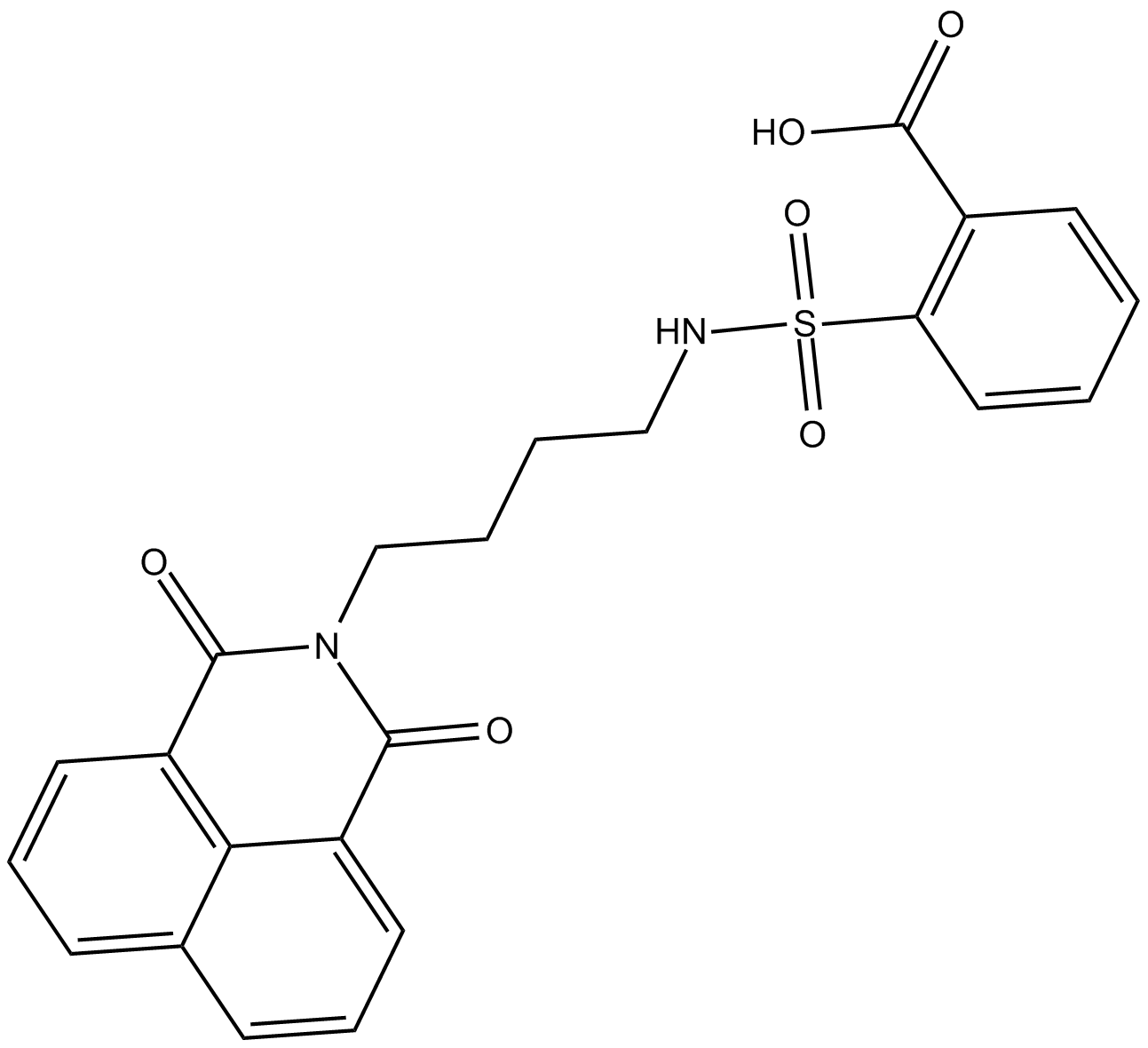
DBIBB ist ein spezifischer Nicht-Lipid-Agonist des Typ-2-G-Protein-gekoppelten Rezeptors fÜr LysophosphatidsÄure (LPA2).
Products are for research use only. Not for human use. We do not sell to patients.
Cas No.: 1569309-92-7
Sample solution is provided at 25 µL, 10mM.
_1-3.$$$39978408@51.jpg');)
_1-9.$$$38538795@65.jpg');)
_1-9.$$$39112701@51.jpg');)
_1-7.$$$37316672@70.jpg');)
_366-372.$$$36198801@70.jpg');)
.$$$38565142@65.jpg');)
_1867-1883.$$$33248023@67.jpg');)
_eads6055.$$$39977546@45.jpg');)
_eadm9805.$$$40080571@45.jpg');)
_eadj3020.$$$39666821@45.jpg');)
_1-20.$$$39757301@28.jpg');)
_1-24.$$$38898113@28.jpg');)
_273-287.$$$36806353@46.jpg');)
_1-16.$$$37156877@44.jpg');)
_1-19.$$$37460805@44.jpg');)
_1291-1307.$$$34518654@46.jpg');)
DBIBB, a butylsulfamoyl benzoic acid analog, is a non-lipid agonist of LPA2 with an EC50 of 0.10 μM. DBIBB has no effect at other LPA receptor subtypes [1]. The bioactive phospholipid lysophosphatidic acid (LPA) has been involved in stimulating cell proliferation, migration and survival by acting on its cognate G-protein-coupled receptors. Aberrant LPA production, receptor expression and signalling probably contribute to cancer initiation, progression and metastasis [2].
In vitro: DBIBB treatment postirradiation significantly (p< 0.01) increased the clonogenic survival of IEC-6 cells in the 2-6 Gy dose range. DBIBB reduced DNA fragmentation 4hr after irradiation in a dose dependent manner. DBIBB also reduced caspase 3/7 activity and DNA fragmentation in LPA2MEF treated with adriamycin. In purified CD34+ progenitor cells, DBIBB significantly increased the total number of colonies and specifically enhanced the survival of the granulocyte/macrophage lineages [1].
In vivo: Using a murine GI-ARS mice model of partial-body irradiation (PBI) with shielding of the bone marrow contained in the tibiae, fibulae, and paws, administrations of up to 10 mg/kg of DBIBB for 10 days showed no visually observable adverse effects and pathological findings at necropsy, indicating the lack of toxicity. The group that received 10 mg/kg DBIBB showed a significant increase in survival. In C57BL/6 mice, DBIBB showed a dose-dependent increase in the number of surviving crypts compared with the vehicle control [1].
References:
[1] Patil R, Szabó E, Fells J I, et al. Combined Mitigation of the Gastrointestinal and Hematopoietic Acute Radiation Syndromes by an LPA 2 Receptor-Specific Nonlipid Agonist[J]. Chemistry & biology, 2015, 22(2): 206-216.
[2] Mills G B, Moolenaar W H. The emerging role of lysophosphatidic acid in cancer[J]. Nature Reviews Cancer, 2003, 3(8): 582-591.
| Cas No. | 1569309-92-7 | SDF | |
| Chemical Name | 2-[[[4-(1,3-dioxo-1H-benz[de]isoquinolin-2(3H)-yl)butyl]amino]sulfonyl]-benzoic acid | ||
| Canonical SMILES | O=C(C1=C2C(C=CC=C23)=CC=C1)N(CCCCNS(C4=C(C(O)=O)C=CC=C4)(=O)=O)C3=O | ||
| Formula | C23H20N2O6S | M.Wt | 452.5 |
| Löslichkeit | ≤30mg/ml in DMSO;10mg/ml in dimethyl formamide | Storage | Store at -20°C |
| General tips | Please select the appropriate solvent to prepare the stock solution according to the
solubility of the product in different solvents; once the solution is prepared, please store it in
separate packages to avoid product failure caused by repeated freezing and thawing.Storage method
and period of the stock solution: When stored at -80°C, please use it within 6 months; when stored
at -20°C, please use it within 1 month. To increase solubility, heat the tube to 37°C and then oscillate in an ultrasonic bath for some time. |
||
| Shipping Condition | Evaluation sample solution: shipped with blue ice. All other sizes available: with RT, or with Blue Ice upon request. | ||
| Prepare stock solution | |||

|
1 mg | 5 mg | 10 mg |
| 1 mM | 2.2099 mL | 11.0497 mL | 22.0994 mL |
| 5 mM | 442 μL | 2.2099 mL | 4.4199 mL |
| 10 mM | 221 μL | 1.105 mL | 2.2099 mL |
Step 1: Enter information below (Recommended: An additional animal making an allowance for loss during the experiment)
 g
μL
g
μL
Step 2: Enter the in vivo formulation (This is only the calculator, not formulation. Please contact us first if there is no in vivo formulation at the solubility Section.)
Calculation results:
Working concentration: mg/ml;
Method for preparing DMSO master liquid: mg drug pre-dissolved in μL DMSO ( Master liquid concentration mg/mL, Please contact us first if the concentration exceeds the DMSO solubility of the batch of drug. )
Method for preparing in vivo formulation: Take μL DMSO master liquid, next addμL PEG300, mix and clarify, next addμL Tween 80, mix and clarify, next add μL saline, mix and clarify.
Method for preparing in vivo formulation: Take μL DMSO master liquid, next add μL Corn oil, mix and clarify.
Note: 1. Please make sure the liquid is clear before adding the next solvent.
2. Be sure to add the solvent(s) in order. You must ensure that the solution obtained, in the previous addition, is a clear solution before proceeding to add the next solvent. Physical methods such as vortex, ultrasound or hot water bath can be used to aid dissolving.
3. All of the above co-solvents are available for purchase on the GlpBio website.
Quality Control & SDS
- View current batch:
- Purity: >98.00% Appearance: A solid
- COA (Certificate of Analysis)
- SDS (Safety Data Sheet)
- Datasheet
Average Rating: 5 (Based on Reviews and 12 reference(s) in Google Scholar.)