

Crotaline (Monocrotaline) (Synonyms: Crotaline, MCT, NSC 28693) |
Katalog-Nr.GN10512
 One-Click Copy Product Info
|

Crotaline ist ein Pyrrolizidinalkaloid, das aus den Samen der Pflanze Crotalaria spectabilis extrahiert wird und bei Ratten ein pulmonales Gefäßsyndrom auslöst.
Products are for research use only. Not for human use. We do not sell to patients.
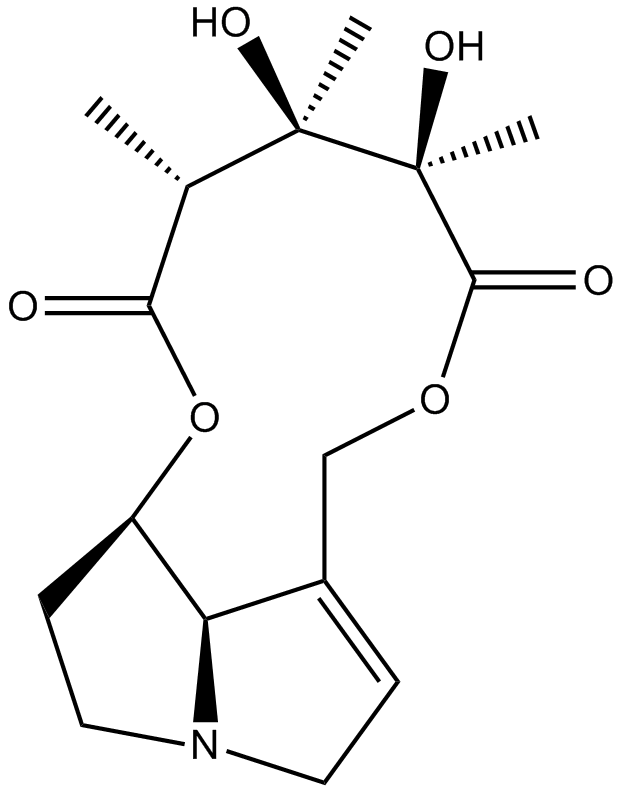
Cas No.: 315-22-0
Sample solution is provided at 25 µL, 10mM.
_1-3.$$$39978408@51.jpg');)
_1-9.$$$38538795@65.jpg');)
_1-9.$$$39112701@51.jpg');)
_1-7.$$$37316672@70.jpg');)
_366-372.$$$36198801@70.jpg');)
.$$$38565142@65.jpg');)
_1867-1883.$$$33248023@67.jpg');)
_eads6055.$$$39977546@45.jpg');)
_eadm9805.$$$40080571@45.jpg');)
_eadj3020.$$$39666821@45.jpg');)
_1-20.$$$39757301@28.jpg');)
_1-24.$$$38898113@28.jpg');)
_273-287.$$$36806353@46.jpg');)
_1-16.$$$37156877@44.jpg');)
_1-19.$$$37460805@44.jpg');)
_1291-1307.$$$34518654@46.jpg');)
Crotaline ist ein Pyrrolizidinalkaloid, das aus den Samen der Pflanze Crotalaria spectabilis extrahiert wird und bei Ratten ein pulmonales Gefäßsyndrom auslöst[1]. Crotaline, ein natürlicher Ligand, zeigt eine dosisabhängige Zytotoxizität mit starker antineoplastischer Wirkung. Die In-vitro-Zytotoxizität von Crotaline wurde mit einem IC50-Wert von 24.966 μg/mL und die Gentoxizität mit dem 2-Fachen des IC50-Werts gegenüber HepG2-Zellen nachgewiesen[2].
In Abwesenheit von HepaRG-Hepatozyten beeinträchtigte Crotaline selbst bei einer heblich hohen Konzentration(1200 μM) nach 24-stündiger Behandlung die Viabilität von HSECs nicht, was auf keine Zytotoxizität hindeutet. Im Gegensatz dazu wurde nach 24-stündiger Behandlung im Zweischicht-Transwell-Kokulturmodell mit HSECs und HepaRG-Hepytozyten eine erhebliche, konzentrationsabhängige Abnahme der HSEC-Viabilität durch Crotaline beobachtet[8].
Crotaline verursacht bei Ratten ein pulmonales Gefäßsyndrom, das durch proliferative pulmonale Vaskulitis, pulmonale Hypertonie(PH) und Cor Pulmonale charakterisiert ist[3]. Nach Crotaline-Injektion wurden Veränderungen in einigen mit der PH-Entwicklung assoziierten Signalwegen beobachtet, darunter eine Aktivierung der Glykolyse, erhöhte Proliferationsmarker, Störungen der Carnitin-Homöostase, erhöhte Entzündungs- und Fibrose-Biomarker sowie eine verminderte Glutathion-Biosynthese[5]. Bei Ratten(14 Tage nach Crotaline-Exposition) wurden Veränderungen in einigen mit der PH-Entwicklung assoziierten Signalwegen beobachtet, darunter eine Aktivierung der Glykolyse, erhöhte Proliferationsmarker, Störungen der Carnitin-Homöostase, erhöhte Entzündungs- und Fibrose-Biomarker sowie eine Reduktion der Glutathion-Biosynthese[4]. Die durch Crotaline induzierte PAH ist eine progressive Erkrankung mit persistierender Entzündung. Die Entzündung im Crotaline -PAH-Modell umfasst ein akutes(die ersten 6 Tage nach Crotaline-Injektion) und ein chronisches Stadium(nach dem akuten Entzündungsstadium). Das akute Entzündungsstadium könnte das Zeitfenster für eine entzündungshemmende Behandlung bei durch Crotaline induzierter PAH sein[6,7].
References:
[1]: Gomez-Arroyo JG, Farkas L, et,al. The monocrotaline model of pulmonary hypertension in perspective. Am J Physiol Lung Cell Mol Physiol. 2012 Feb 15;302(4):L363-9. doi: 10.1152/ajplung.00212.2011. Epub 2011 Sep 30. PMID: 21964406.
[2]: Kusuma SS, Tanneeru K, et,al. Antineoplastic activity of monocrotaline against hepatocellular carcinoma. Anticancer Agents Med Chem. 2014;14(9):1237-48. doi: 10.2174/1871520614666140715085907. PMID: 25028149.
[3]: Wilson DW, Segall HJ, et,al. Mechanisms and pathology of monocrotaline pulmonary toxicity. Crit Rev Toxicol. 1992;22(5-6):307-25. doi: 10.3109/10408449209146311. PMID: 1489509.
[4]: Nogueira-Ferreira R, Vitorino R, et,al. Exploring the monocrotaline animal model for the study of pulmonary arterial hypertension: A network approach. Pulm Pharmacol Ther. 2015 Dec;35:8-16. doi: 10.1016/j.pupt.2015.09.007. Epub 2015 Sep 21. PMID: 26403584.
[5]: Rafikova O, Meadows ML, et,al. Metabolic Changes Precede the Development of Pulmonary Hypertension in the Monocrotaline Exposed Rat Lung. PLoS One. 2016 Mar 3;11(3):e0150480. doi: 10.1371/journal.pone.0150480. PMID: 26937637; PMCID: PMC4777490.
[6]: Tang C, Luo Y, et,al. Characteristics of inflammation process in monocrotaline-induced pulmonary arterial hypertension in rats. Biomed Pharmacother. 2021 Jan;133:111081. doi: 10.1016/j.biopha.2020.111081. Epub 2020 Dec 15. PMID: 33378977.
[7]: Nogueira-Ferreira R, Vitorino R, et,al. Exploring the monocrotaline animal model for the study of pulmonary arterial hypertension: A network approach. Pulm Pharmacol Ther. 2015 Dec;35:8-16. doi: 10.1016/j.pupt.2015.09.007. Epub 2015 Sep 21. PMID: 26403584.
[8]: Lu Y, Ma J, Lin G. Development of a two-layer transwell co-culture model for the in vitro investigation of pyrrolizidine alkaloid-induced hepatic sinusoidal damage. Food Chem Toxicol. 2019 Jul;129:391-398. doi: 10.1016/j.fct.2019.04.057. Epub 2019 May 2. PMID: 31054999.
| Zellexperiment [1]: | |
Zelllinien | HepaRG-Hepatozyten und HSECs |
Vorbereitungsmethode | HSECs wurden mit verschiedenen Konzentrationen von Retrorsine, Crotaline (Monocrotaline) oder Clivorine, gelöst in ECM mit DMSO(0.5% Endkonzentration), oder ECM mit 0.5% DMSO als Lösungsmittelkontrolle in einem zweischichtigen Transwell-Kokulturmodell für 24 Stunden behandelt. |
Reaktionsbedingungen | 100-1200 uM, 24 Stunden |
Anwendungen | In Abwesenheit von HepaRG-Hepatozyten beeinträchtigte Crotaline selbst bei einer erheblich hohen Konzentration(1200 μM) über 24 Stunden die Viabilität von HSECs nicht, was auf keine Zytotoxizität hindeutet. Im Gegensatz dazu wurde nach 24-stündiger Behandlung im Zweischicht-Transwell-Kokulturmodell mit HSECs und HepaRG-Hepatozyten eine erhebliche, konzentrationsabhängige Abnahme der HSEC-Viabilität durch Crotaline beobachtet. |
| Tierversuch [2]: | |
Tiermodelle | 20 männliche Sprague-Dawley-Ratten(SD; 220-270g) |
Vorbereitungsmethode | Die Kontrollgruppe erhielt das Vehikel für Crotaline. Die Gruppe mit präpulmonaler Hypertonie(PH) erhielt eine einmalige Injektion von Crotaline zur Induktion und wurde nach 14 Tagen getötet. |
Dosierungsform | Eine einmalige Injektion von Crotaline 60 mg/kg über 14 Tage |
Anwendungen | Durch die Injektion von Crotaline wurden Veränderungen in einigen Signalwegen beobachtet, die mit der Entwicklung von PH in Zusammenhang stehen. Dazu gehören eine aktivierte Glykolyse, erhöhte Proliferationsmarker, eine Störung der Carnitin-Homöostase, erhöhte Entzündungs- und Fibrose-Biomarker sowie eine verminderte Glutathion-Biosynthese. |
References: | |
| Cas No. | 315-22-0 | SDF | |
| Überlieferungen | Crotaline, MCT, NSC 28693 | ||
| Chemical Name | (3R,4R,5R,8a1R,13aR)-4,5-dihydroxy-3,4,5-trimethyl-4,5,8,8a1,10,12,13,13a-octahydro-2H-[1,6]dioxacycloundecino[2,3,4-gh]pyrrolizine-2,6(3H)-dione | ||
| Canonical SMILES | O=C([C@@](C([H])([H])[H])([H])[C@@]([C@@]1(C([H])([H])[H])O[H])(C([H])([H])[H])O[H])O[C@@]2([H])[C@](C(C([H])([H])OC1=O)=C([H])C3([H])[H])([H])N3C([H])([H])C2([H])[H] | ||
| Formula | C16H23NO6 | M.Wt | 325.15 |
| Löslichkeit | ≥ 67.2 mg/mL in DMSO, ≥ 16.45 mg/mL in ETOH with ultrasonic and warming, ≥ 1.66 mg/mL in Water with ultrasonic and warming | Storage | 4°C, away from moisture and light |
| General tips | Please select the appropriate solvent to prepare the stock solution according to the
solubility of the product in different solvents; once the solution is prepared, please store it in
separate packages to avoid product failure caused by repeated freezing and thawing.Storage method
and period of the stock solution: When stored at -80°C, please use it within 6 months; when stored
at -20°C, please use it within 1 month. To increase solubility, heat the tube to 37°C and then oscillate in an ultrasonic bath for some time. |
||
| Shipping Condition | Evaluation sample solution: shipped with blue ice. All other sizes available: with RT, or with Blue Ice upon request. | ||
| Prepare stock solution | |||

|
1 mg | 5 mg | 10 mg |
| 1 mM | 3.0755 mL | 15.3775 mL | 30.755 mL |
| 5 mM | 615.1 μL | 3.0755 mL | 6.151 mL |
| 10 mM | 307.6 μL | 1.5378 mL | 3.0755 mL |
Step 1: Enter information below (Recommended: An additional animal making an allowance for loss during the experiment)
 g
μL
g
μL
Step 2: Enter the in vivo formulation (This is only the calculator, not formulation. Please contact us first if there is no in vivo formulation at the solubility Section.)
Calculation results:
Working concentration: mg/ml;
Method for preparing DMSO master liquid: mg drug pre-dissolved in μL DMSO ( Master liquid concentration mg/mL, Please contact us first if the concentration exceeds the DMSO solubility of the batch of drug. )
Method for preparing in vivo formulation: Take μL DMSO master liquid, next addμL PEG300, mix and clarify, next addμL Tween 80, mix and clarify, next add μL saline, mix and clarify.
Method for preparing in vivo formulation: Take μL DMSO master liquid, next add μL Corn oil, mix and clarify.
Note: 1. Please make sure the liquid is clear before adding the next solvent.
2. Be sure to add the solvent(s) in order. You must ensure that the solution obtained, in the previous addition, is a clear solution before proceeding to add the next solvent. Physical methods such as vortex, ultrasound or hot water bath can be used to aid dissolving.
3. All of the above co-solvents are available for purchase on the GlpBio website.
Quality Control & SDS
- View current batch:
- Purity: >98.00% Appearance: A solid
- COA (Certificate of Analysis)
- SDS (Safety Data Sheet)
- Datasheet
Average Rating: 5 (Based on Reviews and 30 reference(s) in Google Scholar.)