

FD-1080 |
Katalog-Nr.GC64721
 One-Click Copy Product Info
|

FD-1080 ist ein Fluorophor mit Anregungs- und Emissionswellenlängen im zweiten Nahinfrarotbereich II(NIR-II)(Anregung=1064nm, Emission=1080nm). FD-1080 wird für In-vivo-Bildgebung eingesetzt.
Products are for research use only. Not for human use. We do not sell to patients.
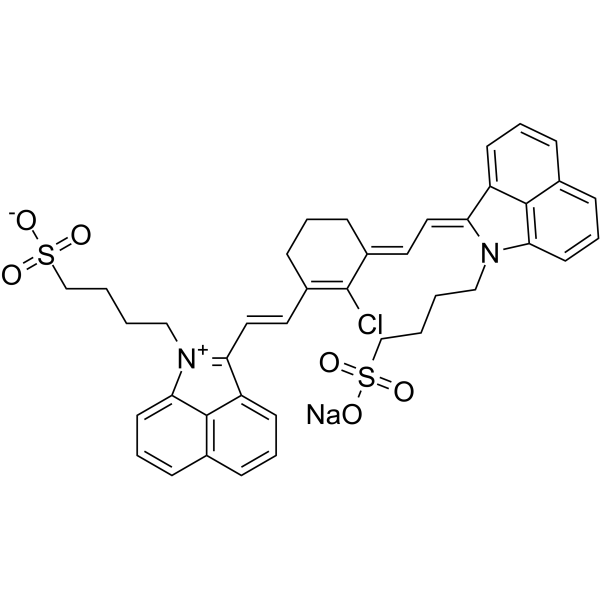
Cas No.: 1151666-58-8
Sample solution is provided at 25 µL, 10mM.
_1-3.$$$39978408@51.jpg');)
_1-9.$$$38538795@65.jpg');)
_1-9.$$$39112701@51.jpg');)
_1-7.$$$37316672@70.jpg');)
_366-372.$$$36198801@70.jpg');)
.$$$38565142@65.jpg');)
_1867-1883.$$$33248023@67.jpg');)
_eads6055.$$$39977546@45.jpg');)
_eadm9805.$$$40080571@45.jpg');)
_eadj3020.$$$39666821@45.jpg');)
_1-20.$$$39757301@28.jpg');)
_1-24.$$$38898113@28.jpg');)
_273-287.$$$36806353@46.jpg');)
_1-16.$$$37156877@44.jpg');)
_1-19.$$$37460805@44.jpg');)
_1291-1307.$$$34518654@46.jpg');)
FD-1080 ist ein Fluorophor mit Anregungs- und Emissionswellenlängen im zweiten Nahinfrarotbereich II(NIR-II)(Anregung=1064nm, Emission=1080nm). FD-1080 wird für In-vivo-Bildgebung eingesetzt[1]. FD-1080 hat eine hohe Quantenausbeute. FD-1080 dringt dief in Gewebe ein. FD-1080 liefert eine gute Ortsauflösung und ein ausgezeichnetes Signal-Rausch-Verhältnis. Zudem erlaubt FD-1080 dynamische Bildaufnahmen[1]. Die Quantenausbeute von FD-1080 steigt in FBS-Lösung auf 5.94% an[2]. Mit FD-1080 lassen sich tief gelegene Gefäße im Hinterbein sowie Hirngefäße nicht-invasiv und mit hoher Auflösung abbilden. Zusätzlich kann man anhand der dynamischen Bildgebung der kraniokaudalen Atembewegung in der Leber die Atemfrequenz berechnen. Das funktioniert sowohl bei wachen als auch bei betäubten Mäusen[3, 4].
References:
[1] Li B, Lu L, Zhao M, et al. An efficient 1064 nm NIR‐II excitation fluorescent molecular dye for deep‐tissue high‐resolution dynamic bioimaging[J]. Angewandte Chemie, 2018, 130(25): 7605-7609.
[2] Zhou H, Xiao Y, Hong X. New NIR-II dyes without a benzobisthiadiazole core[J]. Chinese Chemical Letters, 2018, 29(10): 1425-1428.
[3] He S, Cheng Z. Advancements of second near-infrared biological window fluorophores: Mechanism, synthesis, and application in vivo[J]. Fluorescent Imaging in Medicinal Chemistry, 2020: 81-123.
[4] Ding F, Fan Y, Sun Y, et al. Beyond 1000 nm Emission Wavelength: Recent Advances in Organic and Inorganic Emitters for Deep‐Tissue Molecular Imaging[J]. Advanced Healthcare Materials, 2019, 8(14): 1900260.
Das Protokoll dient nur als Richtlinie. Bitte entsprend den Bedürfnissen ändern.
1. Präparation der Lösungen
(1) Stammlösung: Das tiefgekühlte Festmaterial auf Raumtemperatur äquilibrieren. FD-1080 in DMSO lösen. Eine Stammlösung mit einer Konzentration von 10 mM anfertigen.
Hinweis: Ungenutzte Stammlösung in Aliquote aufteilen und dunkel bei -20°C oder -80°C lagern. Dadurch werden wiederholtes Einfrieren und Auftauen vermieden.
(2) Arbeitslösung: Die Stammlösung mit PBS verdünnen, um eine Arbeitslösung mit einer Konzentration von 2-10 μM anzufertigen. Die Lösung mittels eines 0.2μm Filters sterilisieren.
Hinweis: Bitte die optimale Arbeitskonzentration entsprechend den Versuchsbedingungen ändern. Oder anhand von Literatur selbst Konzentrationsgradienten anlegen. Die Arbeitslösung muss frisch erzeugt und sofort benutzt werden.
2. Zellversuch
(1) Suspensionszellen: Die Zellen durch Zentrifugation sammeln und zweimal mit PBS waschen, jeweils 5 Minuten lang.
Adhärente Zellen: Das Kulturmedium entfernen und die Zellen mit Trypsin verdauen. Zentrifugieren und den Überstand verwerfen. Dann die Zellen zweimal mit PBS waschen, jeweils 5 Minuten lang.
(2) 1mL FD-1080 Arbeitslösung hinzufügen und 10-30 Minuten bei Raumtemperatur inkubieren.
(3) 3-4 Minuten lang mit 400 g bei 4℃ zentrifugieren und den Überstand verwerfen.
(4) Die Zellen zweimal mit PBS waschen, jeweils 5 Minuten lang.
(5) Die Zellen in 1 mL Serum-freiem Medium oder PBS resuspendieren. Dann die Zellen mittels Fluoreszenzmikroskop oder Durchflusszytometrie analysieren.
3. In-vivo-Injektion
(1) 200μL der 80 μM FD-1080 Arbeitslösung den Mäusen intravenös injizieren. 10-20 Minuten nach der Injektion die In-vivo-Bildanalyse durchführen.
| Cas No. | 1151666-58-8 | SDF | |
| Formula | C40H38ClN2NaO6S2 | M.Wt | 765.31 |
| Löslichkeit | Storage | Store at -20°C | |
| General tips | Please select the appropriate solvent to prepare the stock solution according to the
solubility of the product in different solvents; once the solution is prepared, please store it in
separate packages to avoid product failure caused by repeated freezing and thawing.Storage method
and period of the stock solution: When stored at -80°C, please use it within 6 months; when stored
at -20°C, please use it within 1 month. To increase solubility, heat the tube to 37°C and then oscillate in an ultrasonic bath for some time. |
||
| Shipping Condition | Evaluation sample solution: shipped with blue ice. All other sizes available: with RT, or with Blue Ice upon request. | ||
| Prepare stock solution | |||

|
1 mg | 5 mg | 10 mg |
| 1 mM | 1.3067 mL | 6.5333 mL | 13.0666 mL |
| 5 mM | 261.3 μL | 1.3067 mL | 2.6133 mL |
| 10 mM | 130.7 μL | 653.3 μL | 1.3067 mL |
Step 1: Enter information below (Recommended: An additional animal making an allowance for loss during the experiment)
 g
μL
g
μL
Step 2: Enter the in vivo formulation (This is only the calculator, not formulation. Please contact us first if there is no in vivo formulation at the solubility Section.)
Calculation results:
Working concentration: mg/ml;
Method for preparing DMSO master liquid: mg drug pre-dissolved in μL DMSO ( Master liquid concentration mg/mL, Please contact us first if the concentration exceeds the DMSO solubility of the batch of drug. )
Method for preparing in vivo formulation: Take μL DMSO master liquid, next addμL PEG300, mix and clarify, next addμL Tween 80, mix and clarify, next add μL saline, mix and clarify.
Method for preparing in vivo formulation: Take μL DMSO master liquid, next add μL Corn oil, mix and clarify.
Note: 1. Please make sure the liquid is clear before adding the next solvent.
2. Be sure to add the solvent(s) in order. You must ensure that the solution obtained, in the previous addition, is a clear solution before proceeding to add the next solvent. Physical methods such as vortex, ultrasound or hot water bath can be used to aid dissolving.
3. All of the above co-solvents are available for purchase on the GlpBio website.
Quality Control & SDS
- View current batch:
- Purity: >90.00% Appearance: A solid
- COA (Certificate of Analysis)
- SDS (Safety Data Sheet)
- Datasheet
Average Rating: 5 (Based on Reviews and 30 reference(s) in Google Scholar.)