

FD-1080 |
Catalog No.GC64721
 One-Click Copy Product Info
|

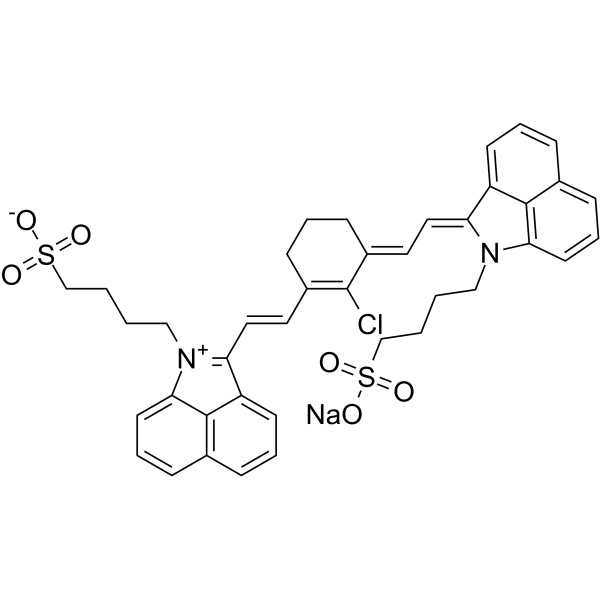
FD-1080 is a fluorophore with excitation and emission light in the second near-infrared region II (NIR-II) (Ex=1064nm, Em=1080nm) that can be used for in vivo imaging.
Products are for research use only. Not for human use. We do not sell to patients.
Cas No.: 1151666-58-8
Sample solution is provided at 25 µL, 10mM.
_1-3.$$$39978408@51.jpg');)
_1-9.$$$38538795@65.jpg');)
_1-9.$$$39112701@51.jpg');)
_1-7.$$$37316672@70.jpg');)
_366-372.$$$36198801@70.jpg');)
.$$$38565142@65.jpg');)
_1867-1883.$$$33248023@67.jpg');)
_eads6055.$$$39977546@45.jpg');)
_eadm9805.$$$40080571@45.jpg');)
_eadj3020.$$$39666821@45.jpg');)
_1-20.$$$39757301@28.jpg');)
_1-24.$$$38898113@28.jpg');)
_273-287.$$$36806353@46.jpg');)
_1-16.$$$37156877@44.jpg');)
_1-19.$$$37460805@44.jpg');)
_1291-1307.$$$34518654@46.jpg');)
FD-1080 is a fluorophore with excitation and emission light in the second near-infrared region II (NIR-II) (Ex=1064nm, Em=1080nm) that can be used for in vivo imaging[1]. FD-1080 has high quantum yield, deep tissue penetration depth, superior spatial resolution, outstanding signal-to-noise ratio, and dynamic imaging capabilities[1]. The quantum yield of FD-1080 in FBS solvent can be increased to 5.94%[2]. FD-1080 can not only achieve non-invasive and high-resolution bioimaging of deep tissue vascular and cerebral vessels in the hind limb, but also quantify respiratory rate based on dynamic imaging of craniocaudal respiratory movement in the liver of awake and anesthetized mice[3, 4].
References:
[1] Li B, Lu L, Zhao M, et al. An efficient 1064 nm NIR‐II excitation fluorescent molecular dye for deep‐tissue high‐resolution dynamic bioimaging[J]. Angewandte Chemie, 2018, 130(25): 7605-7609.
[2] Zhou H, Xiao Y, Hong X. New NIR-II dyes without a benzobisthiadiazole core[J]. Chinese Chemical Letters, 2018, 29(10): 1425-1428.
[3] He S, Cheng Z. Advancements of second near-infrared biological window fluorophores: Mechanism, synthesis, and application in vivo[J]. Fluorescent Imaging in Medicinal Chemistry, 2020: 81-123.
[4] Ding F, Fan Y, Sun Y, et al. Beyond 1000 nm Emission Wavelength: Recent Advances in Organic and Inorganic Emitters for Deep‐Tissue Molecular Imaging[J]. Advanced Healthcare Materials, 2019, 8(14): 1900260.
This plan only provides a guide, please modify it to meet your specific needs.
1. Solution preparation
(1) Stock solution: Equilibrate the cryopreserved solid to room temperature, dissolve FD-1080 in DMSO, and prepare a stock solution with a concentration of 10mM.
Note: It is recommended that unused stock solution be stored at -20°C or -80°C in the dark after aliquoting to avoid repeated freezing and thawing.
(2) Working solution: Dilute the stock solution with PBS to prepare a working solution with a concentration of 2-10μM. Filter and sterilize with a 0.2μm filter.
Note: Please adjust the optimal working concentration according to the actual situation or refer to the literature to set the gradient concentration by yourself. The working solution must be prepared and used immediately.
2. Cell experiment
(1) Suspended cells: Collect cells by centrifugation and wash twice with PBS for 5min each time. Adherent cells: Discard the culture medium and add trypsin to digest the cells. After centrifugation and discarding the supernatant, wash twice with PBS for 5min each time.
(2) Add 1mL FD-1080 working solution and incubate at room temperature for 10-30min.
(3) Centrifuge at 400g, 4℃ for 3-4min and discard the supernatant.
(4) Wash the cells twice with PBS, 5min each time.
(5) Resuspend the cells in 1mL serum-free medium or PBS and examine under a fluorescence microscope or flow cytometer.
3. In vivo injection
(1) Inject 200μL of 80μM FD-1080 working solution intravenously into mice and perform in vivo imaging analysis 10-20min later.
| Cas No. | 1151666-58-8 | SDF | |
| Formula | C40H38ClN2NaO6S2 | M.Wt | 765.31 |
| Solubility | Storage | Store at -20°C | |
| General tips | Please select the appropriate solvent to prepare the stock solution according to the
solubility of the product in different solvents; once the solution is prepared, please store it in
separate packages to avoid product failure caused by repeated freezing and thawing.Storage method
and period of the stock solution: When stored at -80°C, please use it within 6 months; when stored
at -20°C, please use it within 1 month. To increase solubility, heat the tube to 37°C and then oscillate in an ultrasonic bath for some time. |
||
| Shipping Condition | Evaluation sample solution: shipped with blue ice. All other sizes available: with RT, or with Blue Ice upon request. | ||
| Prepare stock solution | |||

|
1 mg | 5 mg | 10 mg |
| 1 mM | 1.3067 mL | 6.5333 mL | 13.0666 mL |
| 5 mM | 261.3 μL | 1.3067 mL | 2.6133 mL |
| 10 mM | 130.7 μL | 653.3 μL | 1.3067 mL |
Step 1: Enter information below (Recommended: An additional animal making an allowance for loss during the experiment)
 g
μL
g
μL
Step 2: Enter the in vivo formulation (This is only the calculator, not formulation. Please contact us first if there is no in vivo formulation at the solubility Section.)
Calculation results:
Working concentration: mg/ml;
Method for preparing DMSO master liquid: mg drug pre-dissolved in μL DMSO ( Master liquid concentration mg/mL, Please contact us first if the concentration exceeds the DMSO solubility of the batch of drug. )
Method for preparing in vivo formulation: Take μL DMSO master liquid, next addμL PEG300, mix and clarify, next addμL Tween 80, mix and clarify, next add μL saline, mix and clarify.
Method for preparing in vivo formulation: Take μL DMSO master liquid, next add μL Corn oil, mix and clarify.
Note: 1. Please make sure the liquid is clear before adding the next solvent.
2. Be sure to add the solvent(s) in order. You must ensure that the solution obtained, in the previous addition, is a clear solution before proceeding to add the next solvent. Physical methods such as vortex, ultrasound or hot water bath can be used to aid dissolving.
3. All of the above co-solvents are available for purchase on the GlpBio website.
Quality Control & SDS
- View current batch:
- Purity: >90.00% Appearance: A solid
- COA (Certificate of Analysis)
- SDS (Safety Data Sheet)
- Datasheet
Average Rating: 5 (Based on Reviews and 30 reference(s) in Google Scholar.)