

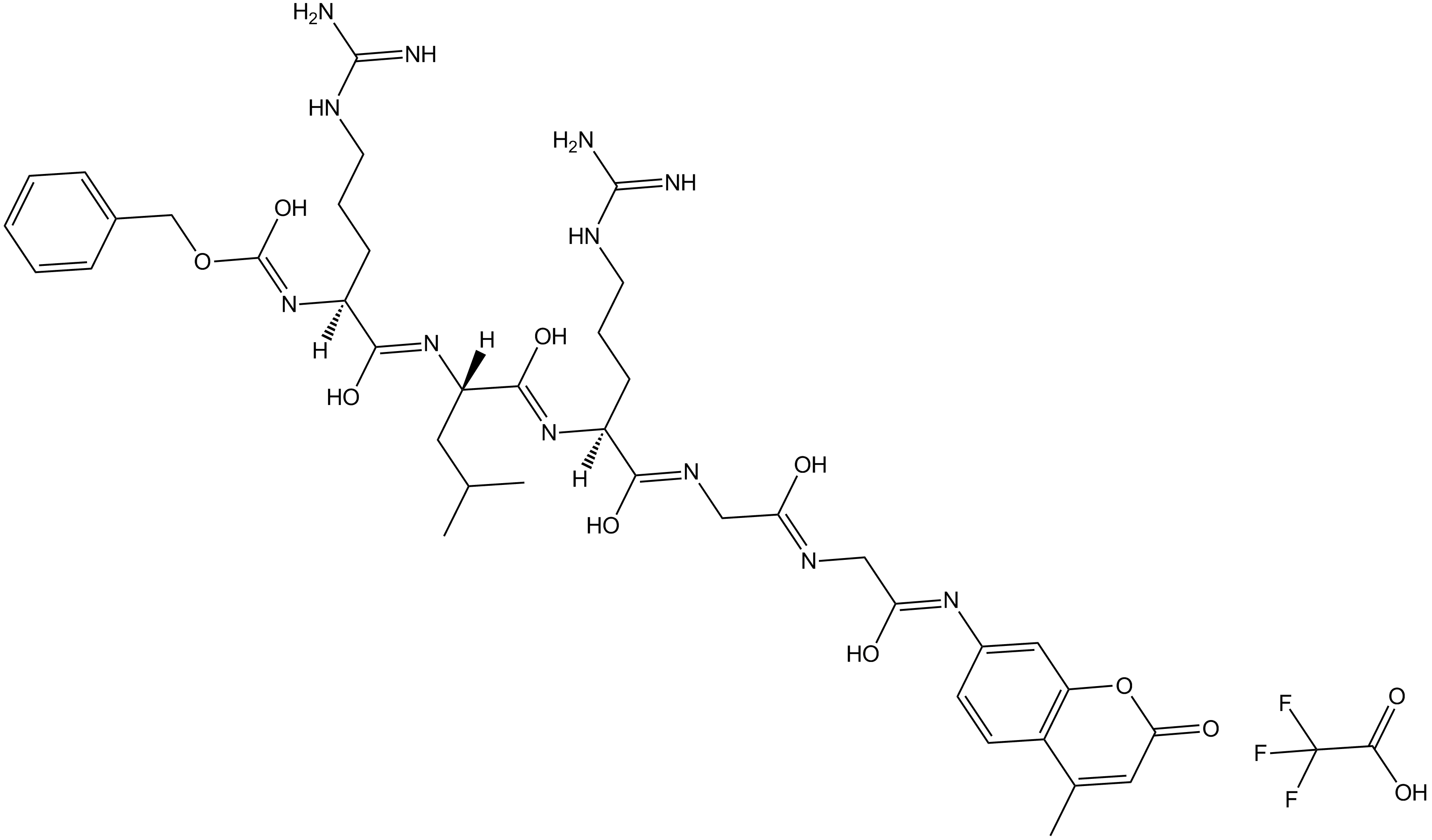
Z-Arg-Leu-Arg-Gly-Gly-AMC |
Katalog-Nr.GA23715
 One-Click Copy Product Info
|

Z-Arg-Leu-Arg-Gly-Gly-AMC (Z-RLRGG-AMC) ist ein Peptidsubstrat von SARS-CoV papain (PLpro), wobei RLRGG die C-terminale Sequenz von Ubiquitin (Ub) ist. Die maxinalen Anregungs-/Emissionswellenlängen von Z-Arg-Leu-Arg-Gly-Gly-AMC betragen 340/450 nm bzw. .
Products are for research use only. Not for human use. We do not sell to patients.
Cas No.: 167698-69-3
Sample solution is provided at 25 µL, 10mM.
Z-Arg-Leu-Arg-Gly-Gly-AMC (Z-RLRGG-AMC) ist ein Peptidsubstrat von SARS-CoV papain (PLpro), wobei RLRGG die C-terminale Sequenz von Ubiquitin (Ub) ist[1, 2]. Die maxinalen Anregungs-/Emissionswellenlängen von Z-Arg-Leu-Arg-Gly-Gly-AMC betragen 340/450 nm bzw. [3].
Z-Arg-Leu-Arg-Gly-Gly-AMC wird hauptsächlich zur Untersuchung der Proteaseaktivität verwendet. Durch die Messung der Flureszenzintensität von freigesetztem 7-Amino-4-methylcumarin (AMC) kann die katalytische Aktivität werden[4]. Z-Arg-Leu-Arg-Gly-Gly-AMC besteht aus einer Pentapeptidsequenz, die an die Fluteszentgruppe AMC gebunden ist. Das "Z" bezeichnet die Benzyloxycarbonyl (Z)-Schutzgruppe, die dazu dient, Aminosäuren vor unspezifischen Reaktionen zu schützen [5].
References:
[1] Báez-Santos Y M, Mielech A M, Deng X, et al. Catalytic function and substrate specificity of the papain-like protease domain of nsp3 from the Middle East respiratory syndrome coronavirus[J]. Journal of virology, 2014, 88(21): 12511-12527.
[2] Li L, Ma L, Hu Y, et al. Natural biflavones are potent inhibitors against SARS-CoV-2 papain-like protease[J]. Phytochemistry, 2022, 193: 112984.
[3] Fu Z, Huang B, Tang J, et al. The complex structure of GRL0617 and SARS-CoV-2 PLpro reveals a hot spot for antiviral drug discovery[J]. Nature communications, 2021, 12(1): 488.
[4] Wang C, Chen S, Yeo S, et al. Elevated p62/SQSTM1 determines the fate of autophagy-deficient neural stem cells by increasing superoxide[J]. Journal of Cell Biology, 2016, 212(5): 545-560.
[5] Kadereit D, Waldmann H. Enzymatic protecting group techniques[J]. Chemical Reviews, 2001, 101(11): 3367-3396.
Dieser Plan enthält nur einen Leitfaden, bitte ändern ihn an Ihre spezifischen Bedürfnnisse.
1.Vorbereitung der Lösung:
(1) Stammlösung: Z-Arg-Leu-Arg-Gly-Gly-AMC in DMSO bis zu einer Endkonzentration von 1 mM auflösen.
Hinweis: Aliquotieren die unbenutzte Stammlösung und lagern sie bei -20°C im Dunkeln. Vermeiden wiederholte Frost-Tau-Zyklen.
(2) Arbeitslösung: Die Stammlösung mit Assay-Puffer auf die gewünschte Arbeitskonzentration verdünnen.
Hinweis: Stellen die optimale Arbeitskonzentration entsprechend den tatsächlichen Bedingungen ein oder beziehen sich auf die Literatur für Gradientenkonzentrationstests. Die Arbeitslösung muss für jeden Gebrauch frisch zubereitet werden.
2. Schritte zur Messung der PLpro Activity Using Z-Arg-Leu-Arg-Gly-Gly-AMC[1] (aus der Literautur, nur als Referenz):
(1) Bereiten den Assay-Puffer von, der 50 mM HEPES (pH 7,4), 0,01 % Triton X-100 (v/v), 0.1 mg/mL BSA, and 2 mM DTT enthält. Richten das Reaktionssystem in einer 384-Well-Platte mit einem endgültigen Reaktionsvolumen von 50 μL per well ein.
(2) Geben PLpro in jede Vertiefung bis zu einer Endkonzentration von 100 nM.
(3) Geben 5 μL Z-Arg-Leu-Arg-Gly-Gly-AMC-Stammlösung in jede Vertiefung, um eine Endkonzentration von 50 μM zu erreichen.
(4) Die Substrathydrolyse wurde mit einem Mikroplatten-Reader überwacht. Die Anregungswellenlänge beträgt 340 nm und die Emissionswellenlänge 450 nm. Zeichnen das Flureszenzsignal alle 3 Minuten auf.
Hinweis: Dieses Protokoll enthält eine Anleitung zur Messung der PLpro-Aktivität mit Z-Arg-Leu-Arg-Gly-Gly-AMC. Anpassungen können entsprechend anderer Literatur und spezifischen experimentellen Anforderungen vorgenommen werden.
References:
[1]Fu Z, Huang B, Tang J, et al. The complex structure of GRL0617 and SARS-CoV-2 PLpro reveals a hot spot for antiviral drug discovery[J]. Nature communications, 2021, 12(1): 488.
| Cas No. | 167698-69-3 | SDF | |
| Formula | C40H56N12O9 | M.Wt | 848.96 |
| Löslichkeit | Soluble in DMSO | Storage | Store at -20°C |
| General tips | Please select the appropriate solvent to prepare the stock solution according to the
solubility of the product in different solvents; once the solution is prepared, please store it in
separate packages to avoid product failure caused by repeated freezing and thawing.Storage method
and period of the stock solution: When stored at -80°C, please use it within 6 months; when stored
at -20°C, please use it within 1 month. To increase solubility, heat the tube to 37°C and then oscillate in an ultrasonic bath for some time. |
||
| Shipping Condition | Evaluation sample solution: shipped with blue ice. All other sizes available: with RT, or with Blue Ice upon request. | ||
| Prepare stock solution | |||

|
1 mg | 5 mg | 10 mg |
| 1 mM | 1.1779 mL | 5.8896 mL | 11.7791 mL |
| 5 mM | 235.6 μL | 1.1779 mL | 2.3558 mL |
| 10 mM | 117.8 μL | 589 μL | 1.1779 mL |
Step 1: Enter information below (Recommended: An additional animal making an allowance for loss during the experiment)
 g
μL
g
μL
Step 2: Enter the in vivo formulation (This is only the calculator, not formulation. Please contact us first if there is no in vivo formulation at the solubility Section.)
Calculation results:
Working concentration: mg/ml;
Method for preparing DMSO master liquid: mg drug pre-dissolved in μL DMSO ( Master liquid concentration mg/mL, Please contact us first if the concentration exceeds the DMSO solubility of the batch of drug. )
Method for preparing in vivo formulation: Take μL DMSO master liquid, next addμL PEG300, mix and clarify, next addμL Tween 80, mix and clarify, next add μL saline, mix and clarify.
Method for preparing in vivo formulation: Take μL DMSO master liquid, next add μL Corn oil, mix and clarify.
Note: 1. Please make sure the liquid is clear before adding the next solvent.
2. Be sure to add the solvent(s) in order. You must ensure that the solution obtained, in the previous addition, is a clear solution before proceeding to add the next solvent. Physical methods such as vortex, ultrasound or hot water bath can be used to aid dissolving.
3. All of the above co-solvents are available for purchase on the GlpBio website.
Quality Control & SDS
- View current batch:
- Purity: >98.00% Appearance: A solid
- COA (Certificate of Analysis)
- SDS (Safety Data Sheet)
- Datasheet
Average Rating: 5 (Based on Reviews and 4 reference(s) in Google Scholar.)