

Cl-amidine |
Katalog-Nr.GC35706
 One-Click Copy Product Info
|

Cl-Amidin ist ein oral aktiver Peptidylarginin-Deminase (PAD)-Inhibitor mit IC50-Werten von 0,8 μM, 6,2 μM und 5,9 μM fÜr PAD1, PAD3 bzw. PAD4.
Products are for research use only. Not for human use. We do not sell to patients.
Cas No.: 913723-61-2
Sample solution is provided at 25 µL, 10mM.
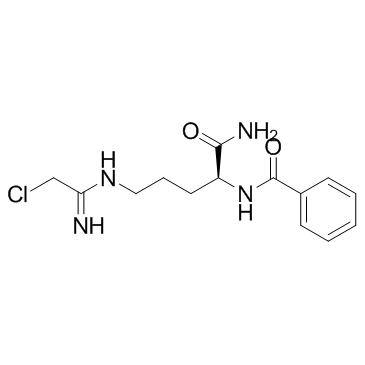
Cl-amidine (N-α-benzoyl-N5-(2-chloro-1-iminoethyl)-l-ornithine amide), is a PAD4 inactivator with enhanced potency. PAD Inhibitor was proved to exhibit enhanced cell killing in PAD-expressing osteosarcoma cells and block the formation of neutrophil extracellular traps. Cl-amidine, as a PAD inhibitor, could reduce the clinical signs and symptoms of colitis, and induced apoptosis of inflammatory cells. The inhibition of PAD by Cl-amidine markedly suppresses the production of CitH3, and neutralization of CitH3 improves survival markedly in septic mice.[1][2]
Cl-amidine is a more potent inhibitor of PAD which has the IC50 of 5.9 ± 0.3 μM. In vitro experiment indicated that Cl-amidine caused a cell cycle arrest at the G1 phase and miRNA-16 induction through a p53-mediated mechanism. In vivo experiment demonstrated that the enhancement of the p300GBD–GRIP1 interaction mediated by PAD4 was antagonized by Cl-amidine in a dose-dependent manner, and that Cl-amidine treatment caused only a minimal reduction in the efficiency of the interaction, indicating that the inhibitory effect of this compound targeted at the active PAD4 enzyme.[1][3]
References:
[1]. Luo Y, et al. Inhibitors and inactivators of protein arginine deiminase 4: functional and structural characterization. Biochemistry. 2006 Oct 3;45(39):11727-36.
[2].Ting Z, et al. Protective effect of Cl-amidine against CLP-induced lethal septic shock in mice. Sci Rep. 2016; 6: 36696
[3].Cui X, et al. The induction of microRNA-16 in colon cancer cells by protein arginine deiminase inhibition causes a p53-dependent cell cycle arrest. PLoS One. 2013;8(1):e53791.
| Cell experiment [1]: | |
|
Cell lines |
HCT 116 wild-type (WT) colon cancer cells, HCT 116 p53−/− colon carcinoma cells, LS-180 colon cancer cells |
|
Preparation Method |
HCT 116 WT and p53−/− cells were cultured in McCoy's medium supplemented with 10% Newborn Calf Serum, 2 mM glutamine, penicillin (10 U/ml) and streptomycin (10 μg/ml). LS-180 colon cancer cells were cultured in DMEM Medium supplemented with 10% Newborn Calf Serum, 2 mM glutamine, penicillin (10 U/mL) and streptomycin (10 μg/mL). |
|
Reaction Conditions |
1×10⁶ were incubated in 6 well plates in McCoy's 5A medium 1 day before treatment and then treated with 50 µg/mL Cl-amidine. The cells were harvested and fixed with ice cold ethanol. After washing with 1x PBS containing 0.5% BSA twice, the cells were incubated with DNA staining solution consisting of Propidium Iodide (PI; 10 µg/mL) and RNase (0.1 mg/mL) for 30 min at room temperature in the dark. |
|
Applications |
Cl-amidine could lead to a cell cycle arrest at the G1 phase through a p53-mediated mechanism. Cl-amidine could cause miRNA-16 induction in a p53-dependent manner. |
| Animal experiment [2]: | |
|
Animal models |
Male C57BL/6J mice (18–26 g) |
|
Preparation Method |
Mice were injected with intra-peritoneal Cl-amidine dissolved in DMSO, or vehicle DMSO 1 h after cecal ligation and puncture (CLP). DMSO was also injected into mice that were not subjected to CLP (n = 12/group). Mortality was monitored for 10 days after surgeries. |
|
Dosage form |
40 mg/kg |
|
Applications |
Cl-amidine protects mice from sepsis-induced lethality. The inhibition of PAD by Cl-amidine significantly suppresses the CitH3 production, while the CitH3 neutralization markedly improves the survival in septic mice. |
|
References: [1]. Cui X, et al. The induction of microRNA-16 in colon cancer cells by protein arginine deiminase inhibition causes a p53-dependent cell cycle arrest. PLoS One. 2013;8(1):e53791. [2]. Ting Z, et al. Protective effect of Cl-amidine against CLP-induced lethal septic shock in mice. Sci Rep. 2016; 6: 36696. |
|
| Cas No. | 913723-61-2 | SDF | |
| Canonical SMILES | O=C(N[C@H](C(N)=O)CCCNC(CCl)=N)C1=CC=CC=C1 | ||
| Formula | C14H19ClN4O2 | M.Wt | 310.78 |
| Löslichkeit | Soluble in DMSO | Storage | Store at -20°C |
| General tips | Please select the appropriate solvent to prepare the stock solution according to the
solubility of the product in different solvents; once the solution is prepared, please store it in
separate packages to avoid product failure caused by repeated freezing and thawing.Storage method
and period of the stock solution: When stored at -80°C, please use it within 6 months; when stored
at -20°C, please use it within 1 month. To increase solubility, heat the tube to 37°C and then oscillate in an ultrasonic bath for some time. |
||
| Shipping Condition | Evaluation sample solution: shipped with blue ice. All other sizes available: with RT, or with Blue Ice upon request. | ||
| Prepare stock solution | |||

|
1 mg | 5 mg | 10 mg |
| 1 mM | 3.2177 mL | 16.0886 mL | 32.1771 mL |
| 5 mM | 643.5 μL | 3.2177 mL | 6.4354 mL |
| 10 mM | 321.8 μL | 1.6089 mL | 3.2177 mL |
Step 1: Enter information below (Recommended: An additional animal making an allowance for loss during the experiment)
 g
μL
g
μL
Step 2: Enter the in vivo formulation (This is only the calculator, not formulation. Please contact us first if there is no in vivo formulation at the solubility Section.)
Calculation results:
Working concentration: mg/ml;
Method for preparing DMSO master liquid: mg drug pre-dissolved in μL DMSO ( Master liquid concentration mg/mL, Please contact us first if the concentration exceeds the DMSO solubility of the batch of drug. )
Method for preparing in vivo formulation: Take μL DMSO master liquid, next addμL PEG300, mix and clarify, next addμL Tween 80, mix and clarify, next add μL saline, mix and clarify.
Method for preparing in vivo formulation: Take μL DMSO master liquid, next add μL Corn oil, mix and clarify.
Note: 1. Please make sure the liquid is clear before adding the next solvent.
2. Be sure to add the solvent(s) in order. You must ensure that the solution obtained, in the previous addition, is a clear solution before proceeding to add the next solvent. Physical methods such as vortex, ultrasound or hot water bath can be used to aid dissolving.
3. All of the above co-solvents are available for purchase on the GlpBio website.
Quality Control & SDS
- View current batch:
- Purity: >97.00% Appearance: A solid
- COA (Certificate of Analysis)
- SDS (Safety Data Sheet)
- Datasheet
Average Rating: 5 (Based on Reviews and 30 reference(s) in Google Scholar.)