

MK-0812 Succinate |
Katalog-Nr.GC36622
 One-Click Copy Product Info
|

MK-0812 Succinat ist ein potenter und selektiver CCR2-Antagonist mit hoher AffinitÄt zu CCR2.
Products are for research use only. Not for human use. We do not sell to patients.
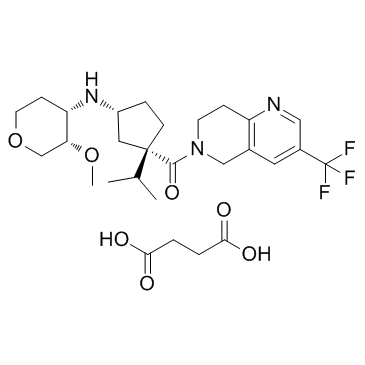
Cas No.: 851916-42-2
Sample solution is provided at 25 µL, 10mM.
MK-0812 Succinate is a potent and selective CCR2 antagonist with high affinity at CCR2. CCR2
MK-0812 is a potent and selective CCR2 antagonist[1]. MK-0812 completely blocks all MCP-1 mediated response in a concentration dependent manner, with an IC50 of 3.2 nM. This value is similar to the potency observed for the inhibition of 125I-MCP-1 binding by MK-0812 on isolated monocytes (IC50 4.5 nM). In fact, MK-0812 not only completely blocks the shape change response to exogenous MCP-1, but also results in a monocyte forward scatter measurement below unstimulated or basal levels. The addition of MK-0812 to rhesus blood also inhibits MCP-1 induced monocyte shape change. The IC50 for MK-0812 in whole blood assays is 8 nM[2]
MK-0812 (30 mg/kg, p.o.) reduces the frequency of Ly6G-Ly6Chi monocytes in the peripheral blood, while no impact on circulating Ly6G+Ly6C+ neutrophil frequency is observed. In addition, MK-0812 treatment causes a dose-dependent reduction in circulating Ly6Chi monocytes and a corresponding elevation in the CCR2 ligand CCL2[1]. MK-0812 is administered by continuous i.v. infusion to maintain a constant level of the drug in blood[2].
[1]. Min SH, et al. Pharmacological targeting reveals distinct roles for CXCR2/CXCR1 and CCR2 in a mouse model of arthritis.Biochem Biophys Res Commun. 2010 Jan 1;391(1):1080-6. [2]. Wisniewski T, et al. Assessment of chemokine receptor function on monocytes in whole blood: In vitro and ex vivo evaluations of a CCR2 antagonist.J Immunol Methods. 2010 Jan 31;352(1-2):101-10.
|
Animal experiment: |
Mice[1]Female BALB/c mice are used between 8 and 10 weeks of age. SCH563705 or MK-0812 are administered in a 0.4% methylcellulose (MC) solution by 30 mg/kg oral gavage (p.o.). Two hours later, the frequency of CD11b+Ly6G-Ly6Chi monocytes and CD11b+Ly6G+Ly6C+ neutrophils is determined by flow cytometry[1]. |
|
References: [1]. Min SH, et al. Pharmacological targeting reveals distinct roles for CXCR2/CXCR1 and CCR2 in a mouse model of arthritis.Biochem Biophys Res Commun. 2010 Jan 1;391(1):1080-6. |
|
| Cas No. | 851916-42-2 | SDF | |
| Canonical SMILES | O=C([C@]1(C(C)C)C[C@H](N[C@H]2CCOC[C@H]2OC)CC1)N3CCC(N=CC(C(F)(F)F)=C4)=C4C3.O=C(O)CCC(O)=O | ||
| Formula | C28H40F3N3O7 | M.Wt | 587.63 |
| Löslichkeit | DMSO: ≥ 32 mg/mL (54.46 mM) | Storage | Store at -20°C |
| General tips | Please select the appropriate solvent to prepare the stock solution according to the
solubility of the product in different solvents; once the solution is prepared, please store it in
separate packages to avoid product failure caused by repeated freezing and thawing.Storage method
and period of the stock solution: When stored at -80°C, please use it within 6 months; when stored
at -20°C, please use it within 1 month. To increase solubility, heat the tube to 37°C and then oscillate in an ultrasonic bath for some time. |
||
| Shipping Condition | Evaluation sample solution: shipped with blue ice. All other sizes available: with RT, or with Blue Ice upon request. | ||
| Prepare stock solution | |||

|
1 mg | 5 mg | 10 mg |
| 1 mM | 1.7018 mL | 8.5088 mL | 17.0175 mL |
| 5 mM | 340.4 μL | 1.7018 mL | 3.4035 mL |
| 10 mM | 170.2 μL | 850.9 μL | 1.7018 mL |
Step 1: Enter information below (Recommended: An additional animal making an allowance for loss during the experiment)
 g
μL
g
μL
Step 2: Enter the in vivo formulation (This is only the calculator, not formulation. Please contact us first if there is no in vivo formulation at the solubility Section.)
Calculation results:
Working concentration: mg/ml;
Method for preparing DMSO master liquid: mg drug pre-dissolved in μL DMSO ( Master liquid concentration mg/mL, Please contact us first if the concentration exceeds the DMSO solubility of the batch of drug. )
Method for preparing in vivo formulation: Take μL DMSO master liquid, next addμL PEG300, mix and clarify, next addμL Tween 80, mix and clarify, next add μL saline, mix and clarify.
Method for preparing in vivo formulation: Take μL DMSO master liquid, next add μL Corn oil, mix and clarify.
Note: 1. Please make sure the liquid is clear before adding the next solvent.
2. Be sure to add the solvent(s) in order. You must ensure that the solution obtained, in the previous addition, is a clear solution before proceeding to add the next solvent. Physical methods such as vortex, ultrasound or hot water bath can be used to aid dissolving.
3. All of the above co-solvents are available for purchase on the GlpBio website.
Quality Control & SDS
- View current batch:
- Purity: >98.00% Appearance: A solid
- COA (Certificate of Analysis)
- SDS (Safety Data Sheet)
- Datasheet
Average Rating: 5 (Based on Reviews and 40 reference(s) in Google Scholar.)