

N-Boc-Phe-Leu-Phe-Leu-Phe (Synonyms: Boc-FLFLF) |
Katalog-Nr.GC36706
 One-Click Copy Product Info
|

N-Boc-Phe-Leu-Phe-Leu-Phe (Boc-FLFLF) ist ein Antagonist des Formylpeptidrezeptors 1 (FPR1), der die Schmerzwirkung verstÄrkt und die antinozizeptive AktivitÄt von Annexin hemmt.
Products are for research use only. Not for human use. We do not sell to patients.
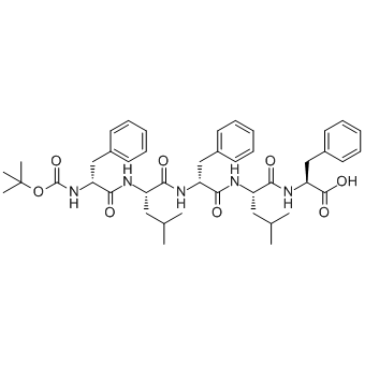
Cas No.: 148182-34-7
Sample solution is provided at 25 µL, 10mM.
_1-3.$$$39978408@51.jpg');)
_1-9.$$$38538795@65.jpg');)
_1-9.$$$39112701@51.jpg');)
_1-7.$$$37316672@70.jpg');)
_366-372.$$$36198801@70.jpg');)
.$$$38565142@65.jpg');)
_1867-1883.$$$33248023@67.jpg');)
_eads6055.$$$39977546@45.jpg');)
_eadm9805.$$$40080571@45.jpg');)
_eadj3020.$$$39666821@45.jpg');)
_1-20.$$$39757301@28.jpg');)
_1-24.$$$38898113@28.jpg');)
_273-287.$$$36806353@46.jpg');)
_1-16.$$$37156877@44.jpg');)
_1-19.$$$37460805@44.jpg');)
_1291-1307.$$$34518654@46.jpg');)
N-Boc-Phe-Leu-Phe-Leu-Phe is an antagonist of formyl peptide receptor (FPR) 1, with the apparent dissociation constant KD of 230nM[1]. N-Boc-Phe-Leu-Phe-Leu-Phe inhibits neutrophil chemotaxis induced by FPR1, and suppresses the production of superoxide[2]. N-Boc-Phe-Leu-Phe-Leu-Phe has been widely used as a model compound to develop a series of derivatives and is employed as a positron emission tomography imaging agent[1,3].
In vitro, N-Boc-Phe-Leu-Phe-Leu-Phe treatment at 120μM for 48h inhibited VEGF-A165-mediated human umbilical vein endothelial cell (HUVEC) proliferation and blocked the activation of the downstream secondary signaling mediators EKR1/2 and AKT[4]. Treatment of rat conjunctival goblet cells with N-Boc-Phe-Leu-Phe-Leu-Phe (0.1mM) for 30 minutes would affect the intracellular calcium ion concentration regulated by Maresin 2 and reduce the response of lipoxin (LX) A4[5].
In, vivo, N-Boc-Phe-Leu-Phe-Leu-Phe treatment via intraperitoneal injections (1mg/kg) twice a week for 8 weeks significantly inhibited the anti-fibrotic effect of Ac2-26 in mice with liver fibrosis and promoted liver inflammation induced by CCl4[6]. Intraperitoneal injection of N-Boc-Phe-Leu-Phe-Leu-Phe (1μl; 10mM) every other day for 6 consecutive days can block the renal injury repair effect of BML-111 in the diabetic mouse model[7].
References:
[1] Hayashi R, Kitajima T, Mizuguchi H, et al. Development of potent antagonists for formyl peptide receptor 1 based on Boc-Phe-D-Leu-Phe-D-Leu-Phe-OH[J]. Bioorganic & Medicinal Chemistry, 2014, 22(15): 3824-3828.
[2] Stenfeldt A L, Karlsson J, Wennerås C, et al. Cyclosporin H, Boc-MLF and Boc-FLFLF are antagonists that preferentially inhibit activity triggered through the formyl peptide receptor[J]. Inflammation, 2007, 30(6): 224-229.
[3] Dalpiaz A, Ferretti M E, Vertuani G, et al. C-and N-terminal residue effect on peptide derivatives' antagonism toward the formyl-peptide receptor[J]. European journal of pharmacology, 2002, 436(3): 187-196.
[4] Nawaz I M, Chiodelli P, Rezzola S, et al. N-tert-butyloxycarbonyl-Phe-Leu-Phe-Leu-Phe (BOC2) inhibits the angiogenic activity of heparin-binding growth factors[J]. Angiogenesis, 2018, 21(1): 47-59.
[5] Olsen M V, Lyngstadaas A V, Bair J A, et al. Signaling pathways used by the specialized pro-resolving mediator maresin 2 regulate goblet cell function: Comparison with maresin 1[J]. International journal of molecular sciences, 2022, 23(11): 6233.
[6] Fan J H, Luo N, Liu G F, et al. Mechanism of annexin A1/N-formylpeptide receptor regulation of macrophage function to inhibit hepatic stellate cell activation through Wnt/β-catenin pathway[J]. World Journal of Gastroenterology, 2023, 29(22): 3422.
[7] Hao H, Xie F, Xu F, et al. LipoxinA4 analog BML-111 protects podocytes cultured in high-glucose medium against oxidative injury via activating Nrf2 pathway[J]. International Immunopharmacology, 2022, 111: 109170.
| Cell experiment [1]: | |
Cell lines | Human umbilical vein endothelial cells (HUVECs) |
Preparation Method | HUVECs were cultured on a plate coated with porcine gelatin, in M199 medium supplemented with 20% FCS, endothelial cell growth factor (10μg/mL) and porcine heparin (100μg/mL). The cells were cultured in a humidified 37°C incubator with 5% CO2. The medium was changed every 2-3 days until the cells reached confluence. HUVECs were seeded at a density of 1.7 × 10⁴ cells/cm2 and incubated under serum starvation conditions overnight. Then, in the presence of 2.5% FCS, the cells were treated with 30ng/mL VEGF-A165 and increasing concentrations of N-Boc-Phe-Leu-Phe-Leu-Phe (0, 3, 7.5, 15, 30, 60, and 120μM) to stimulate the cells. After 48 hours, the cells were counted using a fluorescence counter. |
Reaction Conditions | 0, 3, 7.5, 15, 30, 60, and 120μM; 48h |
Applications | N-Boc-Phe-Leu-Phe-Leu-Phe treatment significantly inhibited VEGF-A165-mediated HUVEC proliferation in a dose-dependent manner. |
| Animal experiment [2]: | |
Animal models | C57BL/6 mice |
Preparation Method | Six to eight-week-old C57BL/6 mice (weighing 18-25g) were raised in a constant temperature and humidity room with a 12-hour day-night cycle. Thirty-two mice were randomly divided into four subgroups, with eight mice in each group: the control group, the CCl4-induced liver fibrosis group, the liver fibrosis + Ac2-26 group, and the liver fibrosis + Ac2-26 + N-Boc-Phe-Leu-Phe-Leu-Phe-Leu-Phe group. The control group mice were intraperitoneally injected with olive oil, and the other three subgroups were intraperitoneally injected twice a week with 20% CCl4 (500mL) and CCl4 + Ac2-26 at 1mg/kg, with or without N-Boc-Phe-Leu-Phe-Leu-Phe-Leu-Phe at 1mg/kg. At 8 weeks after injection, the mice were anesthetized with pentobarbital sodium (50mg/kg intravenous injection) and liver tissue samples were collected for analysis. |
Dosage form | 1mg/kg twice a week for 8 weeks; i.p. |
Applications | N-Boc-Phe-Leu-Phe-Leu-Phe-Leu-Phe treatment inhibited the anti-liver fibrosis effect of Ac2-26 and promoted the liver inflammation induced by CCl4 in mice. |
References: | |
| Cas No. | 148182-34-7 | SDF | |
| Überlieferungen | Boc-FLFLF | ||
| Formula | C44H59N5O8 | M.Wt | 785.97 |
| Löslichkeit | Water: < 0.1 mg/mL (insoluble) | Storage | Store at -20°C |
| General tips | Please select the appropriate solvent to prepare the stock solution according to the
solubility of the product in different solvents; once the solution is prepared, please store it in
separate packages to avoid product failure caused by repeated freezing and thawing.Storage method
and period of the stock solution: When stored at -80°C, please use it within 6 months; when stored
at -20°C, please use it within 1 month. To increase solubility, heat the tube to 37°C and then oscillate in an ultrasonic bath for some time. |
||
| Shipping Condition | Evaluation sample solution: shipped with blue ice. All other sizes available: with RT, or with Blue Ice upon request. | ||
| Prepare stock solution | |||

|
1 mg | 5 mg | 10 mg |
| 1 mM | 1.2723 mL | 6.3616 mL | 12.7231 mL |
| 5 mM | 254.5 μL | 1.2723 mL | 2.5446 mL |
| 10 mM | 127.2 μL | 636.2 μL | 1.2723 mL |
Step 1: Enter information below (Recommended: An additional animal making an allowance for loss during the experiment)
 g
μL
g
μL
Step 2: Enter the in vivo formulation (This is only the calculator, not formulation. Please contact us first if there is no in vivo formulation at the solubility Section.)
Calculation results:
Working concentration: mg/ml;
Method for preparing DMSO master liquid: mg drug pre-dissolved in μL DMSO ( Master liquid concentration mg/mL, Please contact us first if the concentration exceeds the DMSO solubility of the batch of drug. )
Method for preparing in vivo formulation: Take μL DMSO master liquid, next addμL PEG300, mix and clarify, next addμL Tween 80, mix and clarify, next add μL saline, mix and clarify.
Method for preparing in vivo formulation: Take μL DMSO master liquid, next add μL Corn oil, mix and clarify.
Note: 1. Please make sure the liquid is clear before adding the next solvent.
2. Be sure to add the solvent(s) in order. You must ensure that the solution obtained, in the previous addition, is a clear solution before proceeding to add the next solvent. Physical methods such as vortex, ultrasound or hot water bath can be used to aid dissolving.
3. All of the above co-solvents are available for purchase on the GlpBio website.
Quality Control & SDS
- View current batch:
- Purity: >98.00% Appearance: A solid
- COA (Certificate of Analysis)
- SDS (Safety Data Sheet)
- Datasheet
Average Rating: 5 (Based on Reviews and 15 reference(s) in Google Scholar.)