

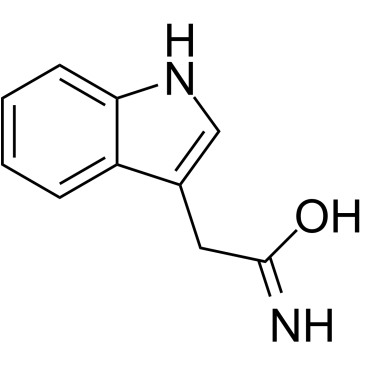
Indole-3-acetamide (Synonyms: IAM, NSC 1969) |
Katalog-Nr.GC38268
 One-Click Copy Product Info
|

Indol-3-acetamid ist ein Biosynthese-Zwischenprodukt der Indol-3-essigsÄure.
Products are for research use only. Not for human use. We do not sell to patients.
Cas No.: 879-37-8
Sample solution is provided at 25 µL, 10mM.
_1-3.$$$39978408@51.jpg');)
_1-9.$$$38538795@65.jpg');)
_1-9.$$$39112701@51.jpg');)
_1-7.$$$37316672@70.jpg');)
_366-372.$$$36198801@70.jpg');)
.$$$38565142@65.jpg');)
_1867-1883.$$$33248023@67.jpg');)
_eads6055.$$$39977546@45.jpg');)
_eadm9805.$$$40080571@45.jpg');)
_eadj3020.$$$39666821@45.jpg');)
_1-20.$$$39757301@28.jpg');)
_1-24.$$$38898113@28.jpg');)
_273-287.$$$36806353@46.jpg');)
_1-16.$$$37156877@44.jpg');)
_1-19.$$$37460805@44.jpg');)
_1291-1307.$$$34518654@46.jpg');)
Indole-3-acetamide is a biosynthesis intermediate of indole-3-acetic acid[1]. Indole-3-acetamide is formed directly from tryptophan by tryptophan monooxygenase or, indirectly, through indole-3-acetonitrile or indole-3-acetaldoxime intermediates, and converted to indole-3-acetic acid(IAA) by amidase[2]. IAA is the most common natural plant growth hormone of the auxin class, mainly regulating growth and development in plants and microorganisms by binding to the auxin receptor TIR1[3][4]. Indole-3-acetamide is usually used in the fileds of plant growth regulation, biochemistry, intestinal microbiota metabolism[5-7].
In vitro, treatment of HepG2 cells with Indole-3-acetamide (0-600米M) for 12 hours bolstered cell viability, decreased levels of ALT, AST, TC, and TG, reduced ROS production, attenuated EtOH-induced oxidative damage, activated AhR gene and protein expression, and significantly upregulated ADH and ALDH gene expression while downregulating inflammatory gene expression[6].
References:
[1]?Lehmann, T., Hoffmann, M., Hentrich, M., & Pollmann, S. (2010). Indole-3-acetamide-dependent auxin biosynthesis: a widely distributed way of indole-3-acetic acid production?. European journal of cell biology, 89(12), 895每905.
[2]?P谷rez-Alonso, M. M., Ortiz-Garc赤a, P., Moya-Cuevas, J., Lehmann, T., S芍nchez-Parra, B., Bj?rk, R. G., Karim, S., Amirjani, M. R., Aronsson, H., Wilkinson, M. D., & Pollmann, S. (2021). Endogenous indole-3-acetamide levels contribute to the crosstalk between auxin and abscisic acid, and trigger plant stress responses in Arabidopsis. Journal of experimental botany, 72(2), 459每475.
[3]?Dimkpa, C. O., Zeng, J., McLean, J. E., Britt, D. W., Zhan, J., & Anderson, A. J. (2012). Production of indole-3-acetic acid via the indole-3-acetamide pathway in the plant-beneficial bacterium Pseudomonas chlororaphis O6 is inhibited by ZnO nanoparticles but enhanced by CuO nanoparticles. Applied and environmental microbiology, 78(5), 1404每1410.
[4]?Duca, D. R., & Glick, B. R. (2020). Indole-3-acetic acid biosynthesis and its regulation in plant-associated bacteria. Applied microbiology and biotechnology, 104(20), 8607每8619.
[5]?Ortiz-Garc赤a, P., P谷rez-Alonso, M. M., Gonz芍lez Ortega-Villaiz芍n, A., S芍nchez-Parra, B., Ludwig-M邦ller, J., Wilkinson, M. D., & Pollmann, S. (2022). The Indole-3-Acetamide-Induced Arabidopsis?Transcription Factor MYB74 Decreases Plant Growth and Contributes to the Control of Osmotic Stress Responses. Frontiers in plant science, 13, 928386.
[6]?Wang, M., Feng, X., Zhao, Y., Lan, Y., & Xu, H. (2023). Indole-3-acetamide from gut microbiota activated hepatic AhR and mediated the remission effect of Lactiplantibacillus plantarum?P101 on alcoholic liver injury in mice. Food & function, 14(23), 10535每10548.
[7]?Eguchi, N., Watanabe, Y., Kawanishi, K., Hashimoto, Y., & Hayaishi, O. (1984). Inhibition of indoleamine 2,3-dioxygenase and tryptophan 2,3-dioxygenase by beta-carboline and indole derivatives. Archives of biochemistry and biophysics, 232(2), 602每609.
| Cell experiment [1]: | |
Cell lines | HepG2 cell line |
Preparation Method | The HepG2 cells were cultured in a 25cm2?culture flask using DMEM that was supplemented with 10% fetal bovine serum, 100U/mL penicillin, and 0.1mg/mL streptomycin. The cells were maintained at 37~C and 5% CO2?and passaged every 2 days. HepG2 cells were seeded in a 96-well plate at a density of 3 ℅ 105 cells per mL, when they reached 80% confluence, HepG2 cells were stimulated with Indole-3-acetamide dissolved in DMSO at the concentrations of 0, 50, 100, 200, 400 and 600?M for 12h. The cells were then treated with varying concentrations of ethanol (EtOH) at 0, 400, 600 and 800mM for 24h. After the treatment, the cells were washed with PBS and incubated with CCK-8 solution for 2h. The absorbance at 450nm was measured using a Varioskan. Finally, 4 groups including a control group without Indole-3-acetamide?and EtOH treatment (Ctrl), a model group with 400mM EtOH only (EtOH), and two treatment groups with different doses of Indole-3-acetamide (200, and 400?M) before EtOH (L-IAM and H-IAM) were divided. Accordingly, HepG2 cells were seeded in 6-well plates at a density of 3 ℅ 105 cells per mL and treated as description for the analysis of the protein and transcript levels. |
Reaction Conditions | 0-600米M; 12h |
Applications | Indole-3-acetamide bolstered cell viability, decreased levels of ALT, AST, TC, and TG, reduced ROS production, attenuated EtOH-induced oxidative damage, activated AhR gene and protein expression,and significantly upregulated ADH and ALDH gene expression while downregulating inflammatory gene expression. |
References: | |
| Cas No. | 879-37-8 | SDF | |
| Überlieferungen | IAM, NSC 1969 | ||
| Canonical SMILES | C1=CC=CC2=C1C(=C[NH]2)CC(N)=O | ||
| Formula | C10H10N2O | M.Wt | 174.2 |
| Löslichkeit | DMSO : 100 mg/mL (574.05 mM; Need ultrasonic); H2O : 1.3 mg/mL (7.46 mM; Need ultrasonic) | Storage | Store at -20°C |
| General tips | Please select the appropriate solvent to prepare the stock solution according to the
solubility of the product in different solvents; once the solution is prepared, please store it in
separate packages to avoid product failure caused by repeated freezing and thawing.Storage method
and period of the stock solution: When stored at -80°C, please use it within 6 months; when stored
at -20°C, please use it within 1 month. To increase solubility, heat the tube to 37°C and then oscillate in an ultrasonic bath for some time. |
||
| Shipping Condition | Evaluation sample solution: shipped with blue ice. All other sizes available: with RT, or with Blue Ice upon request. | ||
| Prepare stock solution | |||

|
1 mg | 5 mg | 10 mg |
| 1 mM | 5.7405 mL | 28.7026 mL | 57.4053 mL |
| 5 mM | 1.1481 mL | 5.7405 mL | 11.4811 mL |
| 10 mM | 574.1 μL | 2.8703 mL | 5.7405 mL |
Step 1: Enter information below (Recommended: An additional animal making an allowance for loss during the experiment)
 g
μL
g
μL
Step 2: Enter the in vivo formulation (This is only the calculator, not formulation. Please contact us first if there is no in vivo formulation at the solubility Section.)
Calculation results:
Working concentration: mg/ml;
Method for preparing DMSO master liquid: mg drug pre-dissolved in μL DMSO ( Master liquid concentration mg/mL, Please contact us first if the concentration exceeds the DMSO solubility of the batch of drug. )
Method for preparing in vivo formulation: Take μL DMSO master liquid, next addμL PEG300, mix and clarify, next addμL Tween 80, mix and clarify, next add μL saline, mix and clarify.
Method for preparing in vivo formulation: Take μL DMSO master liquid, next add μL Corn oil, mix and clarify.
Note: 1. Please make sure the liquid is clear before adding the next solvent.
2. Be sure to add the solvent(s) in order. You must ensure that the solution obtained, in the previous addition, is a clear solution before proceeding to add the next solvent. Physical methods such as vortex, ultrasound or hot water bath can be used to aid dissolving.
3. All of the above co-solvents are available for purchase on the GlpBio website.
Quality Control & SDS
- View current batch:
- Purity: >98.00% Appearance: A solid
- COA (Certificate of Analysis)
- SDS (Safety Data Sheet)
- Datasheet
Average Rating: 5 (Based on Reviews and 37 reference(s) in Google Scholar.)