

Genipin (Synonyms: (+)Genipin) |
Katalog-Nr.GN10116
 One-Click Copy Product Info
|

Genipin is a specific UCP2 (uncoupling protein 2) inhibitor extracted from the Gardenia jasminoides Ellis.
Products are for research use only. Not for human use. We do not sell to patients.
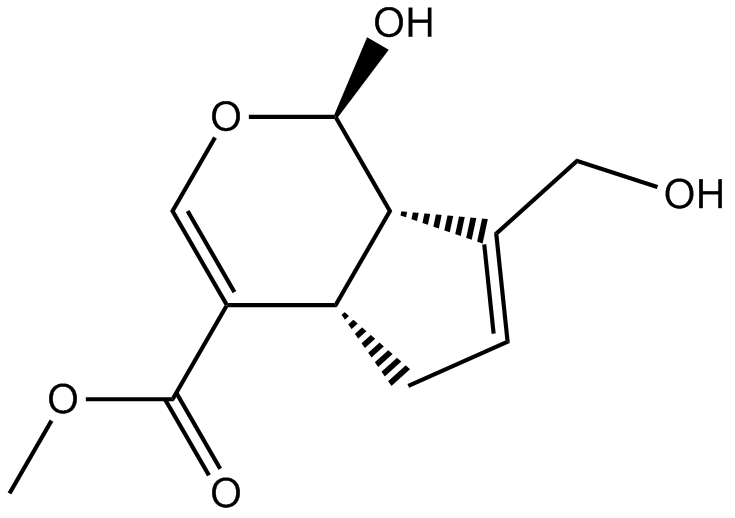
Cas No.: 6902-77-8
Sample solution is provided at 25 µL, 10mM.
_1-3.$$$39978408@51.jpg');)
_1-9.$$$38538795@65.jpg');)
_1-9.$$$39112701@51.jpg');)
_1-7.$$$37316672@70.jpg');)
_366-372.$$$36198801@70.jpg');)
.$$$38565142@65.jpg');)
_1867-1883.$$$33248023@67.jpg');)
_eads6055.$$$39977546@45.jpg');)
_eadm9805.$$$40080571@45.jpg');)
_eadj3020.$$$39666821@45.jpg');)
_1-20.$$$39757301@28.jpg');)
_1-24.$$$38898113@28.jpg');)
_273-287.$$$36806353@46.jpg');)
_1-16.$$$37156877@44.jpg');)
_1-19.$$$37460805@44.jpg');)
_1291-1307.$$$34518654@46.jpg');)
Genipin is a specific UCP2 (uncoupling protein 2) inhibitor extracted from the Gardenia jasminoides Ellis[1]. Genipin has been widely used for drug delivery due to its excellent biocompatibility, admirable biodegradability, and stable cross-linking attributes[2]. Genipin has also been used as a fingerprint collection reagent and a cross-linker for the preparation of immobilized enzymes[3][4].
Genipin (10mM, 2h) treatment led to the activation of IRS-1, PI3-K, and downstream signaling in mouse skeletal muscle cells (C2C12 myoblasts)[5]. Genipin (200μM, 24h) induces apoptosis in FaO rat hepatoma cells and human hepatocarcinoma Hep3B cells[6].
Genipin (25, 50, 100 and 200mg/kg; i.p.) markedly decreased hemorrhagic necrosis, portal inflammation and the mortality in hepatic apoptosis and liver failure mouse model[7]. Genipin (50mg/kg, 7 days, p.o.) exerts protective effects on ethanol-induced acute gastric injury in mice by inhibiting the activation of the NLRP3 inflammasome[8].
References:
[1] Piscopo M, Tenore GC, Notariale R, et al. Antimicrobial and antioxidant activity of proteins from Feijoa sellowiana Berg. fruit before and after in vitro gastrointestinal digestion. Natural product research. 2020 Sep 16;34(18):2607-11.
[2] Yu Y, Xu S, Li S, et al. Genipin-cross-linked hydrogels based on biomaterials for drug delivery: A review. Biomaterials science. 2021;9(5):1583-97.
[3] Zhou T, Liu H, Wen J, et al. Fragmentation study of iridoid glycosides including epimers by liquid chromatography‐diode array detection/electrospray ionization mass spectrometry and its application in metabolic fingerprint analysis of Gardenia jasminoides Ellis. Rapid Communications in Mass Spectrometry. 2010 Sep 15;24(17):2520-8.
[4] Pujana MA, Pérez-Álvarez L, Iturbe LC, et al. Water soluble folate-chitosan nanogels crosslinked by genipin. Carbohydrate polymers. 2014 Jan 30;101:113-20.
[5] Ma ChanJuan MC, Nie AiFang NA, Zhang ZhiJian ZZ, et al. Genipin stimulates glucose transport in C2C12 myotubes via an IRS-1 and calcium-dependent mechanism.
[6] Kim BC, Kim HG, Lee SA, et al. Genipin-induced apoptosis in hepatoma cells is mediated by reactive oxygen species/c-Jun NH2-terminal kinase-dependent activation of mitochondrial pathway. Biochemical pharmacology. 2005 Nov 1;70(9):1398-407.
[7] Kim SJ, Kim JK, Lee DU, et al. Genipin protects lipopolysaccharide-induced apoptotic liver damage in D-galactosamine-sensitized mice. European journal of pharmacology. 2010 Jun 10;635(1-3):188-93.
[8] Zhao T, Zhang Y, Mu S, et al. Protective effects of genipin on ethanol-induced acute gastric injury in mice by inhibiting NLRP3 inflammasome activation. European Journal of Pharmacology. 2020 Jan 15;867:172800.
| Cell experiment [1]: | |
Cell lines | Mouse skeletal muscle C2C12 cells |
Preparation Method | C2C12 cells were treated with 10 μM Genipin for 0.5h and 2h. The cell lysates were extracted with lysis buffer (RIPA, 1×PBS, 1% Nonidet P-40, 5mM EDTA, 0.1% SDS, 1mM sodium orthovanadate, 1% PMSF, complete protease inhibitor cocktail, and complete phosphatase inhibitors). The whole-cell lysates were centrifuged at 12000g at 4°C for 20min to remove the insoluble materials. For immunoprecipitation, supernatants were incubated with IRS-1 antibody at 4°C for 16h followed by incubation with protein A-agarose beads for 2h. The beads were washed in lysis buffer three times, boiled with Laemmli sample buffer for 5min, and then loaded onto SDS-PAGE. |
Reaction Conditions | 10mM; 0.5h, 2h |
Applications | Genipin treatment led to the activation of IRS-1 in mouse skeletal muscle C2C12 cells. |
| Animal experiment [2]: | |
Animal models | Hepatic apoptosis and liver failure mouse model |
Preparation Method | Male ICR mice (20-22g) were fasted overnight but given access to water ad libitum. In the Genipin-treated group, mice were administered Genipin (suspended in 10% Tween 80-saline) at 25, 50, 100 and 200mg/kg intraperitoneally 1h before the d-galactosamine (GalN)/lipopolysaccharide (LPS) treatment, while other groups received an equivalent volume of vehicle as the control. All animals (except for the normal control) were injected intraperitoneally with GalN (700mg/kg) and LPS (10μg/kg Escherichia coli 026:B6) dissolved in phosphate-buffered saline. |
Dosage form | 25, 50, 100 and 200mg/kg; i.p. |
Applications | Genipin markedly decreased hemorrhagic necrosis, portal inflammation and the mortality in hepatic apoptosis and liver failure mouse model. |
References: | |
| Cas No. | 6902-77-8 | SDF | |
| Überlieferungen | (+)Genipin | ||
| Chemical Name | methyl (1R,4aS,7aS)-1-hydroxy-7-(hydroxymethyl)-1,4a,5,7a-tetrahydrocyclopenta[c]pyran-4-carboxylate | ||
| Canonical SMILES | COC(=O)C1=COC(C2C1CC=C2CO)O | ||
| Formula | C11H14O5 | M.Wt | 226.23 |
| Löslichkeit | ≥ 9.8 mg/mL in DMSO, ≥ 101.6 mg/mL in EtOH, ≥ 5.97 mg/mL in Water | Storage | 4°C, protect from light |
| General tips | Please select the appropriate solvent to prepare the stock solution according to the
solubility of the product in different solvents; once the solution is prepared, please store it in
separate packages to avoid product failure caused by repeated freezing and thawing.Storage method
and period of the stock solution: When stored at -80°C, please use it within 6 months; when stored
at -20°C, please use it within 1 month. To increase solubility, heat the tube to 37°C and then oscillate in an ultrasonic bath for some time. |
||
| Shipping Condition | Evaluation sample solution: shipped with blue ice. All other sizes available: with RT, or with Blue Ice upon request. | ||
| Prepare stock solution | |||

|
1 mg | 5 mg | 10 mg |
| 1 mM | 4.4203 mL | 22.1014 mL | 44.2028 mL |
| 5 mM | 884.1 μL | 4.4203 mL | 8.8406 mL |
| 10 mM | 442 μL | 2.2101 mL | 4.4203 mL |
Step 1: Enter information below (Recommended: An additional animal making an allowance for loss during the experiment)
 g
μL
g
μL
Step 2: Enter the in vivo formulation (This is only the calculator, not formulation. Please contact us first if there is no in vivo formulation at the solubility Section.)
Calculation results:
Working concentration: mg/ml;
Method for preparing DMSO master liquid: mg drug pre-dissolved in μL DMSO ( Master liquid concentration mg/mL, Please contact us first if the concentration exceeds the DMSO solubility of the batch of drug. )
Method for preparing in vivo formulation: Take μL DMSO master liquid, next addμL PEG300, mix and clarify, next addμL Tween 80, mix and clarify, next add μL saline, mix and clarify.
Method for preparing in vivo formulation: Take μL DMSO master liquid, next add μL Corn oil, mix and clarify.
Note: 1. Please make sure the liquid is clear before adding the next solvent.
2. Be sure to add the solvent(s) in order. You must ensure that the solution obtained, in the previous addition, is a clear solution before proceeding to add the next solvent. Physical methods such as vortex, ultrasound or hot water bath can be used to aid dissolving.
3. All of the above co-solvents are available for purchase on the GlpBio website.
Quality Control & SDS
- View current batch:
- Purity: >98.00% Appearance: A solid
- COA (Certificate of Analysis)
- SDS (Safety Data Sheet)
- Datasheet
Average Rating: 5 (Based on Reviews and 30 reference(s) in Google Scholar.)