

HET0016 (Synonyms: N-hydroxy-N'-(4-n-butyl-2-methylphenyl)Formamidine) |
Katalog-Nr.GC11540
 One-Click Copy Product Info
|

HET0016 ist ein potenter und selektiver 20-HydroxyeicosatetraensÄure (20-HETE)-Synthase-Inhibitor mit IC50-Werten von 17,7 nM, 12,1 nM und 20,6 nM fÜr die rekombinante CYP4A1-, CYP4A2- bzw. CYP4A3-katalysierte 20-HETE-Synthese.
Products are for research use only. Not for human use. We do not sell to patients.
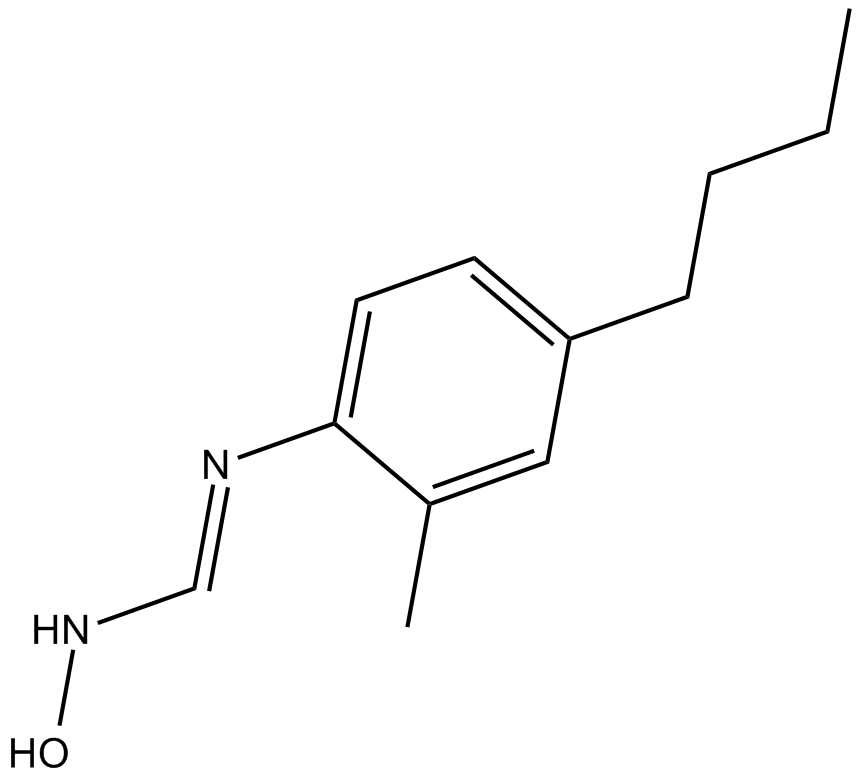
Cas No.: 339068-25-6
Sample solution is provided at 25 µL, 10mM.
HET0016 is a highly selective inhibitor of 20-hydroxy eicosatrienoic acid (20-HETE) synthase. The IC50 values for the catalytic synthesis of 20-HETE by recombinant CYP4A1, CYP4A2, and CYP4A3 are 17.7nM, 12.1nM, and 20.6nM, respectively [1-2]. 20-HETE is an effective vasoconstrictor that can inhibit Na+ transport in the proximal tubule and thick ascending limb of the loop of Henle (TALH) [3]. HET0016 can be used to inhibit angiogenesis and tumor growth [4].
In vitro, treatment with HET0016 (100μM; 24, 48h) significantly reduced the motility of 4T1 and MDA-MB-231 cells, the total area of cell invasion decreased, and cell migration also showed a similar reduction [4]. Treatment with HET0016 (1, 10μM; 48h) dose-dependently inhibited the cell proliferation of the 9L gliosarcoma cell line. HET0016 could inhibit proliferation induced by epidermal growth factor (EGF) and platelet-derived growth factor (PDGF) and reduce the phosphorylation of PDGF receptors [5].
In vivo, HET0016 (10mg/kg/day; 5d; i.p.) Treatment reduced tumor growth in breast cancer xenograft model mice, and decreased tumor volume in both the early treatment group and the delayed treatment group [6]. HET0016 (10mg/kg/day; once every 12 hours for three days; i.p.) treatment significantly reduced the brain lesion volume and neurological deficits in collagenase-induced Intracerebral Hemorrhage (ICH) model mice, and decreased neuronal death, ROS production, gelatin dissolution activity and inflammatory response 3 days after ICH [7].
References:
[1] Seki T, et al. Cytochrome P450 4A isoform inhibitory profile of N-hydroxy-N'-(4-butyl-2-methylphenyl)-formamidine (HET0016), a selective inhibitor of 20-HETE synthesis. Biol Pharm Bull. 2005 Sep;28(9):1651-4.
[2] Borin T F, Zuccari D A P C, Jardim-Perassi B V, et al. HET0016, a selective inhibitor of 20-HETE synthesis, decreases pro-angiogenic factors and inhibits growth of triple negative breast cancer in mice[J]. PLoS One, 2014, 9(12): e116247.
[3] Hoagland K M, Flasch A K, Roman R J. Inhibitors of 20-HETE formation promote salt-sensitive hypertension in rats[J]. Hypertension, 2003, 42(4): 669-673.
[4] Borin TF, et al. HET0016 decreases lung metastasis from breast cancer in immune-competent mouse model. PLoS One. 2017 Jun 13;12(6): e0178830.
[5] Guo M, Roman R J, Fenstermacher J D, et al. 9L gliosarcoma cell proliferation and tumor growth in rats are suppressed by N-hydroxy-N′-(4-butyl-2-methylphenol) formamidine (HET0016), a selective inhibitor of CYP4A[J]. The Journal of pharmacology and experimental therapeutics, 2006, 317(1): 97-108.
[6] Borin T F, Zuccari D A P C, Jardim-Perassi B V, et al. HET0016, a selective inhibitor of 20-HETE synthesis, decreases pro-angiogenic factors and inhibits growth of triple negative breast cancer in mice[J]. PLoS One, 2014, 9(12): e116247.
[7] Han X, Zhao X, Lan X, et al. 20-HETE synthesis inhibition promotes cerebral protection after intracerebral hemorrhage without inhibiting angiogenesis. J Cereb Blood Flow Metab. 2019;39(8):1531-1543.
| Cell experiment [1]: | |
Cell lines | 4T1 luciferase positive cells and MDA-MB-231 cells |
Preparation Method | Wound healing assay was performed to detect the potential of HET0016 treatment to decrease migration malignant cells. 4T1 luciferase positive cells and MDA-MB-231 cells achieving 80-90% of confluency in 6 well plates were starved overnight with 0.5% FBS for cell cycle synchronization. Then, cells were treated with 100μM of HET0016 for 24 and 48 hours in 2% FBS media, and microphotographed every 24 hours. The wound size was measured using Image J software (NIH) by drawing a rectangular region of interest to quantify the visible area of wound. |
Reaction Conditions | 100μM; 24 and 48h |
Applications | HET0016 significantly reduced the motility of 4T1 luciferase positive cells and MDA-MB-231 cells, the total area of cell invasion decreased, and cell migration also showed a similar reduction. |
| Animal experiment [2]: | |
Animal models | Athymic nude mice |
Preparation Method | Athymic nude female mice (n = 28) 6–8 week-old and weighing 20–25 grams obtained from Charles River laboratory (Frederick, MD) were used in all experiments. After tumor implantation the animals received treatment with HET0016 (10mg/kg per day) or phosphate buffered saline (PBS) containing 10% of dimethyl sulfoxide (DMSO) and 10% cremophor as a vehicle control intraperitoneally (IP) for five days during the week (Monday through Friday). To better evaluate the effect of treatment, the animals were divided into four treatment groups receiving early treatment (beginning on the day of tumor inoculation) or delayed (on day 8 after inoculation of the tumor) and maintained for 21 or 28 days. Group 1 (n = 6) starting treatment early on day 0 until day 21; Group 2 (n = 4) also starting treatment early on day 0, however, was maintained for 28 days; Group 3 (n = 6) starting treatment delayed, after tumor establishment on day 8 until day 21 and Group 4 (n = 4) also starting treatment delayed on day 8, however, was maintained for 28 days. Eight animals were used as control receiving vehicle, four were maintained for 21 days and others four were maintained for 28 days. |
Dosage form | 10mg/kg/day for 5 days; i.p. |
Applications | HET0016 treatment decreased tumor volume in all animals in both early and delayed treatment groups. |
References: | |
| Cas No. | 339068-25-6 | SDF | |
| Überlieferungen | N-hydroxy-N'-(4-n-butyl-2-methylphenyl)Formamidine | ||
| Chemical Name | N-(4-butyl-2-methylphenyl)-N'-hydroxy-methanimidamide | ||
| Canonical SMILES | CCCCC1=CC=C(/N=C/NO)C(C)=C1 | ||
| Formula | C12H18N2O | M.Wt | 206.3 |
| Löslichkeit | ≤14mg/ml in ethanol;14mg/ml in DMSO;14mg/ml in dimethyl formamide | Storage | Store at -20°C |
| General tips | Please select the appropriate solvent to prepare the stock solution according to the
solubility of the product in different solvents; once the solution is prepared, please store it in
separate packages to avoid product failure caused by repeated freezing and thawing.Storage method
and period of the stock solution: When stored at -80°C, please use it within 6 months; when stored
at -20°C, please use it within 1 month. To increase solubility, heat the tube to 37°C and then oscillate in an ultrasonic bath for some time. |
||
| Shipping Condition | Evaluation sample solution: shipped with blue ice. All other sizes available: with RT, or with Blue Ice upon request. | ||
| Prepare stock solution | |||

|
1 mg | 5 mg | 10 mg |
| 1 mM | 4.8473 mL | 24.2365 mL | 48.4731 mL |
| 5 mM | 969.5 μL | 4.8473 mL | 9.6946 mL |
| 10 mM | 484.7 μL | 2.4237 mL | 4.8473 mL |
Step 1: Enter information below (Recommended: An additional animal making an allowance for loss during the experiment)
 g
μL
g
μL
Step 2: Enter the in vivo formulation (This is only the calculator, not formulation. Please contact us first if there is no in vivo formulation at the solubility Section.)
Calculation results:
Working concentration: mg/ml;
Method for preparing DMSO master liquid: mg drug pre-dissolved in μL DMSO ( Master liquid concentration mg/mL, Please contact us first if the concentration exceeds the DMSO solubility of the batch of drug. )
Method for preparing in vivo formulation: Take μL DMSO master liquid, next addμL PEG300, mix and clarify, next addμL Tween 80, mix and clarify, next add μL saline, mix and clarify.
Method for preparing in vivo formulation: Take μL DMSO master liquid, next add μL Corn oil, mix and clarify.
Note: 1. Please make sure the liquid is clear before adding the next solvent.
2. Be sure to add the solvent(s) in order. You must ensure that the solution obtained, in the previous addition, is a clear solution before proceeding to add the next solvent. Physical methods such as vortex, ultrasound or hot water bath can be used to aid dissolving.
3. All of the above co-solvents are available for purchase on the GlpBio website.
Quality Control & SDS
- View current batch:
- Purity: >98.50% Appearance: A solid
- COA (Certificate of Analysis)
- SDS (Safety Data Sheet)
- Datasheet

Average Rating: 5 (Based on Reviews and 29 reference(s) in Google Scholar.)