

Ki8751 |
Katalog-Nr.GC11666
 One-Click Copy Product Info
|

Ki8751 ist ein potenter VEGFR2-Inhibitor mit einem IC50 von 0,9 nM.
Products are for research use only. Not for human use. We do not sell to patients.
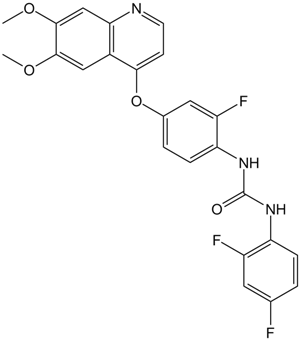
Cas No.: 228559-41-9
Sample solution is provided at 25 µL, 10mM.
_1-3.$$$39978408@51.jpg');)
_1-9.$$$38538795@65.jpg');)
_1-9.$$$39112701@51.jpg');)
_1-7.$$$37316672@70.jpg');)
_366-372.$$$36198801@70.jpg');)
.$$$38565142@65.jpg');)
_1867-1883.$$$33248023@67.jpg');)
_eads6055.$$$39977546@45.jpg');)
_eadm9805.$$$40080571@45.jpg');)
_eadj3020.$$$39666821@45.jpg');)
_1-20.$$$39757301@28.jpg');)
_1-24.$$$38898113@28.jpg');)
_273-287.$$$36806353@46.jpg');)
_1-16.$$$37156877@44.jpg');)
_1-19.$$$37460805@44.jpg');)
_1291-1307.$$$34518654@46.jpg');)
Ki8751 is a selective and potent inhibitor of VEGFR2 with IC50 value of 0.9 nM [1].
VEGF receptors are receptors for vascular endothelial growth factor (VEGF) and regulate angiogenesis [2].
In cell-based assays, Ki8751 inhibited VEGFR2 with IC50 value of 0.9 nM. And it also inhibited c-Kit (IC50 40 nM), PDGFRα(IC50 67 nM), and FGFR-2 (IC50 170 nM) [1]. Treatment human umbilical vein endothelial cells (HUVECs) with Ki8751 (0.01, 0.1, 1, 10, 100 nM) caused inhibition of HUVEC growth in a dose-dependent way and completely suppressed it at 1 nM [1]. In metastatic colorectal cancer (CRC) cells of MIP, RKO, SW620, and SW480, Ki8751 (10 nM) induced cellular senescence [2].
In nude mice using xenografts of human glioma GL07, human stomach carcinoma St-4, human lung carcinoma LC-6, human colon carcinoma DLD-1 and human melanoma A375 cells, Ki8751 inhibited tumor growth. In nude rats using LC-6 human tumor xenografts, Ki8751 inhibited tumor growth, but then tumor regrowth was observed [1].
References:
[1]. Kubo K, Shimizu T, Ohyama S, et al. Novel potent orally active selective VEGFR-2 tyrosine kinase inhibitors: synthesis, structure-activity relationships, and antitumor activities of N-phenyl-N'-{4-(4-quinolyloxy)phenyl}ureas. J Med Chem, 2005, 48(5): 1359-1366.
[2]. Hasan MR, Ho SH, Owen DA, et al. Inhibition of VEGF induces cellular senescence in colorectal cancer cells. Int J Cancer, 2011, 129(9): 2115–2123.
|
Kinase experiment: |
VEGFR-2 kinase assay is described below; GST-fusion proteins of KDR (Flk-1: cytoplasmic domain) are produced in the baculo-virus expression system. GST-KDR is premixed with a serial dilution of Ki8751 in the kinase buffer. The kinase reaction is initiated by the addition of 2 µM ATP in a solution of MnCl2. After 20 min incubation at room temperature, the reaction is stopped with an addition of EDTA. Phosphorylation levels of GST-KDR are detected by immunoblotting with anti-phosphotyrosine monoclonal antibodies (PY20) and detected by ECL fluorography[1]. |
|
Cell experiment: |
HUVECs are placed at a density of 4000 cells/200 µL/well on collagene type I precoated 96-well plates in M199 medium with 5% fetal bovine serum (FBS). After 24 h, the cells are incubated for 1 h in the presence or absence of Ki8751; then the cells are stimulated by rhVEGF (20 ng/mL). The cultures are incubated at 37 °C for 72 h, then pulsed with 1 µCi/well [3H]thymidine and reincubated for 14 h. Cells are assayed for the incorporation of tritium using a beta counter[1]. |
|
Animal experiment: |
Mice: The effects of Ki8751 on tumor growth is tested against various tumors, human stomach carcinoma (St-4), human lung carcinoma (LC-6), human colon carcinoma (DLD-1) and human melanoma (A375), using human tumor xenografts in nude mice. Ki8751 is administered orally to mice in the experimental groups once a day for 9 consecutive days at 5 mg/kg, and the vehicle is administered to control animals. Tumor volumes are monitored twice weekly[1]. |
|
References: [1]. Kubo K, et al. Novel potent orally active selective VEGFR-2 tyrosine kinase inhibitors: synthesis, structure-activity relationships, and antitumor activities of N-phenyl-N'-{4-(4-quinolyloxy)phenyl}ureas. J Med Chem, 2005, 48(5), 1359-1366. |
|
| Cas No. | 228559-41-9 | SDF | |
| Chemical Name | 1-(2,4-difluorophenyl)-3-[4-(6,7-dimethoxyquinolin-4-yl)oxy-2-fluorophenyl]urea | ||
| Canonical SMILES | COC1=CC2=C(C=CN=C2C=C1OC)OC3=CC(=C(C=C3)NC(=O)NC4=C(C=C(C=C4)F)F)F | ||
| Formula | C24H18F3N3O4 | M.Wt | 469.41 |
| Löslichkeit | ≥ 23.45mg/mL in DMSO | Storage | Store at -20°C |
| General tips | Please select the appropriate solvent to prepare the stock solution according to the
solubility of the product in different solvents; once the solution is prepared, please store it in
separate packages to avoid product failure caused by repeated freezing and thawing.Storage method
and period of the stock solution: When stored at -80°C, please use it within 6 months; when stored
at -20°C, please use it within 1 month. To increase solubility, heat the tube to 37°C and then oscillate in an ultrasonic bath for some time. |
||
| Shipping Condition | Evaluation sample solution: shipped with blue ice. All other sizes available: with RT, or with Blue Ice upon request. | ||
| Prepare stock solution | |||

|
1 mg | 5 mg | 10 mg |
| 1 mM | 2.1303 mL | 10.6517 mL | 21.3033 mL |
| 5 mM | 426.1 μL | 2.1303 mL | 4.2607 mL |
| 10 mM | 213 μL | 1.0652 mL | 2.1303 mL |
Step 1: Enter information below (Recommended: An additional animal making an allowance for loss during the experiment)
 g
μL
g
μL
Step 2: Enter the in vivo formulation (This is only the calculator, not formulation. Please contact us first if there is no in vivo formulation at the solubility Section.)
Calculation results:
Working concentration: mg/ml;
Method for preparing DMSO master liquid: mg drug pre-dissolved in μL DMSO ( Master liquid concentration mg/mL, Please contact us first if the concentration exceeds the DMSO solubility of the batch of drug. )
Method for preparing in vivo formulation: Take μL DMSO master liquid, next addμL PEG300, mix and clarify, next addμL Tween 80, mix and clarify, next add μL saline, mix and clarify.
Method for preparing in vivo formulation: Take μL DMSO master liquid, next add μL Corn oil, mix and clarify.
Note: 1. Please make sure the liquid is clear before adding the next solvent.
2. Be sure to add the solvent(s) in order. You must ensure that the solution obtained, in the previous addition, is a clear solution before proceeding to add the next solvent. Physical methods such as vortex, ultrasound or hot water bath can be used to aid dissolving.
3. All of the above co-solvents are available for purchase on the GlpBio website.
Quality Control & SDS
- View current batch:
- Purity: >98.00% Appearance: A solid
- COA (Certificate of Analysis)
- SDS (Safety Data Sheet)
- Datasheet
Average Rating: 5 (Based on Reviews and 38 reference(s) in Google Scholar.)