

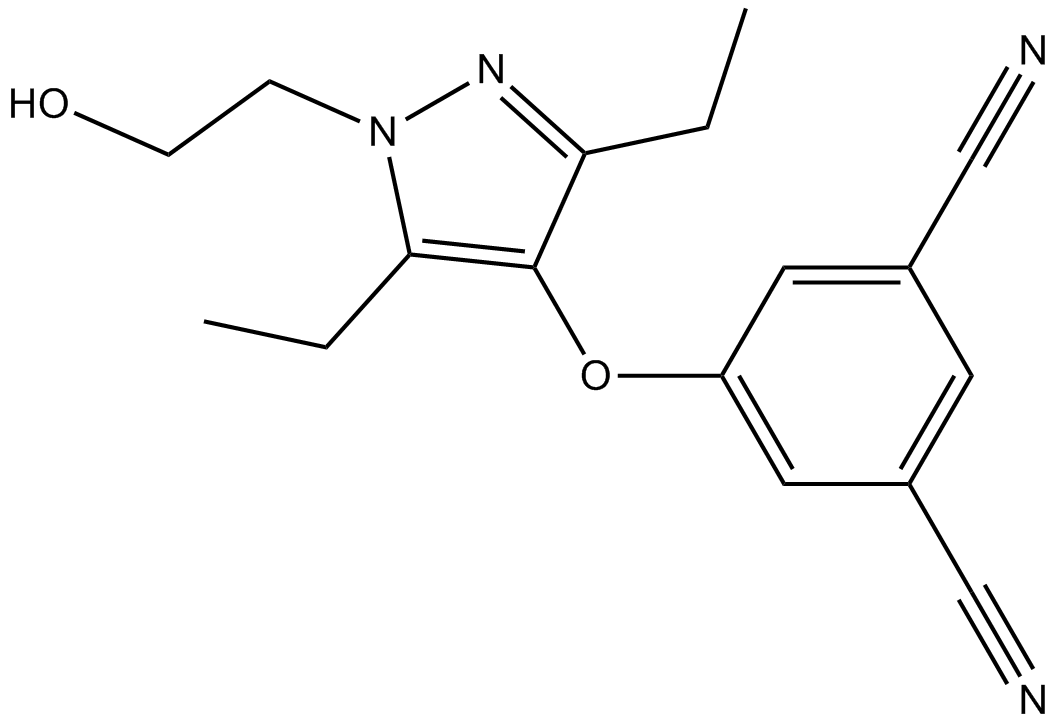
Lersivirine (Synonyms: UK-453,061) |
Katalog-Nr.GC16596
 One-Click Copy Product Info
|

An NNRTI
Products are for research use only. Not for human use. We do not sell to patients.
Cas No.: 473921-12-9
Sample solution is provided at 25 µL, 10mM.
_1-3.$$$39978408@51.jpg');)
_1-9.$$$38538795@65.jpg');)
_1-9.$$$39112701@51.jpg');)
_1-7.$$$37316672@70.jpg');)
_366-372.$$$36198801@70.jpg');)
.$$$38565142@65.jpg');)
_1867-1883.$$$33248023@67.jpg');)
_eads6055.$$$39977546@45.jpg');)
_eadm9805.$$$40080571@45.jpg');)
_eadj3020.$$$39666821@45.jpg');)
_1-20.$$$39757301@28.jpg');)
_1-24.$$$38898113@28.jpg');)
_273-287.$$$36806353@46.jpg');)
_1-16.$$$37156877@44.jpg');)
_1-19.$$$37460805@44.jpg');)
_1291-1307.$$$34518654@46.jpg');)
Lersivirine (UK-453061) is a next-generation non-nucleoside reverse transcriptase inhibitor (NNRTI)for human immunodeficincy virus (HIV) infection with IC50 value of 119 nM [1].
HIV is a retro virus that causes HIV infection and acquired immunodeficiency syndrome (AIDS). It may infect vital cells of human immune system such as helper T cells and dendritic cells. HIV transcriptase plays an important role in the infection process. HIV carries a reverse transcriptase which can transcript single-stranded virus RNA into double-stranded DNA. When the virus anchor to the target cell surface, the reverse transcriptase will be injected into host cell, there it may complete the transcription. And the transcribed DNA is able to integrate into host genome to complete infection and viral replication.
Lersivirine (UK-453061) is a NNRTI with a unique resistance profile that exhibits potent antiretroviral activity against wild-type HIV and clinically relevant NNRTI-resistant strains. When lersivirine was tested with a panel of isolated wild-type and drug-resistant HIV reverse transcriptase, it exhibited excellent inhibitory activity, which confirmed the high potency of it as the next-generation anti-HIV NNRTI. The compound also has good aqueous solubility and formulation characteristics which enable further in vivo evaluation [2].
Mated Crl:CD1 mice were administered 0, 150, 350, and 500 mg/kg lersivirine once daily by oral gavage on gestation days 6 to 17, followed by cesarean section on gestation day 18. The first 2 days of dosing for the high-dose group were done at 250 mg/kg to allow induction of hepatic metabolizing enzymes, after which the dose was increased to 500 mg/kg/day. Exposure of lersivirine did not cause any increases in external, visceral, or skeletal malformation, which demonstrated lersivirine is not teratogenic in mice [3].
References:
[1] Mowbray C E et al. , Pyrazole NNRTIs 4: selection of UK-453,061 (lersivirine) as a development candidate. Bioorg Med Chem Lett. 2009, 19(20):5857-60.
[2] Davis J et al. , The effect of lersivirine, a next-generation NNRTI, on the pharmacokinetics of midazolam and oral contraceptives in healthy subjects. Eur J Clin Pharmacol. 2012, 68(11):1567-1572.
[3] Cappon G D et al. , Developmental toxicity study of lersivirine in mice. Birth Defects Res B Dev Reprod Toxicol. 2012, 95(3):225-30.
| Cas No. | 473921-12-9 | SDF | |
| Überlieferungen | UK-453,061 | ||
| Chemical Name | 5-[3,5-diethyl-1-(2-hydroxyethyl)pyrazol-4-yl]oxybenzene-1,3-dicarbonitrile | ||
| Canonical SMILES | CCC1=C(C(=NN1CCO)CC)OC2=CC(=CC(=C2)C#N)C#N | ||
| Formula | C17H18N4O2 | M.Wt | 310.35 |
| Löslichkeit | DMF: 30 mg/ml,DMSO: 30 mg/ml,Ethanol: 10 mg/ml | Storage | Store at -20°C |
| General tips | Please select the appropriate solvent to prepare the stock solution according to the
solubility of the product in different solvents; once the solution is prepared, please store it in
separate packages to avoid product failure caused by repeated freezing and thawing.Storage method
and period of the stock solution: When stored at -80°C, please use it within 6 months; when stored
at -20°C, please use it within 1 month. To increase solubility, heat the tube to 37°C and then oscillate in an ultrasonic bath for some time. |
||
| Shipping Condition | Evaluation sample solution: shipped with blue ice. All other sizes available: with RT, or with Blue Ice upon request. | ||
| Prepare stock solution | |||

|
1 mg | 5 mg | 10 mg |
| 1 mM | 3.2222 mL | 16.1108 mL | 32.2217 mL |
| 5 mM | 644.4 μL | 3.2222 mL | 6.4443 mL |
| 10 mM | 322.2 μL | 1.6111 mL | 3.2222 mL |
Step 1: Enter information below (Recommended: An additional animal making an allowance for loss during the experiment)
 g
μL
g
μL
Step 2: Enter the in vivo formulation (This is only the calculator, not formulation. Please contact us first if there is no in vivo formulation at the solubility Section.)
Calculation results:
Working concentration: mg/ml;
Method for preparing DMSO master liquid: mg drug pre-dissolved in μL DMSO ( Master liquid concentration mg/mL, Please contact us first if the concentration exceeds the DMSO solubility of the batch of drug. )
Method for preparing in vivo formulation: Take μL DMSO master liquid, next addμL PEG300, mix and clarify, next addμL Tween 80, mix and clarify, next add μL saline, mix and clarify.
Method for preparing in vivo formulation: Take μL DMSO master liquid, next add μL Corn oil, mix and clarify.
Note: 1. Please make sure the liquid is clear before adding the next solvent.
2. Be sure to add the solvent(s) in order. You must ensure that the solution obtained, in the previous addition, is a clear solution before proceeding to add the next solvent. Physical methods such as vortex, ultrasound or hot water bath can be used to aid dissolving.
3. All of the above co-solvents are available for purchase on the GlpBio website.
Quality Control & SDS
- View current batch:
- Purity: >98.00% Appearance: A solid
- COA (Certificate of Analysis)
- SDS (Safety Data Sheet)
- Datasheet
Average Rating: 5 (Based on Reviews and 30 reference(s) in Google Scholar.)