

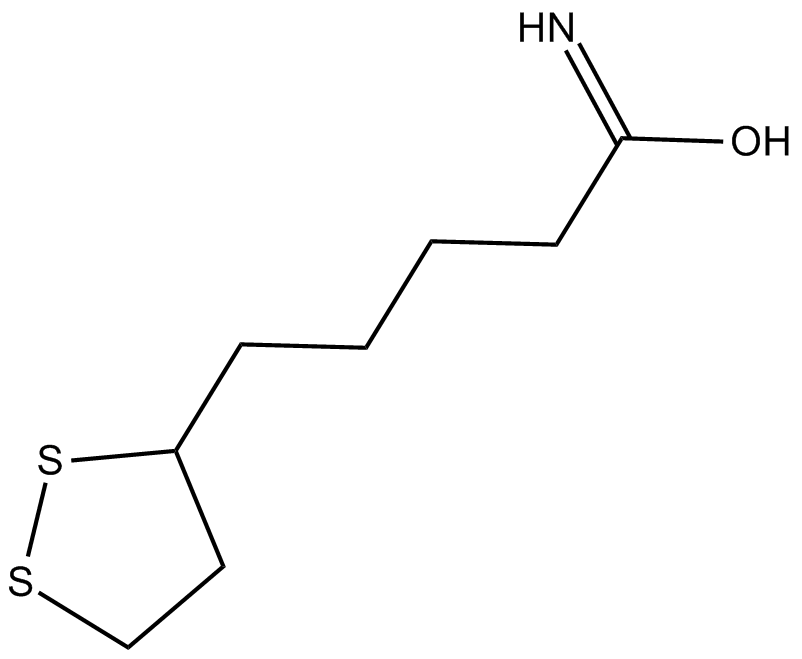
Lipoamide (Synonyms: α-Lipoamide, DL-α-Lipoic Acid amide, NSC 90787, (±)-Thioctic Acid amide) |
Katalog-Nr.GC13051
 One-Click Copy Product Info
|

Lipoamid ((±)-α-Lipoamid) ist ein MonocarbonsÄureamid, das aus der formalen Kondensation der Carboxygruppe von LiponsÄure mit Ammoniak resultiert.
Products are for research use only. Not for human use. We do not sell to patients.
Cas No.: 940-69-2
Sample solution is provided at 25 µL, 10mM.
_1-3.$$$39978408@51.jpg');)
_1-9.$$$38538795@65.jpg');)
_1-9.$$$39112701@51.jpg');)
_1-7.$$$37316672@70.jpg');)
_366-372.$$$36198801@70.jpg');)
.$$$38565142@65.jpg');)
_1867-1883.$$$33248023@67.jpg');)
_eads6055.$$$39977546@45.jpg');)
_eadm9805.$$$40080571@45.jpg');)
_eadj3020.$$$39666821@45.jpg');)
_1-20.$$$39757301@28.jpg');)
_1-24.$$$38898113@28.jpg');)
_273-287.$$$36806353@46.jpg');)
_1-16.$$$37156877@44.jpg');)
_1-19.$$$37460805@44.jpg');)
_1291-1307.$$$34518654@46.jpg');)
Lipoamide is a neutral amide derivative with coenzyme activity. Lipoamide stimulates mitochondrial biogenesis by activating the eNOS-cGMP-PKG signaling pathway and prevents abnormal protein aggregation and promotes nuclear function recovery by regulating stress granule dynamics. Lipoamide can be used for research on obesity, type 2 diabetes, and neurodegenerative diseases such as amyotrophic lateral sclerosis (ALS)[1-4].
In vitro, human retinal pigment epithelial (ARPE-19) cells were pretreated with Lipoamide (40μM) for 48h, followed by acrolein (75μM) stimulation for 24h. Lipoamide significantly inhibited the decrease in cell viability, mitochondrial dysfunction, and oxidative stress damage, while enhancing the intracellular antioxidant defense system[5]. ARPE-19 cells were treated with Lipoamide (5–80μM) for 48h. Lipoamide significantly increased mitochondrial DNA copy number, viable mitochondria mass, and the expression of electron transport chain complexes, while activating the Nrf2 pathway and inducing the expression and activity of phase II antioxidant enzymes (NQO-1, GST, GCL, catalase, and Cu/Zn SOD)[6].
In vivo, nude mice transplanted with Nfkd SW10 cells were subcutaneously injected with Lipoamide (8mg/kg/day) for one week. Lipoamide significantly inhibited the growth of Nfkd xenograft tumors[7]. db/db mice (type 2 diabetes model) were administered Lipoamide (50mg/kg/day) by gavage for 8 weeks. Lipoamide significantly restored renal function, improved mitochondrial dysfunction, and ameliorated tubulointerstitial fibrotic lesions[8].
References:
[1] Arnér ES, Nordberg J, Holmgren A. Efficient reduction of lipoamide and lipoic acid by mammalian thioredoxin reductase. Biochem Biophys Res Commun. 1996 Aug 5;225(1):268-74.
[2] Hou Y, Li X, Peng S, et al. Lipoamide Ameliorates Oxidative Stress via Induction of Nrf2/ARE Signaling Pathway in PC12 Cells. J Agric Food Chem. 2019 Jul 24;67(29):8227-8234.
[3] Shen W, Hao J, Feng Z, et al. Lipoamide or lipoic acid stimulates mitochondrial biogenesis in 3T3-L1 adipocytes via the endothelial NO synthase-cGMP-protein kinase G signalling pathway. Br J Pharmacol. 2011 Mar;162(5):1213-24.
[4] Sumegi B, Butwell NB, Malloy CR, et al. Lipoamide influences substrate selection in post-ischaemic perfused rat hearts. Biochem J. 1994 Jan 1;297 ( Pt 1)(Pt 1):109-13.
[5] Li X, Liu Z, Luo C, et al. Lipoamide protects retinal pigment epithelial cells from oxidative stress and mitochondrial dysfunction. Free Radic Biol Med. 2008 Apr 1;44(7):1465-74.
[6] Zhao L, Liu Z, Jia H, et al. Lipoamide Acts as an Indirect Antioxidant by Simultaneously Stimulating Mitochondrial Biogenesis and Phase II Antioxidant Enzyme Systems in ARPE-19 Cells. PLoS One. 2015 Jun 1;10(6):e0128502.
[7] Zhang Y, Zhou R, Qu Y, et al. Lipoamide Inhibits NF1 Deficiency-induced Epithelial-Mesenchymal Transition in Murine Schwann Cells. Arch Med Res. 2017 Aug;48(6):498-505.
[8] Zhang HF, Liu HM, Xiang JY, et al. Alpha lipoamide inhibits diabetic kidney fibrosis via improving mitochondrial function and regulating RXRα expression and activation. Acta Pharmacol Sin. 2023 May;44(5):1051-1065.
| Cell experiment [1]: | |
Cell lines | ARPE-19 cells (human retinal pigment epithelial cell line) |
Preparation Method | ARPE-19 cells were cultured in DMEM-F12 medium supplemented with 10% fetal bovine serum, 2mmol/L L-glutamine, 100U/ml penicillin, and 100μg/ml streptomycin. ARPE-19 cells were treated with Lipoamide at indicated concentrations (5–80μM) for 48 hours. |
Reaction Conditions | 5–80μM; 48h |
Applications | Lipoamide significantly increased the protein expression of electron transport chain complexes (I, II, III, IV, and V) and the mitochondrial DNA copy number in ARPE-19 cells. Lipoamide significantly increased viable mitochondria mass, activated the Nrf2 pathway, and induced the expression and activity of phase II antioxidant enzymes (including NQO-1, GST, GCL, catalase, and Cu/Zn SOD). |
| Animal experiment [2]: | |
Animal models | 9-week-old male db/db mice (Type 2 diabetes mellitus model) |
Preparation Method | Mice were treated with Lipoamide (50mg/kg/day) by gavage for 8 weeks. Age-matched male db/m mice were used as controls. Mice were euthanized after the 8-week intervention for renal analysis. |
Dosage form | 50mg/kg/day; i.g.; 8 weeks |
Applications | Lipoamide administration did not affect blood glucose levels but restored renal function by decreasing 24h urine microalbuminuria, serum triglyceride, and serum cholesterol levels. Lipoamide significantly improved tubulointerstitial fibrotic lesions, ameliorated mitochondrial dysfunction, reduced oxidative stress and apoptosis in the kidneys of db/db mice. |
References: | |
| Cas No. | 940-69-2 | SDF | |
| Überlieferungen | α-Lipoamide, DL-α-Lipoic Acid amide, NSC 90787, (±)-Thioctic Acid amide | ||
| Chemical Name | 5-(1,2-dithiolan-3-yl)pentanimidic acid | ||
| Canonical SMILES | N=C(O)CCCCC1CCSS1 | ||
| Formula | C8H15NOS2 | M.Wt | 205.34 |
| Löslichkeit | ≥ 6.8mg/mL in Etoh with ultrasonic | Storage | Store at -20°C,unstable in solution, ready to use. |
| General tips | Please select the appropriate solvent to prepare the stock solution according to the
solubility of the product in different solvents; once the solution is prepared, please store it in
separate packages to avoid product failure caused by repeated freezing and thawing.Storage method
and period of the stock solution: When stored at -80°C, please use it within 6 months; when stored
at -20°C, please use it within 1 month. To increase solubility, heat the tube to 37°C and then oscillate in an ultrasonic bath for some time. |
||
| Shipping Condition | Evaluation sample solution: shipped with blue ice. All other sizes available: with RT, or with Blue Ice upon request. | ||
| Prepare stock solution | |||

|
1 mg | 5 mg | 10 mg |
| 1 mM | 4.87 mL | 24.3499 mL | 48.6997 mL |
| 5 mM | 974 μL | 4.87 mL | 9.7399 mL |
| 10 mM | 487 μL | 2.435 mL | 4.87 mL |
Step 1: Enter information below (Recommended: An additional animal making an allowance for loss during the experiment)
 g
μL
g
μL
Step 2: Enter the in vivo formulation (This is only the calculator, not formulation. Please contact us first if there is no in vivo formulation at the solubility Section.)
Calculation results:
Working concentration: mg/ml;
Method for preparing DMSO master liquid: mg drug pre-dissolved in μL DMSO ( Master liquid concentration mg/mL, Please contact us first if the concentration exceeds the DMSO solubility of the batch of drug. )
Method for preparing in vivo formulation: Take μL DMSO master liquid, next addμL PEG300, mix and clarify, next addμL Tween 80, mix and clarify, next add μL saline, mix and clarify.
Method for preparing in vivo formulation: Take μL DMSO master liquid, next add μL Corn oil, mix and clarify.
Note: 1. Please make sure the liquid is clear before adding the next solvent.
2. Be sure to add the solvent(s) in order. You must ensure that the solution obtained, in the previous addition, is a clear solution before proceeding to add the next solvent. Physical methods such as vortex, ultrasound or hot water bath can be used to aid dissolving.
3. All of the above co-solvents are available for purchase on the GlpBio website.
Quality Control & SDS
- View current batch:
- Purity: >98.00% Appearance: A solid
- COA (Certificate of Analysis)
- SDS (Safety Data Sheet)
- Datasheet
Average Rating: 5 (Based on Reviews and 25 reference(s) in Google Scholar.)