
Nimesulide (Synonyms: R805) |
| Katalog-Nr.GC18084 |
Nimesulid ist ein selektiver COX-2-Hemmer mit zeitabhÄngigen IC50-Werten von 70 nM-70 μM, zeigt jedoch keine Wirkung auf COX-1 (IC50 > 100 μM).
Products are for research use only. Not for human use. We do not sell to patients.
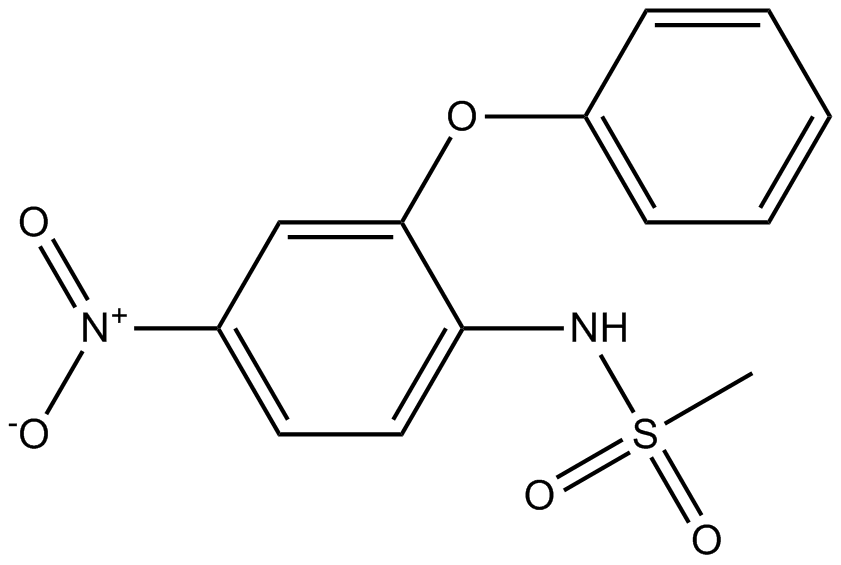
Cas No.: 51803-78-2
Sample solution is provided at 25 µL, 10mM.
Nimesulide is a selective COX-2 inhibitor, with IC50s of 70 nM-70 μM in a time-dependent manner, but it shows no effect on COX-1 (IC50 >100 μM). Nimesulide has potent anti-inflammatory, analgesic and antipyretic properties.
Nimesulide is a selective COX-2 inhibitor, with IC50s of 70 nM-70 μM in a time-dependent manner, but it shows weak effect on COX-1 (IC50 >100 μM)[1]. Nimesulide (10 µM) effectively decreases VEGF in endometrium cancer cells, and shows no effect on that in normal cells. Nimesulide (10 and 50 µM) dramatically decreases MCP-1 levels in normal cell, and such an effect is also observed with 10 µM in cancer cells. In addition, Nimesulide (50 µM) potently affects IL-8 level in normal cells, but causes no changes in cancer cells[3].
Nimesulide (3 and 10 mg/kg, i.p.) effectively blocks fever induced by i.p. injection of LPS in rats. Nimesulide (3 mg/kg, i.p.) potently reduces fever response induced by IL-1β, IL-6 or TNF-α, but does not prevent the initial rise in the febrile response induced by arachidonic acid. Nimesulide also significantly reduces PGE2 levels and PGF2α levels in the cerebrospinal fluid of the LPS-stimulated animals, and inhibits the increase in plasma TNF-α by 97%[2].
References:
[1]. Vago T, et al. Effect of nimesulide action time dependence on selectivity towards prostaglandin G/H synthase/cyclooxygenase activity. Arzneimittelforschung. 1995 Oct;45(10):1096-8.
[2]. Werner MF, et al. Nimesulide-induced antipyresis in rats involves both cyclooxygenase-dependent and independent mechanisms. Eur J Pharmacol. 2006 Aug 14;543(1-3):181-9.
[3]. Genç S, et al. The effect of COX-2 inhibitor, nimesulide, on angiogenetic factors in primary endometrial carcinoma cell culture. Clin Exp Med. 2007 Mar;7(1):6-10.

|
Cell experiment: |
5×10⁵ viable cells are carefully dislodged with sterile Pasteur pipettes, transferred into new flasks and incubated with two different doses of Nimesulide (10 and 50 µM) for another 24 h. Incubations for different doses of Nimesulide are repeated three times. The culture supernatant is then collected and stored in small aliquots at -70°C until studied. VEGF, MCP-1 and IL-8 concentrations are determined by sandwich quantitative enzyme immunoassay (ELISA) using commercial kits[3]. |
|
Animal experiment: |
Rats[2]In the initial experiments, rats are pre-treated with intraperitoneal injections of 1, 3 or 10 mg/kg doses of Nimesulide, diluted in a 5% cremophor vehicle, or 2 mg/kg of indomethacin diluted in tris(hydroximetyl)-aminomethane-HCl (TRIS), pH 8.2, 30 min prior to an i.p. injection of LPS (50 μg/kg). Control animals receive the appropriate vehicle plus saline (1 mL/200 g, i.p.). The dose of 3 mg/kg of Nimesulide is chosen for the remaining experiments. In another set of experiments, rats are pretreated with an i.p. injection of Nimesulide (3 mg/kg) or indomethacin (2 mg/kg), diluted in the appropriate vehicles, 30 min prior to an i.c.v. injection (2 μL over 1 min) of IL-1β (3.12 ng), IL-6 (300 ng), TNF-α (250 ng), arachidonic acid (50 μg), MIP-1α (500 ng), PGE2 (250 ng), PGF2α (250 ng), CRF (2 μg) or ET-1 (1 pmol). Control animals receive the appropriate vehicles (1 mL/200 g, i.p.) and sterile saline (2 μL over 1 min, i.c.v.). All the drugs are injected between 10:00 and 11:00 AM to avoid circadian rhythm variations[2]. |
|
References: [1]. Vago T, et al. Effect of nimesulide action time dependence on selectivity towards prostaglandin G/H synthase/cyclooxygenase activity. Arzneimittelforschung. 1995 Oct;45(10):1096-8. |
|
| Cas No. | 51803-78-2 | SDF | |
| Überlieferungen | R805 | ||
| Chemical Name | N-(4-nitro-2-phenoxyphenyl)methanesulfonamide | ||
| Canonical SMILES | CS(=O)(=O)NC1=C(C=C(C=C1)[N+](=O)[O-])OC2=CC=CC=C2 | ||
| Formula | C13H12N2O5S | M.Wt | 308.31 |
| Löslichkeit | ≥ 15.42mg/mL in DMSO | Storage | Store at 2-8°C |
| General tips | Please select the appropriate solvent to prepare the stock solution according to the
solubility of the product in different solvents; once the solution is prepared, please store it in
separate packages to avoid product failure caused by repeated freezing and thawing.Storage method
and period of the stock solution: When stored at -80°C, please use it within 6 months; when stored
at -20°C, please use it within 1 month. To increase solubility, heat the tube to 37°C and then oscillate in an ultrasonic bath for some time. |
||
| Shipping Condition | Evaluation sample solution: shipped with blue ice. All other sizes available: with RT, or with Blue Ice upon request. | ||
| Prepare stock solution | |||
|
1 mg | 5 mg | 10 mg |
| 1 mM | 3.2435 mL | 16.2174 mL | 32.4349 mL |
| 5 mM | 648.7 μL | 3.2435 mL | 6.487 mL |
| 10 mM | 324.3 μL | 1.6217 mL | 3.2435 mL |
Step 1: Enter information below (Recommended: An additional animal making an allowance for loss during the experiment)
Step 2: Enter the in vivo formulation (This is only the calculator, not formulation. Please contact us first if there is no in vivo formulation at the solubility Section.)
Calculation results:
Working concentration: mg/ml;
Method for preparing DMSO master liquid: mg drug pre-dissolved in μL DMSO ( Master liquid concentration mg/mL, Please contact us first if the concentration exceeds the DMSO solubility of the batch of drug. )
Method for preparing in vivo formulation: Take μL DMSO master liquid, next addμL PEG300, mix and clarify, next addμL Tween 80, mix and clarify, next add μL ddH2O, mix and clarify.
Method for preparing in vivo formulation: Take μL DMSO master liquid, next add μL Corn oil, mix and clarify.
Note: 1. Please make sure the liquid is clear before adding the next solvent.
2. Be sure to add the solvent(s) in order. You must ensure that the solution obtained, in the previous addition, is a clear solution before proceeding to add the next solvent. Physical methods such as vortex, ultrasound or hot water bath can be used to aid dissolving.
3. All of the above co-solvents are available for purchase on the GlpBio website.
Quality Control & SDS
- View current batch:
- Purity: >99.50%
- COA (Certificate Of Analysis)
- SDS (Safety Data Sheet)
- Datasheet
Average Rating: 5 (Based on Reviews and 21 reference(s) in Google Scholar.)
GLPBIO products are for RESEARCH USE ONLY. Please make sure your review or question is research based.
Required fields are marked with *


