

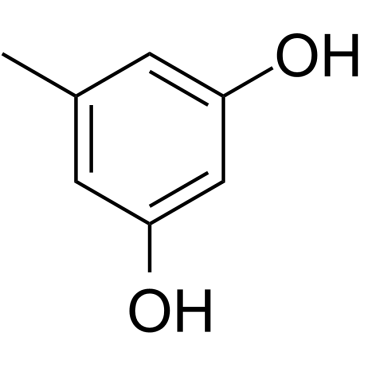
Orcinol (Synonyms: 3,5-Dihydroxytoluene, 5-Methylresorcinol, NSC 12441) |
Katalog-Nr.GC61445
 One-Click Copy Product Info
|

Orcinol (3,5-Dihydroxytoluol) ist eine organische Verbindung, die als biologischer Farbstoff und Indikator fÜr die Proteomforschung verwendet wird.
Products are for research use only. Not for human use. We do not sell to patients.
Cas No.: 504-15-4
Sample solution is provided at 25 µL, 10mM.
_1-3.$$$39978408@51.jpg');)
_1-9.$$$38538795@65.jpg');)
_1-9.$$$39112701@51.jpg');)
_1-7.$$$37316672@70.jpg');)
_366-372.$$$36198801@70.jpg');)
.$$$38565142@65.jpg');)
_1867-1883.$$$33248023@67.jpg');)
_eads6055.$$$39977546@45.jpg');)
_eadm9805.$$$40080571@45.jpg');)
_eadj3020.$$$39666821@45.jpg');)
_1-20.$$$39757301@28.jpg');)
_1-24.$$$38898113@28.jpg');)
_273-287.$$$36806353@46.jpg');)
_1-16.$$$37156877@44.jpg');)
_1-19.$$$37460805@44.jpg');)
_1291-1307.$$$34518654@46.jpg');)
Orcinol is a phenolic compound found in various lichen species with acetylcholinesterase inhibition and antifungal properties[1]. Orcinol reacts with furfural to give a colored compound, which is used for the determination of the amount of RNA[2]. Orcinol serves as a starting material to form biodegradable polyesters with excellent thermal stability through reactions involving the two phenolic hydroxyl groups[3]. Orcinol exhibits antimutagenic, antioxidant, antibacterial, and radical-scavenging effects, and can penetrate the blood-brain barrier, thus Orcinol has been widely used to mitigate depression and anxiety in animal models[4].
In vitro, Orcinol treatment for 72 hours significantly inhibited the viability of L929 cells, with an IC50 value of 858µg/ml[5]. 3mM of Orcinol treatment for 24 hours strongly induced cell death in RAW264.7 cells[6]. Incubation with 1mM Orcinol for 24 hours reduced tyrosinase activity and melanin content in B16F10 cells, attenuated the protein expression and mRNA levels of melanogenesis-related genes, and increased the phosphorylation of extracellular signal-regulated kinase (ERK)[7].
In vivo, daily feeding of a diet containing 2% Orcinol for 9 days led to reduced food intake, urine acidification, and altered nitrogen metabolism in common brushtail possums[8].
References:[1] Zorrilla J G, D’Addabbo T, Roscetto E, et al. Antibiotic and nematocidal metabolites from two lichen species collected on the Island of Lampedusa (Sicily)[J]. International Journal of Molecular Sciences, 2022, 23(15): 8471.
[2] Lusena C V. Estimation of ribonucleic acid with orcinol[J]. Canadian Journal of Chemistry, 1951, 29(1): 107-108.
[3] Wang L, Cheng Z, Djouonkep L D W, et al. Synthesis and properties of biodegradable polyesters based on orcinol[J]. Journal of Polymers and the Environment, 2023, 31(10): 4314-4325.
[4] Wang X, Li G, Li P, et al. Anxiolytic effects of orcinol glucoside and orcinol monohydrate in mice[J]. Pharmaceutical biology, 2015, 53(6): 876-881.
[5] Biskup I, Zaczynska E, Krauze-Baranowska M, et al. Evaluation of cytotoxicity of 5-n-alkylresorcinol homologs and fraction on mouse fibroblast cell line L929[J]. European Food Research and Technology, 2017, 243(7): 1137-1148.
[6] Murakami Y, Kawata A, Ito S, et al. The radical scavenging activity and cytotoxicity of resveratrol, orcinol and 4-allylphenol and their inhibitory effects on cox-2 gene expression and Nf-κb activation in RAW264. 7 cells stimulated with Porphyromonas gingivalis-fimbriae[J]. in vivo, 2015, 29(3): 341-349.
[7] Yu C L, Wu H, Chen Y P, et al. Orcinol inhibits melanogenesis in B16F10 cells via the upregulation of the MAPK/ERK signaling pathway[J]. Natural Product Communications, 2023, 18(3): 1934578X231156704.
[8] Edwards M J, Wallis I R, Foley W J. Acid loads induced by the detoxification of plant secondary metabolites do not limit feeding by common brushtail possums (Trichosurus vulpecula)[J]. Journal of Comparative Physiology B, 2010, 180(2): 247-257.
| Cell experiment [1]: | |
|
Cell lines |
L929 cells |
|
Preparation Method |
L929 cells were cultured in minimum essential medium supplemented with 10% inactivated fetal bovine serum, 100U/ml penicillin, 100µg/ml streptomycin and 2mM L-glutamine at 37°C, in a humidified atmosphere containing 5% CO2. 100µl of 2×10⁴ cells were seeded in 96-well plates and left for 24h. Then, 100µl various doses (0, 20, 50, 100, 500, 1000, 1500, 2000, and 2500µg/ml) of Orcinol were added to the cells and cultivated for 72h, and the cell viability was tested. |
|
Reaction Conditions |
0, 20, 50, 100, 500, 1000, 1500, 2000, and 2500µg/ml; 72h |
|
Applications |
Orcinol treatment reduced cell viability of L929 cells in a dose-dependent manner. |
| Animal experiment [2]: | |
|
Animal models |
Male common brushtail possums |
|
Preparation Method |
Male common brushtail possums were maintained individually in large outdoor pens and fed a variety of leaves and fruits whilst gradually introducing them to an artificial diet over a period of 1 month. Once acclimated to captivity, the possums were housed in individual metabolism cages. The metabolism cages were kept in a temperature-controlled room (18±2°C) conditioned on a 12:12h, light:dark cycle, with the transitions occurring gradually over 1h at 0600 and 1800 hours. Eight common brushtail possums (2.8±0.1kg) were offered two diets, the basal diet and the basal diet supplemented with 2% Orcinol. The experiment was a one-group time series design with all possums receiving the same diet on the same day. The first 2 days the possums ate the basal diet, followed by 9 days of the Orcinol diet and then 4 days of the basal diet. Urine was collected for later analysis of pH, titratable acidity, total N, ammonium and urea. |
|
Dosage form |
2% diet; 9 days; p.o. |
|
Applications |
Orcinol treatment caused urine acidification and altered nitrogen metabolism in common brushtail possums. |
| References: [1] Biskup I, Zaczynska E, Krauze-Baranowska M, et al. Evaluation of cytotoxicity of 5-n-alkylresorcinol homologs and fraction on mouse fibroblast cell line L929[J]. European Food Research and Technology, 2017, 243(7): 1137-1148. [2] Edwards M J, Wallis I R, Foley W J. Acid loads induced by the detoxification of plant secondary metabolites do not limit feeding by common brushtail possums (Trichosurus vulpecula)[J]. Journal of Comparative Physiology B, 2010, 180(2): 247-257. | |
| Cas No. | 504-15-4 | SDF | |
| Überlieferungen | 3,5-Dihydroxytoluene, 5-Methylresorcinol, NSC 12441 | ||
| Canonical SMILES | OC1=CC(C)=CC(O)=C1 | ||
| Formula | C7H8O2 | M.Wt | 124.14 |
| Löslichkeit | DMSO: 100 mg/mL (805.54 mM) | Storage | Store at -20°C |
| Shipping Condition | Evaluation sample solution: shipped with blue ice. All other sizes available: with RT, or with Blue Ice upon request. | ||
| Prepare stock solution | |||

|
1 mg | 5 mg | 10 mg |
| 1 mM | 8.0554 mL | 40.2771 mL | 80.5542 mL |
| 5 mM | 1.6111 mL | 8.0554 mL | 16.1108 mL |
| 10 mM | 805.5 μL | 4.0277 mL | 8.0554 mL |
Step 1: Enter information below (Recommended: An additional animal making an allowance for loss during the experiment)
 g
μL
g
μL
Step 2: Enter the in vivo formulation (This is only the calculator, not formulation. Please contact us first if there is no in vivo formulation at the solubility Section.)
Calculation results:
Working concentration: mg/ml;
Method for preparing DMSO master liquid: mg drug pre-dissolved in μL DMSO ( Master liquid concentration mg/mL, Please contact us first if the concentration exceeds the DMSO solubility of the batch of drug. )
Method for preparing in vivo formulation: Take μL DMSO master liquid, next addμL PEG300, mix and clarify, next addμL Tween 80, mix and clarify, next add μL saline, mix and clarify.
Method for preparing in vivo formulation: Take μL DMSO master liquid, next add μL Corn oil, mix and clarify.
Note: 1. Please make sure the liquid is clear before adding the next solvent.
2. Be sure to add the solvent(s) in order. You must ensure that the solution obtained, in the previous addition, is a clear solution before proceeding to add the next solvent. Physical methods such as vortex, ultrasound or hot water bath can be used to aid dissolving.
3. All of the above co-solvents are available for purchase on the GlpBio website.
Quality Control & SDS
- View current batch:
- Purity: >99.50% Appearance: A solid
- COA (Certificate of Analysis)
- SDS (Safety Data Sheet)
- Datasheet
Average Rating: 5 (Based on Reviews and 17 reference(s) in Google Scholar.)