
Palovarotene (Synonyms: Ro 3300074) |
| Katalog-Nr.GC14304 |
Palovaroten ist ein Agonist des nukleÄren RetinsÄurerezeptors γ (RAR-γ).
Products are for research use only. Not for human use. We do not sell to patients.
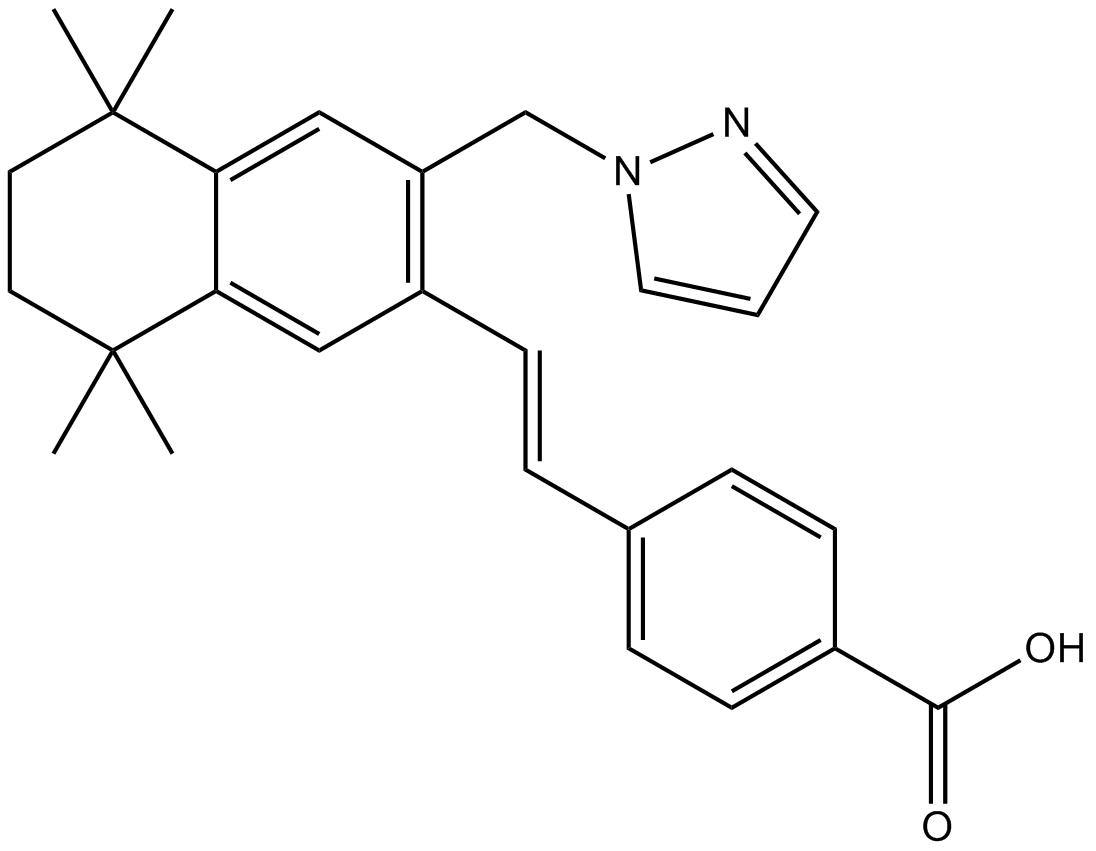
Cas No.: 410528-02-8
Sample solution is provided at 25 µL, 10mM.
Palovarotene is a nuclear retinoic acid receptor γ (RAR-γ) agonist.
Palovarotene suppresses post-traumatic chondrogenesis and osteogenesis and mitigated trauma-induced ectopic bone formation. Palovarotene inhibits subcutaneous and intramuscular heterotopic ossification (HO) in mice. Palovarotene is given orally for 14 days at 1 mg/kg/day starting on post-operative day (POD) 1 or POD-5, and HO amount, wound dehiscence and related processes are monitored for up to 84 days post injury. Compared to vehicle-control animals, Palovarotene significantly decreases HO by 50 to 60% regardless of when the treatment started and if infection is present[1]. Starting from day 1 of injury, half of the Acvr1cR206H/+ mice are treated with Palovarotene by daily gavage for 14 days and the other half received vehicle as control. Analysis by mCT and 3D image reconstruction at day 14 shows that large HO tissue masses have formed in the targeted leg of Acvr1cR206H/+ mutant mice receiving vehicle, but HO formation is greatly diminished in Palovarotene-treated companions by more than 80% based on bone volume/total volume quantification[2].
Reference:
[1]. Pavey GJ, et al. Targeted stimulation of retinoic acid receptor-γ mitigates the formation of heterotopic ossification in an established blast-related traumatic injury model. Bone. 2016 Sep;90:159-67.
[2]. Chakkalakal SA, et al. Palovarotene Inhibits Heterotopic Ossification and Maintains Limb Mobility and Growth in Mice With the Human ACVR1(R206H) Fibrodysplasia Ossificans Progressiva (FOP) Mutation. J Bone Miner Res. 2016 Sep;31(9):1666-75.
[3]. Lees-Shepard JB, et al. Palovarotene reduces heterotopic ossification in juvenile FOP mice but exhibits pronounced skeletal toxicity. Elife. 2018 Sep 18;7. pii: e40814.

Animal experiment: | Rats[1] A total of 110 young adult pathogen-free male Sprague Dawley rats (Rattus norvegicus; 400-600 g) are used. Rats receive via oral gavage (100 μL) either Palovarotene (1.0 mg/kg) or vehicle as control (5% DMSO in corn oil) prepared every other day for 14 days, starting at postoperative day 1 (POD-1) or POD-5. Rats are euthanized at indicated time points post-injury for ex vivo end point analysis by micro-computed CT (μCT), histology and RT-PCR gene transcript expression. Mice[2] One-month-old Acvr1cR206H/+ mice are provided doxycycline chow for 3 days to induce mutant gene expression globally. Mouse quadriceps muscles are injured by injection with 50 mL of 10mM cardiotoxin. Beginning on the day of injury, Palovarotene or vehicle (1:4 DMSO in corn oil) is administered daily for 14 days by oral gavage (100 mg/mouse from days 1 to 3 and 15mg/mouse from days 4 to 14) using a 20-gauge gavage needle. Palovarotene solution in DMSO is stored at -20°C under argon and diluted (1:4) with corn oil for administration. |
References: [1]. Pavey GJ, et al. Targeted stimulation of retinoic acid receptor-γ mitigates the formation of heterotopic ossification in an established blast-related traumatic injury model. Bone. 2016 Sep;90:159-67. | |
| Cas No. | 410528-02-8 | SDF | |
| Überlieferungen | Ro 3300074 | ||
| Chemical Name | 4-[(E)-2-[5,5,8,8-tetramethyl-3-(pyrazol-1-ylmethyl)-6,7-dihydronaphthalen-2-yl]ethenyl]benzoic acid | ||
| Canonical SMILES | CC1(CCC(C2=C1C=C(C(=C2)C=CC3=CC=C(C=C3)C(=O)O)CN4C=CC=N4)(C)C)C | ||
| Formula | C27H30N2O2 | M.Wt | 414.54 |
| Löslichkeit | ≥ 41.5mg/mL in DMSO | Storage | Store at -20°C |
| General tips | Please select the appropriate solvent to prepare the stock solution according to the
solubility of the product in different solvents; once the solution is prepared, please store it in
separate packages to avoid product failure caused by repeated freezing and thawing.Storage method
and period of the stock solution: When stored at -80°C, please use it within 6 months; when stored
at -20°C, please use it within 1 month. To increase solubility, heat the tube to 37°C and then oscillate in an ultrasonic bath for some time. |
||
| Shipping Condition | Evaluation sample solution: shipped with blue ice. All other sizes available: with RT, or with Blue Ice upon request. | ||
| Prepare stock solution | |||
|
1 mg | 5 mg | 10 mg |
| 1 mM | 2.4123 mL | 12.0616 mL | 24.1231 mL |
| 5 mM | 482.5 μL | 2.4123 mL | 4.8246 mL |
| 10 mM | 241.2 μL | 1.2062 mL | 2.4123 mL |
Step 1: Enter information below (Recommended: An additional animal making an allowance for loss during the experiment)
Step 2: Enter the in vivo formulation (This is only the calculator, not formulation. Please contact us first if there is no in vivo formulation at the solubility Section.)
Calculation results:
Working concentration: mg/ml;
Method for preparing DMSO master liquid: mg drug pre-dissolved in μL DMSO ( Master liquid concentration mg/mL, Please contact us first if the concentration exceeds the DMSO solubility of the batch of drug. )
Method for preparing in vivo formulation: Take μL DMSO master liquid, next addμL PEG300, mix and clarify, next addμL Tween 80, mix and clarify, next add μL ddH2O, mix and clarify.
Method for preparing in vivo formulation: Take μL DMSO master liquid, next add μL Corn oil, mix and clarify.
Note: 1. Please make sure the liquid is clear before adding the next solvent.
2. Be sure to add the solvent(s) in order. You must ensure that the solution obtained, in the previous addition, is a clear solution before proceeding to add the next solvent. Physical methods such as vortex, ultrasound or hot water bath can be used to aid dissolving.
3. All of the above co-solvents are available for purchase on the GlpBio website.
Quality Control & SDS
- View current batch:
- Purity: >99.00%
- COA (Certificate Of Analysis)
- SDS (Safety Data Sheet)
- Datasheet
Average Rating: 5 (Based on Reviews and 27 reference(s) in Google Scholar.)
GLPBIO products are for RESEARCH USE ONLY. Please make sure your review or question is research based.
Required fields are marked with *


