

RO8191 (Synonyms: RO4948191) |
Katalog-Nr.GC16956
 One-Click Copy Product Info
|

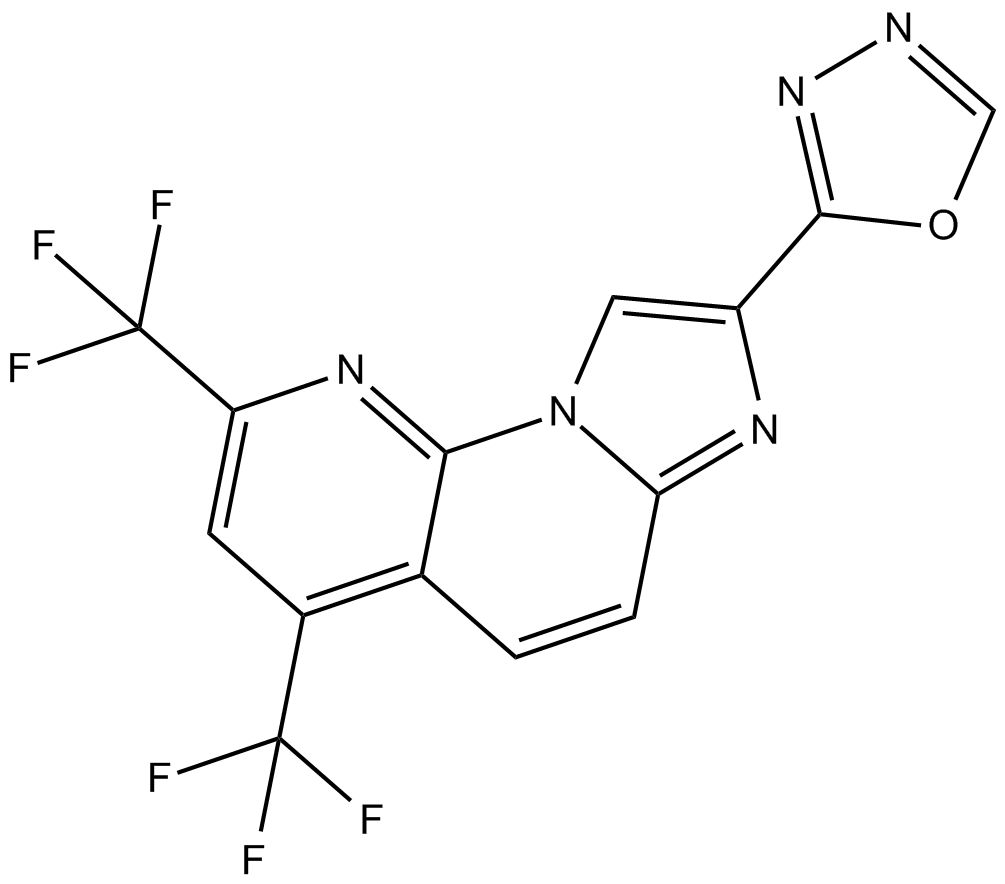
RO8191 (CDM-3008), eine Imidazonaphthyridin-Verbindung, ist ein oral aktiver und potenter Interferon (IFN)-Rezeptoragonist.
Products are for research use only. Not for human use. We do not sell to patients.
Cas No.: 691868-88-9
Sample solution is provided at 25 µL, 10mM.
_1-3.$$$39978408@51.jpg');)
_1-9.$$$38538795@65.jpg');)
_1-9.$$$39112701@51.jpg');)
_1-7.$$$37316672@70.jpg');)
_366-372.$$$36198801@70.jpg');)
.$$$38565142@65.jpg');)
_1867-1883.$$$33248023@67.jpg');)
_eads6055.$$$39977546@45.jpg');)
_eadm9805.$$$40080571@45.jpg');)
_eadj3020.$$$39666821@45.jpg');)
_1-20.$$$39757301@28.jpg');)
_1-24.$$$38898113@28.jpg');)
_273-287.$$$36806353@46.jpg');)
_1-16.$$$37156877@44.jpg');)
_1-19.$$$37460805@44.jpg');)
_1291-1307.$$$34518654@46.jpg');)
RO8191 is an orally active interferon (IFN) receptor agonist that displays potent anti-Hepatitis C virus (HCV) activity with an EC50 value of 0.2µM[1]. RO8191 activates the JAK2/STAT3 signaling pathway, reducing the protein density of E-cadherin and promoting the process of epithelial-mesenchymal transition (EMT)[2]. RO8191 has been widely used in tumor research to regulate the malignant phenotype of non-small cell lung cancer and the tumor microenvironment[3].
In vitro, RO8191 treatment for 16 hours significantly inhibited the replication of Chikungunya virus (CHIKV) in BHK-21 cells, with an EC50 value of 0.88µM[4]. 4µM of RO8191 treatment for 24 hours interfered with the inhibitory effect of 25µM Baicalein on the expression of p-STAT3, c-Myc and GLUT1 in lipopolysaccharide (LPS)-treated BV-2 cells, and restored glycolytic activity[5]. Treatment with 10µM RO8191 for 7 days reversed the inhibitory effect of si-FoxO1 on the cell death of SRA01/04 cells under high glucose conditions, reducing cell viability and increasing the expression levels of NLRC4 and IL-6[6]. Incubation with 10µM RO8191 for 48 hours reversed the cell death and pyroptosis mediated by SH-4-54 (10µM) in U87 and LN229 cells, and restored the normal morphology of the cells[7].
In vivo, a single intraperitoneal injection of RO8191 at a dose of 400µg on the third day induced embryo implantation and decidualization in a mouse model of delayed implantation, and activated STAT3 in the endometrium[8]. Intraperitoneal injection of RO8191 at a dose of 1mg/kg/day for 5 consecutive days aggravated radiation-induced esophagitis, reduced the area of the epithelial layer, increased the mRNA levels of Cxcl1 and Il1b in esophageal tissue, accompanied by elevated levels of cleaved PARP protein, and led to body weight loss in mice[9].
References:[1] Wang H, Wang S, Cheng L, et al. Discovery of imidazo [1, 2-α][1, 8] naphthyridine derivatives as potential HCV entry inhibitor[J]. ACS medicinal chemistry letters, 2015, 6(9): 977.
[2] Lei H, Shi J, Teng Y, et al. Baicalein modulates the radiosensitivity of cervical cancer cells in vitro via miR-183 and the JAK2/STAT3 signaling pathway[J]. Advances in Clinical and Experimental Medicine, 2021, 30(7): 727-736.
[3] Shi S, Han J, Wu Q, et al. FAM64A regulates the malignant phenotype and tumor microenvironment of non-small cell lung cancer by activating the JAK/STAT3/PDL1 axis[J]. Journal of Molecular Histology, 2025, 56(2): 95.
[4] Ruiz U E A, Santos I A, Grosche V R, et al. Imidazonaphthyridine effects on Chikungunya virus replication: Antiviral activity by dependent and independent of interferon type 1 pathways[J]. Virus Research, 2023, 324: 199029.
[5] Gao L, Liu Y, Zhou Y, et al. Baicalein attenuates neuroinflammation in LPS-treated BV-2 cells by inhibiting glycolysis via STAT3/c-Myc pathway[J]. Neurochemical Research, 2023, 48(11): 3363-3377.
[6] Li Y, Pan A P, Ye Y, et al. FoxO1 promotes high glucose-induced inflammation and cataract formation via JAK1/STAT1[J]. Graefe's Archive for Clinical and Experimental Ophthalmology, 2025, 263(6): 1585-1596.
[7] Yu D, Wang S, Wang J, et al. EZH2–STAT3 signaling pathway regulates GSDMD-mediated pyroptosis in glioblastoma[J]. Cell Death Discovery, 2024, 10(1): 341.
[8] Shu J, Terakawa J, Takikawa S, et al. RO8191, a new compound for initiating embryo implantation in mice[J]. Scientific Reports, 2025, 15(1): 32387.
[9] Kitamura H, Tanigawa T, Kuzumoto T, et al. Interferon-α exerts proinflammatory properties in experimental radiation-induced esophagitis: possible involvement of plasmacytoid dendritic cells[J]. Life sciences, 2022, 289: 120215.
| Cell experiment [1]: | |
|
Cell lines |
BHK-21 cells |
|
Preparation Method |
BHK-21 cells were cultured in DMEM medium, supplemented 100U/ml of penicillin, 100mg/ml of streptomycin, 1% non-essential amino acids, and 1% fetal bovine serum (FBS) in a humidified 5% CO2 incubator at 37°C. BHK-21 cells were seeded at a density of 5×10⁴ cells per well into 48-well plates 24h, the cell proliferation was tested. Cells were infected with CHIKV-nanoluc at a multiplicity of infection (MOI) of 0.1 in the presence of RO8191 at serial dilutions (0.5, 1, 5, 10, 30, and 60µM). After 16h incubation, cell viability was calculated. |
|
Reaction Conditions |
0.5, 1, 5, 10, 30, and 60µM; 16h |
|
Applications |
RO8191 treatment reduced cell viability of CHIKV-infected BHK-21 cells in a dose-dependent manner. |
| Animal experiment [2]: | |
|
Animal models |
Female ICR mice |
|
Preparation Method |
Female ICR mice were fed ad libitum under controlled light-dark cycles (12h of light followed by 12h of dark) at 22±3°C. The first day of pregnancy (D1) was determined as the morning when a vaginal plug was observed in the female that had been mated with fertile wild-type males the previous evening. To induce the delayed implantation mice, plug-positive ICR females were ovariectomized between 13:00 and 15:30 on D3 under sevoflurane anesthesia, and siliconized medroxyprogesterone acetate (100 µl/head) was injected subcutaneously in the ventral region. RO8191 was dissolved in sesame oil, and a single intraperitoneal injection of RO8191 (400µg/head) or sesame oil was performed at 13:00 on D7. Mice were euthanized in a carbon dioxide chamber, followed by dissection at 13:00 on D10 to count the number of implantation sites. |
|
Dosage form |
400µg; once; i.p. |
|
Applications |
RO8191 treatment induced embryo implantation in delayed implantation mice. |
| References: [1] Ruiz U E A, Santos I A, Grosche V R, et al. Imidazonaphthyridine effects on Chikungunya virus replication: Antiviral activity by dependent and independent of interferon type 1 pathways[J]. Virus Research, 2023, 324: 199029. [2] Shu J, Terakawa J, Takikawa S, et al. RO8191, a new compound for initiating embryo implantation in mice[J]. Scientific Reports, 2025, 15(1): 32387. | |
| Cas No. | 691868-88-9 | SDF | |
| Überlieferungen | RO4948191 | ||
| Chemical Name | 8-(1,3,4-oxadiazol-2-yl)-2,4-bis(trifluoromethyl)-imidazo[1,2-a][1,8]naphthyridine | ||
| Canonical SMILES | FC(C1=CC(C(F)(F)F)=C2C(N3C(C=C2)=NC(C4=NN=CO4)=C3)=N1)(F)F | ||
| Formula | C14H5F6N5O | M.Wt | 373.2 |
| Löslichkeit | ≤0.1mg/ml in DMSO;0.5mg/ml in dimethyl formamide | Storage | Store at 2-8°C |
| General tips | Please select the appropriate solvent to prepare the stock solution according to the
solubility of the product in different solvents; once the solution is prepared, please store it in
separate packages to avoid product failure caused by repeated freezing and thawing.Storage method
and period of the stock solution: When stored at -80°C, please use it within 6 months; when stored
at -20°C, please use it within 1 month. To increase solubility, heat the tube to 37°C and then oscillate in an ultrasonic bath for some time. |
||
| Shipping Condition | Evaluation sample solution: shipped with blue ice. All other sizes available: with RT, or with Blue Ice upon request. | ||
| Prepare stock solution | |||

|
1 mg | 5 mg | 10 mg |
| 1 mM | 2.6795 mL | 13.3976 mL | 26.7953 mL |
| 5 mM | 535.9 μL | 2.6795 mL | 5.3591 mL |
| 10 mM | 268 μL | 1.3398 mL | 2.6795 mL |
Step 1: Enter information below (Recommended: An additional animal making an allowance for loss during the experiment)
 g
μL
g
μL
Step 2: Enter the in vivo formulation (This is only the calculator, not formulation. Please contact us first if there is no in vivo formulation at the solubility Section.)
Calculation results:
Working concentration: mg/ml;
Method for preparing DMSO master liquid: mg drug pre-dissolved in μL DMSO ( Master liquid concentration mg/mL, Please contact us first if the concentration exceeds the DMSO solubility of the batch of drug. )
Method for preparing in vivo formulation: Take μL DMSO master liquid, next addμL PEG300, mix and clarify, next addμL Tween 80, mix and clarify, next add μL saline, mix and clarify.
Method for preparing in vivo formulation: Take μL DMSO master liquid, next add μL Corn oil, mix and clarify.
Note: 1. Please make sure the liquid is clear before adding the next solvent.
2. Be sure to add the solvent(s) in order. You must ensure that the solution obtained, in the previous addition, is a clear solution before proceeding to add the next solvent. Physical methods such as vortex, ultrasound or hot water bath can be used to aid dissolving.
3. All of the above co-solvents are available for purchase on the GlpBio website.
Quality Control & SDS
- View current batch:
- Purity: >98.50% Appearance: A solid
- COA (Certificate of Analysis)
- SDS (Safety Data Sheet)
- Datasheet
Average Rating: 5 (Based on Reviews and 20 reference(s) in Google Scholar.)