

PMSF (Synonyms: Benzylsulfonyl fluoride, NSC 88499, PMSF) |
Katalog-Nr.GC10477
 One-Click Copy Product Info
|

PMSF ist ein irreversibler Serinproteaseinhibitor, der oft vor der Zell- oder Gewebelyse dem Lysepuffer zugesetzt wird, um Proteinabbau zu verhindern.
Products are for research use only. Not for human use. We do not sell to patients.
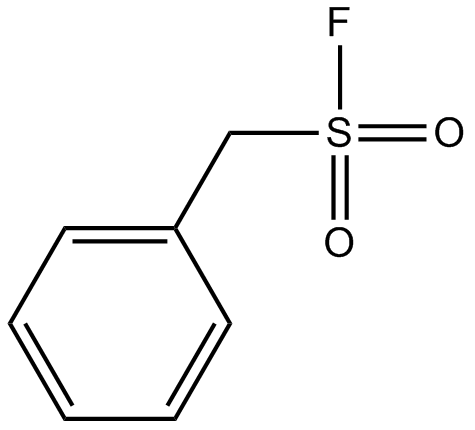
Cas No.: 329-98-6
Sample solution is provided at 25 µL, 10mM.
PMSF ist ein irreversibler Serinproteaseinhibitor, der oft vor der Zell- oder Gewebelyse dem Lysepuffer zugesetzt wird, um Proteinabbau zu verhindern[1,2]. PMSF kann Chymotrypsin, Trypsin, Thrombin usw. wirksam hemmen. Das Wirkprinzip von PMSF ist, das aktive Zentrum des Serinrests, das die Enzymaktivität bestimmt, spezifisch zu erkennen und zu sulfonieren. PMSF ist auch ein Inhibitor der Fettsäureamidhydrolase(FAAH), von Cysteinproteasen(wie Papain, dessen inhibitorische Aktivität durch DTT aufgehoben wird) und der Acetylcholinesterase aus Säugetieren[3]. Die inhibitorische Wirkung von PMSF auf Papain kann durch DTT(Dithiothreitol) aufgehoben werden.
Die Deaktivierung von PMSF nimmt mit steigendem pH-Wert und steigender Temperatur zu. Die Halbwertszeiten der Inhibitoren sind bei 25°C und pH 7.0, 7.5 bzw. 8.0 etwa 110, 55 bzw. 35 Minuten. Bei pH 8 werden 100μM PMSF innerhalb von 1 Stunde bei 25°C oder 22 Stunden bei 4°C nahezu vollständig inaktiviert. Mit 100% Isopropylalkohol hergestellte PMSF-Stammlösungen sind bei 25°C über Monate oder länger stabil. Innerhalb einer Woche bei 25°C und pH 7.0 reaktivierte sich durch PMSF gehemmtes Chymotrypsin nicht[4].
Im Tierversuch zeigte PMSF in Dosierungen von 120 und 300 mg/kg signifikante analgetische Effekte. Subanalgetische Dosierungen(60 mg/kg, i.p.) von PMSF können die Toleranz gegenüber akuter und chronischer Gabe von Opioid reduzieren[3].
PMSF kann allein oder häufig gemischt mit anderen Proteaseinhibitoren wie Aprotinin A oder Phosphataseinhibitoren wie Natriumorthovanadat verwendet werden.
PMSF ist schlecht wasserlöslich und in wässrigen Lösungen wenig stabil. Es wird empfohlen, es vor Gebrauch Lysepuffer oder anderen wässrigen Lösungen zuzusetzen. PMSF-Pulver kann zur Herstellung einer Aufbewahrungslösung in Methanol, Ethanol oder Isopropylalkohol gelöst werden. Die empfohlene Konzentration ist 100-200 mM. Die effektive Arbeitskonzentration von PMSF ist 0.1-1mM.
| Tierversuch [1]: | |
Tiermodelle | Erwachsene männliche Mäuse |
Vorbereitungsmethode | Der Test misst die analgetische Aktivität. Alle Tiere wurden auf eine 55 ± 1 °C heiße Platte gelegt und die Latenzzeit bis zum Springen oder Lecken aufgezeichnet. Die Cut-off-Zeit wurde auf 15 Sekunden festgelegt, um die Mäuse vor Schäden zu schützen. Die antinozizeptiven Effekte einer Einzeldosis Morphin(10 mg/kg s.c.) und PMSF(60, 120 und 300 mg/kg) wurden bestimmt. |
Dosierungsform | 60, 120 und 300 mg/kg, i.p. |
Anwendungen | Die Ergebnisse deuten darauf hin, dass die Verabreichung der PMSF-Dosen(120 und 300 mg/kg, i.p.) zu signifikanten Änderungen der analgetischen Latenzzeit führte, während die Verabreichung von PMSF(60 mg/kg i.p.) keinen signifikanten Unterschied hatte. |
References: | |
| Cas No. | 329-98-6 | SDF | |
| Überlieferungen | Benzylsulfonyl fluoride, NSC 88499, PMSF | ||
| Chemical Name | phenylmethanesulfonyl fluoride | ||
| Canonical SMILES | C1=CC=C(C=C1)CS(=O)(=O)F | ||
| Formula | C7H7FO2S | M.Wt | 174.2 |
| Löslichkeit | ≥ 17.4mg/mL in DMSO | Storage | Store at RT |
| General tips | Please select the appropriate solvent to prepare the stock solution according to the
solubility of the product in different solvents; once the solution is prepared, please store it in
separate packages to avoid product failure caused by repeated freezing and thawing.Storage method
and period of the stock solution: When stored at -80°C, please use it within 6 months; when stored
at -20°C, please use it within 1 month. To increase solubility, heat the tube to 37°C and then oscillate in an ultrasonic bath for some time. |
||
| Shipping Condition | Evaluation sample solution: shipped with blue ice. All other sizes available: with RT, or with Blue Ice upon request. | ||
| Prepare stock solution | |||

|
1 mg | 5 mg | 10 mg |
| 1 mM | 5.7405 mL | 28.7026 mL | 57.4053 mL |
| 5 mM | 1.1481 mL | 5.7405 mL | 11.4811 mL |
| 10 mM | 574.1 μL | 2.8703 mL | 5.7405 mL |
Step 1: Enter information below (Recommended: An additional animal making an allowance for loss during the experiment)
 g
μL
g
μL
Step 2: Enter the in vivo formulation (This is only the calculator, not formulation. Please contact us first if there is no in vivo formulation at the solubility Section.)
Calculation results:
Working concentration: mg/ml;
Method for preparing DMSO master liquid: mg drug pre-dissolved in μL DMSO ( Master liquid concentration mg/mL, Please contact us first if the concentration exceeds the DMSO solubility of the batch of drug. )
Method for preparing in vivo formulation: Take μL DMSO master liquid, next addμL PEG300, mix and clarify, next addμL Tween 80, mix and clarify, next add μL saline, mix and clarify.
Method for preparing in vivo formulation: Take μL DMSO master liquid, next add μL Corn oil, mix and clarify.
Note: 1. Please make sure the liquid is clear before adding the next solvent.
2. Be sure to add the solvent(s) in order. You must ensure that the solution obtained, in the previous addition, is a clear solution before proceeding to add the next solvent. Physical methods such as vortex, ultrasound or hot water bath can be used to aid dissolving.
3. All of the above co-solvents are available for purchase on the GlpBio website.
Quality Control & SDS
- View current batch:
- Purity: >98.00% Appearance: A solid
- COA (Certificate of Analysis)
- SDS (Safety Data Sheet)
- Datasheet
Average Rating: 5 (Based on Reviews and 30 reference(s) in Google Scholar.)