

SN-6 |
Katalog-Nr.GC15195
 One-Click Copy Product Info
|

SN-6 ist ein selektiver Na+/Ca2+-Austauscher (NCX)-Inhibitor und hemmt die 45Ca2+-Aufnahme durch NCX1, NCX2 und NCX3 mit IC50-Werten von 2,9, 16 bzw. 8,6 μM.
Products are for research use only. Not for human use. We do not sell to patients.
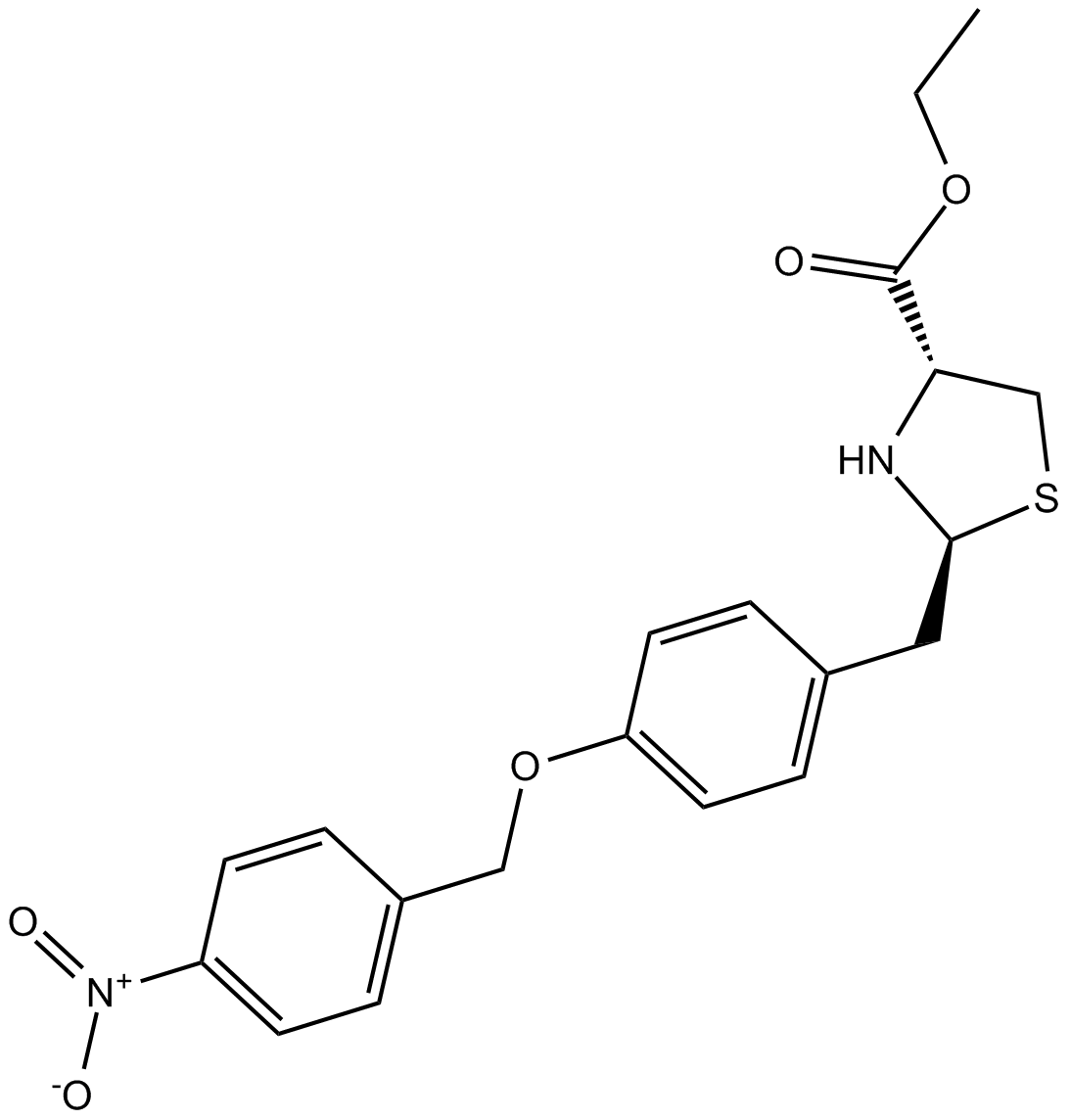
Cas No.: 415697-08-4
Sample solution is provided at 25 µL, 10mM.
_1-3.$$$39978408@51.jpg');)
_1-9.$$$38538795@65.jpg');)
_1-9.$$$39112701@51.jpg');)
_1-7.$$$37316672@70.jpg');)
_366-372.$$$36198801@70.jpg');)
.$$$38565142@65.jpg');)
_1867-1883.$$$33248023@67.jpg');)
_eads6055.$$$39977546@45.jpg');)
_eadm9805.$$$40080571@45.jpg');)
_eadj3020.$$$39666821@45.jpg');)
_1-20.$$$39757301@28.jpg');)
_1-24.$$$38898113@28.jpg');)
_273-287.$$$36806353@46.jpg');)
_1-16.$$$37156877@44.jpg');)
_1-19.$$$37460805@44.jpg');)
_1291-1307.$$$34518654@46.jpg');)
SN 6 is a selective Na+/Ca2+ exchanger (NCX) inhibitor, and inhibits 45Ca2+ uptake by NCX1, NCX2, and NCX3, with IC50s of 2.9, 16, and 8.6 μM, respectively.
SN 6 is a selective Na+/Ca2+ exchanger inhibitor, which inhibits the initial rate of 45Ca2+ uptake into NCX1, NCX2, and NCX3 transfectants with IC50 values of 2.9 ± 0.12, 16 ± 1.1, and 8.6 ± 0.27 μM. SN 6 (up to 30 μM) also less potently inhibits muscarinic acetylcholine receptor, with a higher IC50 of 18 μM. SN 6 (0.3-30 μM) completely inhibits the initial rate of Na+i-dependent 45Ca2+ uptake into Na+-loaded sarcolemmal vesicles in a dose dependent manner (IC50, 5.3 ± 0.37 μM). SN 6 (0.3-10 μM) dose-dependently protects against the hypoxia/reoxygenation-induced LDH release in parental LLC-PK1 cells and NCX1 transfectants but not in K229Q transfectants[1]. SN 6 (1-30 μM) suppresses the bidirectional outward and inward INCX in a concentration-dependent manner, with IC50 values of 2.3 μM and 1.9 μM, respectively. SN 6 also inhibits bidirectional current (INCX) in a [Na+]i concentration-dependent manner, with IC50 values of 3.4 μM, 2.3 μM, and 1.1 μM at 10 mM, 20 mM, and 30 mM [Na+]i, respectively[2]. SN 6 inhibits hypoxia/reoxygenation-induced LDH release with an IC50 value of 0.63 ± 0.15 μM in NCX1 transfectants[3].
References:
[1]. Iwamoto T, et al. The exchanger inhibitory peptide region-dependent inhibition of Na+/Ca2+ exchange by SN-6 [2-[4-(4-nitrobenzyloxy)benzyl]thiazolidine-4-carboxylic acid ethyl ester], a novel benzyloxyphenyl derivative. Mol Pharmacol. 2004 Jul;66(1):45-55.
[2]. Niu CF, et al. Electrophysiological effects of SN-6, a novel Na+/Ca2+ exchange inhibitor on membrane currents in guinea pig ventricular myocytes. Ann N Y Acad Sci. 2007 Mar;1099:534-9.
[3]. Kita S, et al. Inhibitory mechanism of SN-6, a novel benzyloxyphenyl Na+/Ca2+ exchange inhibitor. Ann N Y Acad Sci. 2007 Mar;1099:529-33.
Cell experiment: | Na+i-dependent 45Ca2+ uptake into cells expressing the wild-type or mutated exchangers are assayed. In brief, confluent transfectants in 24-well dishes are loaded with Na+ by incubation at 37°C for 40 min in 0.5 mL of balanced salt solution (BSS) (10 mM HEPES/Tris, pH 7.4, 146 mM NaCl, 4 mM KCl, 2 mM MgCl2, 0.1 mM CaCl2, 10 mM glucose, and 0.1% bovine serum albumin) containing 1 mM ouabain and 10 μM monensin. 45Ca2+ uptake is then initiated by switching the medium to Na+-free BSS (replacing NaCl with equimolar choline chloride) or to normal BSS, both of which contain 0.1 mM 45CaCl2 (370 kBq/mL) and 1 mM ouabain. After a 30-s incubation, 45Ca2+ uptake is terminated by washing cells four times with an ice-cold solution containing 10 mM HEPES/Tris, pH 7.4, 120 mM choline chloride, and 10 mM LaCl3. Cells are then solubilized with 0.1 N NaOH, and aliquots are taken for determination of radioactivity and protein. When present, SN 6 and KB-R7943 are included in the medium 15 min before the start of 45Ca2+ uptake[1]. |
References: [1]. Iwamoto T, et al. The exchanger inhibitory peptide region-dependent inhibition of Na+/Ca2+ exchange by SN-6 [2-[4-(4-nitrobenzyloxy)benzyl]thiazolidine-4-carboxylic acid ethyl ester], a novel benzyloxyphenyl derivative. Mol Pharmacol. 2004 Jul;66(1):45-55. | |
| Cas No. | 415697-08-4 | SDF | |
| Chemical Name | (2S,4R)-ethyl 2-(4-((4-nitrobenzyl)oxy)benzyl)thiazolidine-4-carboxylate | ||
| Canonical SMILES | O=C([C@H]1N[C@H](CC(C=C2)=CC=C2OCC(C=C3)=CC=C3[N+]([O-])=O)SC1)OCC | ||
| Formula | C20H22N2O5S | M.Wt | 402.16 |
| Löslichkeit | DMSO : 62.5 mg/mL (155.29 mM; Need ultrasonic) | Storage | Store at -20°C |
| General tips | Please select the appropriate solvent to prepare the stock solution according to the
solubility of the product in different solvents; once the solution is prepared, please store it in
separate packages to avoid product failure caused by repeated freezing and thawing.Storage method
and period of the stock solution: When stored at -80°C, please use it within 6 months; when stored
at -20°C, please use it within 1 month. To increase solubility, heat the tube to 37°C and then oscillate in an ultrasonic bath for some time. |
||
| Shipping Condition | Evaluation sample solution: shipped with blue ice. All other sizes available: with RT, or with Blue Ice upon request. | ||
| Prepare stock solution | |||

|
1 mg | 5 mg | 10 mg |
| 1 mM | 2.4866 mL | 12.4329 mL | 24.8657 mL |
| 5 mM | 497.3 μL | 2.4866 mL | 4.9731 mL |
| 10 mM | 248.7 μL | 1.2433 mL | 2.4866 mL |
Step 1: Enter information below (Recommended: An additional animal making an allowance for loss during the experiment)
 g
μL
g
μL
Step 2: Enter the in vivo formulation (This is only the calculator, not formulation. Please contact us first if there is no in vivo formulation at the solubility Section.)
Calculation results:
Working concentration: mg/ml;
Method for preparing DMSO master liquid: mg drug pre-dissolved in μL DMSO ( Master liquid concentration mg/mL, Please contact us first if the concentration exceeds the DMSO solubility of the batch of drug. )
Method for preparing in vivo formulation: Take μL DMSO master liquid, next addμL PEG300, mix and clarify, next addμL Tween 80, mix and clarify, next add μL saline, mix and clarify.
Method for preparing in vivo formulation: Take μL DMSO master liquid, next add μL Corn oil, mix and clarify.
Note: 1. Please make sure the liquid is clear before adding the next solvent.
2. Be sure to add the solvent(s) in order. You must ensure that the solution obtained, in the previous addition, is a clear solution before proceeding to add the next solvent. Physical methods such as vortex, ultrasound or hot water bath can be used to aid dissolving.
3. All of the above co-solvents are available for purchase on the GlpBio website.
Quality Control & SDS
- View current batch:
- Purity: >99.50% Appearance: A solid
- COA (Certificate of Analysis)
- SDS (Safety Data Sheet)
- Datasheet
Average Rating: 5 (Based on Reviews and 23 reference(s) in Google Scholar.)