

Vatalanib (Synonyms: CGP-79787; PTK 787; ZK222584) |
Katalog-Nr.GC14464
 One-Click Copy Product Info
|

A potent and selective VEGF receptor inhibitor
Products are for research use only. Not for human use. We do not sell to patients.
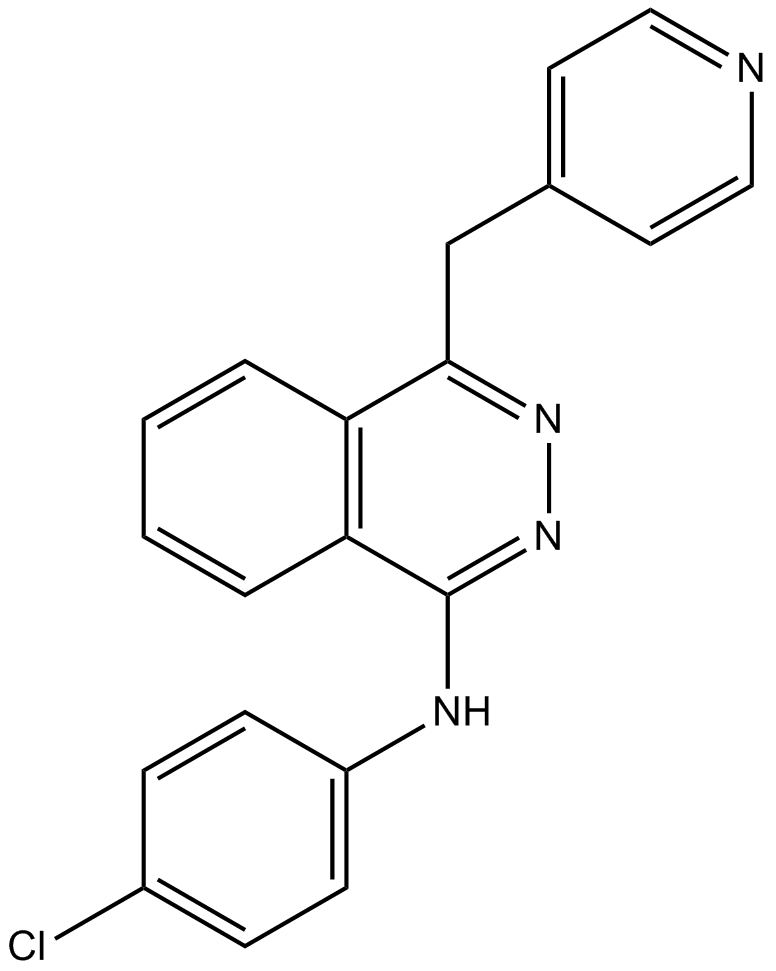
Cas No.: 212141-54-3
Sample solution is provided at 25 µL, 10mM.
Vatalanib is a novel and potent inhibitor of VEGFR with IC50 value of 77 nM, 27 nM and 37 nM for VEGFR-1 (Flt-1), VEGFR-2 (FLK-1) and VEGFR-2 (KDR), respectively [1].
The vascular endothelial growth factor receptors (VEGFRs) are tyrosine kinases and are receptors for VEGF. VEGF acts as a key factor in pathological situations that involve in pathological situations that involve enhancing vascular permeability as well as neovascularization [1].
In CHO and HUVECs cells transfected with the KDR receptor, Vatalanib inhibited the VEGF-induced phosphorylation of KDR with an IC50 of 34 nM and 17 nM for the CHO and HUVECs cells, respectively. Also, Vatalanib inhibited thymidine incorporation induced by VEGF with IC50 value of 7.1 nM in HUVECs cells. Vatalanib inhibited VEGF-induced endothelial cell proliferation in a dose-dependant way [1].
In a growth factor implant mice model, Vatalanib (12.5, 25 or 50 mg/kg, 6 days) inhibited the angiogenic response around the implant induced by VEGF and PDGF [1]. In a xenograft mouse model, treatment mice with Vatalanib through gastric tube daily caused tumor inhibition rate of 76% [2].
References:
[1]. Wood JM, Bold G, Buchdunger E, et al. PTK787/ZK 222584, a novel and potent inhibitor of vascular endothelial growth factor receptor tyrosine kinases, impairs vascular endothelial growth factor-induced responses and tumor growth after oral administration. Cancer Res, 2000, 60(8): 2178-2189.
[2]. Paesler J, Gehrke I, Gandhirajan RK, et al. The vascular endothelial growth factor receptor tyrosine kinase inhibitors vatalanib and pazopanib potently induce apoptosis in chronic lymphocytic leukemia cells in vitro and in vivo. Clin Cancer Res, 2010, 16(13): 3390-3398.
Kinase experiment: | Each GST-fused kinase is incubated under optimized buffer conditions. ATP in a total volume of 30 μL in the presence or absence of a test substance (Vatalanib) for 10 min at ambient temperature. The reaction is stopped by adding 10 μL of 250 mM EDTA[1]. |
Cell experiment: | Subconfluent HUVECs are seeded into 96-well plates coated with 1.5% gelatin. After 24 h, growth medium is replaced by basal medium containing 1.5% FCS and a constant concentration of VEGF (50 ng/mL), bFGF (0.5 ng/mL), or FCS (5%), in the presence or absence of Vatalanib. As a control, wells without growth factor are also included. After 24 h of incubation, BrdUrd labeling solution is added, and cells incubated an additional 24 h before fixation, blocking, and addition of peroxidase-labeled anti-BrdUrd antibody. Bound antibody is then detected using 3,3' 5,5'-tetramethylbenzidine substrate[1]. |
Animal experiment: | A porous Teflon chamber (volume, 0.5 mL) is filled with 0.8% w/v agar containing heparin (20 units/mL) with or without growth factor (3 μg/mL human VEGF, 2 μg/mL human PDGF) is implanted s.c. on the dorsal flank of C57/C6 mice. The mice are treated with Vatalanib (12.5, 25 or 50 mg/kg dihydrochloride p.o. once daily) or vehicle (water) starting 1 day before implantation of the chamber and continuing for 5 days after. At the end of treatment, the mice are killed, and the chambers are removed. The vascularized tissue growing around the chamber is carefully removed and weighed, and the blood content is assessed by measuring the hemoglobin content of the tissue[1]. |
References: [1]. Wood JM, et al. PTK787/ZK 222584, a novel and potent inhibitor of vascular endothelial growth factor receptor tyrosine kinases, impairs vascular endothelial growth factor-induced responses and tumor growth after oral administration. Cancer Res. 2000, 60(8 | |
| Cas No. | 212141-54-3 | SDF | |
| Überlieferungen | CGP-79787; PTK 787; ZK222584 | ||
| Chemical Name | N-(4-chlorophenyl)-4-(pyridin-4-ylmethyl)phthalazin-1-amine | ||
| Canonical SMILES | C1=CC=C2C(=C1)C(=NN=C2NC3=CC=C(C=C3)Cl)CC4=CC=NC=C4 | ||
| Formula | C20H15ClN4 | M.Wt | 346.81 |
| Löslichkeit | ≥ 16.85 mg/mL in DMSO, ≥ 3.0125 mg/mL in EtOH with ultrasonic and warming, ≥ 32.53 mg/mL in Water with ultrasonic and warming | Storage | Store at -20°C |
| General tips | Please select the appropriate solvent to prepare the stock solution according to the
solubility of the product in different solvents; once the solution is prepared, please store it in
separate packages to avoid product failure caused by repeated freezing and thawing.Storage method
and period of the stock solution: When stored at -80°C, please use it within 6 months; when stored
at -20°C, please use it within 1 month. To increase solubility, heat the tube to 37°C and then oscillate in an ultrasonic bath for some time. |
||
| Shipping Condition | Evaluation sample solution: shipped with blue ice. All other sizes available: with RT, or with Blue Ice upon request. | ||
| Prepare stock solution | |||

|
1 mg | 5 mg | 10 mg |
| 1 mM | 2.8834 mL | 14.4171 mL | 28.8342 mL |
| 5 mM | 576.7 μL | 2.8834 mL | 5.7668 mL |
| 10 mM | 288.3 μL | 1.4417 mL | 2.8834 mL |
Step 1: Enter information below (Recommended: An additional animal making an allowance for loss during the experiment)
 g
μL
g
μL
Step 2: Enter the in vivo formulation (This is only the calculator, not formulation. Please contact us first if there is no in vivo formulation at the solubility Section.)
Calculation results:
Working concentration: mg/ml;
Method for preparing DMSO master liquid: mg drug pre-dissolved in μL DMSO ( Master liquid concentration mg/mL, Please contact us first if the concentration exceeds the DMSO solubility of the batch of drug. )
Method for preparing in vivo formulation: Take μL DMSO master liquid, next addμL PEG300, mix and clarify, next addμL Tween 80, mix and clarify, next add μL saline, mix and clarify.
Method for preparing in vivo formulation: Take μL DMSO master liquid, next add μL Corn oil, mix and clarify.
Note: 1. Please make sure the liquid is clear before adding the next solvent.
2. Be sure to add the solvent(s) in order. You must ensure that the solution obtained, in the previous addition, is a clear solution before proceeding to add the next solvent. Physical methods such as vortex, ultrasound or hot water bath can be used to aid dissolving.
3. All of the above co-solvents are available for purchase on the GlpBio website.
Quality Control & SDS
- View current batch:
- Purity: >98.00% Appearance: A solid
- COA (Certificate of Analysis)
- SDS (Safety Data Sheet)
- Datasheet
Average Rating: 5 (Based on Reviews and 30 reference(s) in Google Scholar.)