

XL413 |
Katalog-Nr.GC18117
 One-Click Copy Product Info
|

XL413 ist ein potenter, selektiver und ATP-kompetitiver Inhibitor von Cdc7 mit einem IC50 von 3,4 nM und zeigt auch eine starke Wirkung mit IC50s von 215, 42 nM auf CK2 bzw. PIM1 und einem EC50 von 118 nM auf pMCM.
Products are for research use only. Not for human use. We do not sell to patients.
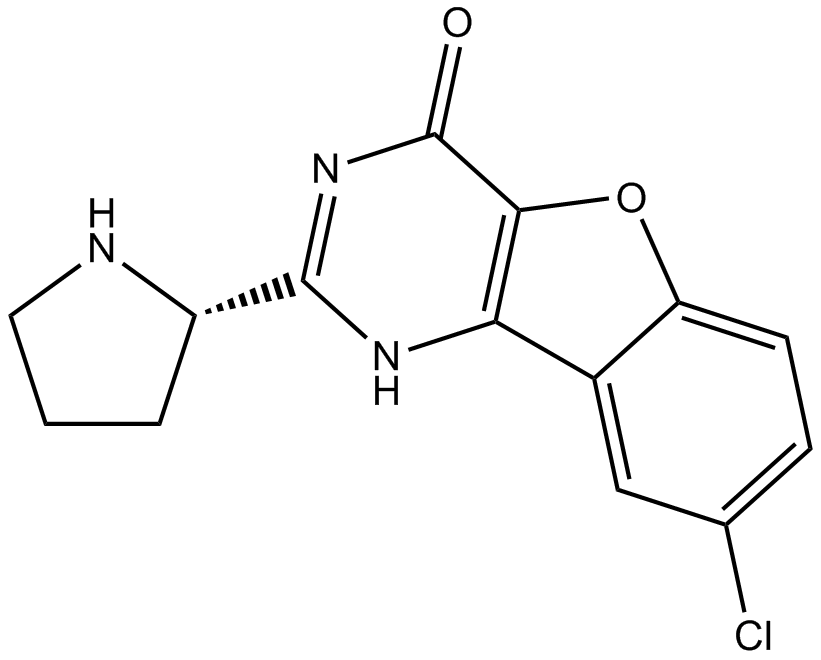
Cas No.: 1169558-38-6
Sample solution is provided at 25 µL, 10mM.
_1-3.$$$39978408@51.jpg');)
_1-9.$$$38538795@65.jpg');)
_1-9.$$$39112701@51.jpg');)
_1-7.$$$37316672@70.jpg');)
_366-372.$$$36198801@70.jpg');)
.$$$38565142@65.jpg');)
_1867-1883.$$$33248023@67.jpg');)
_eads6055.$$$39977546@45.jpg');)
_eadm9805.$$$40080571@45.jpg');)
_eadj3020.$$$39666821@45.jpg');)
_1-20.$$$39757301@28.jpg');)
_1-24.$$$38898113@28.jpg');)
_273-287.$$$36806353@46.jpg');)
_1-16.$$$37156877@44.jpg');)
_1-19.$$$37460805@44.jpg');)
_1291-1307.$$$34518654@46.jpg');)
XL413 is a potent, selective and ATP competitive inhibitor of Cdc7, with an IC50 of 3.4 nM, and also shows potent effect with IC50s of 215, 42 nM on CK2, PIM1, respectively, and an EC50 of 118 nM on pMCM.
XL413 inhibits the cell proliferation (IC50 = 2685 nM), decreases cell viability (IC50 = 2142 nM) and elicits the caspase 3/7 activity (EC50 = 2288 nM) in Colo-205 cells. XL413 also significantly inhibits the anchorage-independent growth of colo-205 in soft agar (IC50 = 715 nM)[1]. XL413 shows cytotoxic effects on tumors, with IC50 of 22.9 µM in HCC1954 cells and 1.1 µM in Colo-205 cells. XL413 induces apoptosis in the Colo-205 cells, but not in HCC1954 cells. XL413 is effective DDK inhibitors in vitro, with IC50 of 22.7 nM. XL413 is defective in inhibiting DDK-dependent Mcm2 phosphorylation in HCC1954 cells but is effective in Colo-205 cells[2].
XL413 (100 mg/kg, p.o.) shows excellent plasma exposures in mice and possesses good PK properties. XL413 (10, 30, or 100 mg/kg, p.o.) is well tolerated at all the doses, with no significant body weight loss[1].
References:
[1]. Koltun ES, et al. Discovery of XL413, a potent and selective CDC7 inhibitor. Bioorg Med Chem Lett. 2012 Jun 1;22(11):3727-31.
[2]. Sasi NK, et al. The potent Cdc7-Dbf4 (DDK) kinase inhibitor XL413 has limited activity in many cancer cell lines and discovery of potential new DDK inhibitor scaffolds. PLoS One. 2014 Nov 20;9(11):e113300.
Kinase experiment: | 20 ng of purified human DDK is pre-incubated with increasing concentrations of each DDK inhibitor for 5 min. Then 10 µCi (γ)-32P ATP and 1.5 µM cold ATP are added in a buffer containing 50 mM Tris-HCl (pH 7.5), 10 mM MgCl2, and 1 mM DTT and incubated for 30 min at 30°C. The proteins are denatured in 1X Laemmli buffer at 100°C followed by SDS-PAGE and autoradiography on HyBlot CL film. Auto-phosphorylation of DDK is used as an indicator of its kinase activity. 32P-labeled bands are quantified using ImageJ and the IC50 values are calculated using GraphPad. |
Cell experiment: | For assays in 96 well plates 2500 cells are plated per well. After 24 hours, cells are treated with small molecule inhibitors and incubated for 72 hours at 37°C. Subsequently the cells are lysed and the ATP content is measured as an indicator of metabolically active cells using the CellTiter-Glo assay. IC50 values are calculated using the GraphPad software. For assays in six well plates, 100,000 cells are plated per well. After 24 hours, cells are treated with small molecule inhibitors and incubated for varying time points. Cells are trypsinized and a suspension is made in 5 mL of phosphate buffered saline. 30 µL of this suspension is mixed with 30 µL of CellTiter-Glo reagent followed by a 10-minute incubation at room temperature. Luminescence is measured using EnVision 2104 Multilabel Reader and BioTek Synergy Neo Microplate Reader. |
References: [1]. Koltun ES, et al. Discovery of XL413, a potent and selective CDC7 inhibitor. Bioorg Med Chem Lett. 2012 Jun 1;22(11):3727-31. | |
| Cas No. | 1169558-38-6 | SDF | |
| Chemical Name | 8-chloro-2-[(2S)-pyrrolidin-2-yl]-1H-[1]benzofuro[3,2-d]pyrimidin-4-one | ||
| Canonical SMILES | C1CC(NC1)C2=NC(=O)C3=C(N2)C4=C(O3)C=CC(=C4)Cl | ||
| Formula | C14H12ClN3O2 | M.Wt | 289.72 |
| Löslichkeit | Soluble in DMSO | Storage | Store at -20°C |
| General tips | Please select the appropriate solvent to prepare the stock solution according to the
solubility of the product in different solvents; once the solution is prepared, please store it in
separate packages to avoid product failure caused by repeated freezing and thawing.Storage method
and period of the stock solution: When stored at -80°C, please use it within 6 months; when stored
at -20°C, please use it within 1 month. To increase solubility, heat the tube to 37°C and then oscillate in an ultrasonic bath for some time. |
||
| Shipping Condition | Evaluation sample solution: shipped with blue ice. All other sizes available: with RT, or with Blue Ice upon request. | ||
| Prepare stock solution | |||

|
1 mg | 5 mg | 10 mg |
| 1 mM | 3.4516 mL | 17.258 mL | 34.5161 mL |
| 5 mM | 690.3 μL | 3.4516 mL | 6.9032 mL |
| 10 mM | 345.2 μL | 1.7258 mL | 3.4516 mL |
Step 1: Enter information below (Recommended: An additional animal making an allowance for loss during the experiment)
 g
μL
g
μL
Step 2: Enter the in vivo formulation (This is only the calculator, not formulation. Please contact us first if there is no in vivo formulation at the solubility Section.)
Calculation results:
Working concentration: mg/ml;
Method for preparing DMSO master liquid: mg drug pre-dissolved in μL DMSO ( Master liquid concentration mg/mL, Please contact us first if the concentration exceeds the DMSO solubility of the batch of drug. )
Method for preparing in vivo formulation: Take μL DMSO master liquid, next addμL PEG300, mix and clarify, next addμL Tween 80, mix and clarify, next add μL saline, mix and clarify.
Method for preparing in vivo formulation: Take μL DMSO master liquid, next add μL Corn oil, mix and clarify.
Note: 1. Please make sure the liquid is clear before adding the next solvent.
2. Be sure to add the solvent(s) in order. You must ensure that the solution obtained, in the previous addition, is a clear solution before proceeding to add the next solvent. Physical methods such as vortex, ultrasound or hot water bath can be used to aid dissolving.
3. All of the above co-solvents are available for purchase on the GlpBio website.
Quality Control & SDS
- View current batch:
- Purity: >98.00% Appearance: A solid
- COA (Certificate of Analysis)
- SDS (Safety Data Sheet)
- Datasheet
Average Rating: 5 (Based on Reviews and 16 reference(s) in Google Scholar.)