

XMD8-92 |
Katalog-Nr.GC11076
 One-Click Copy Product Info
|

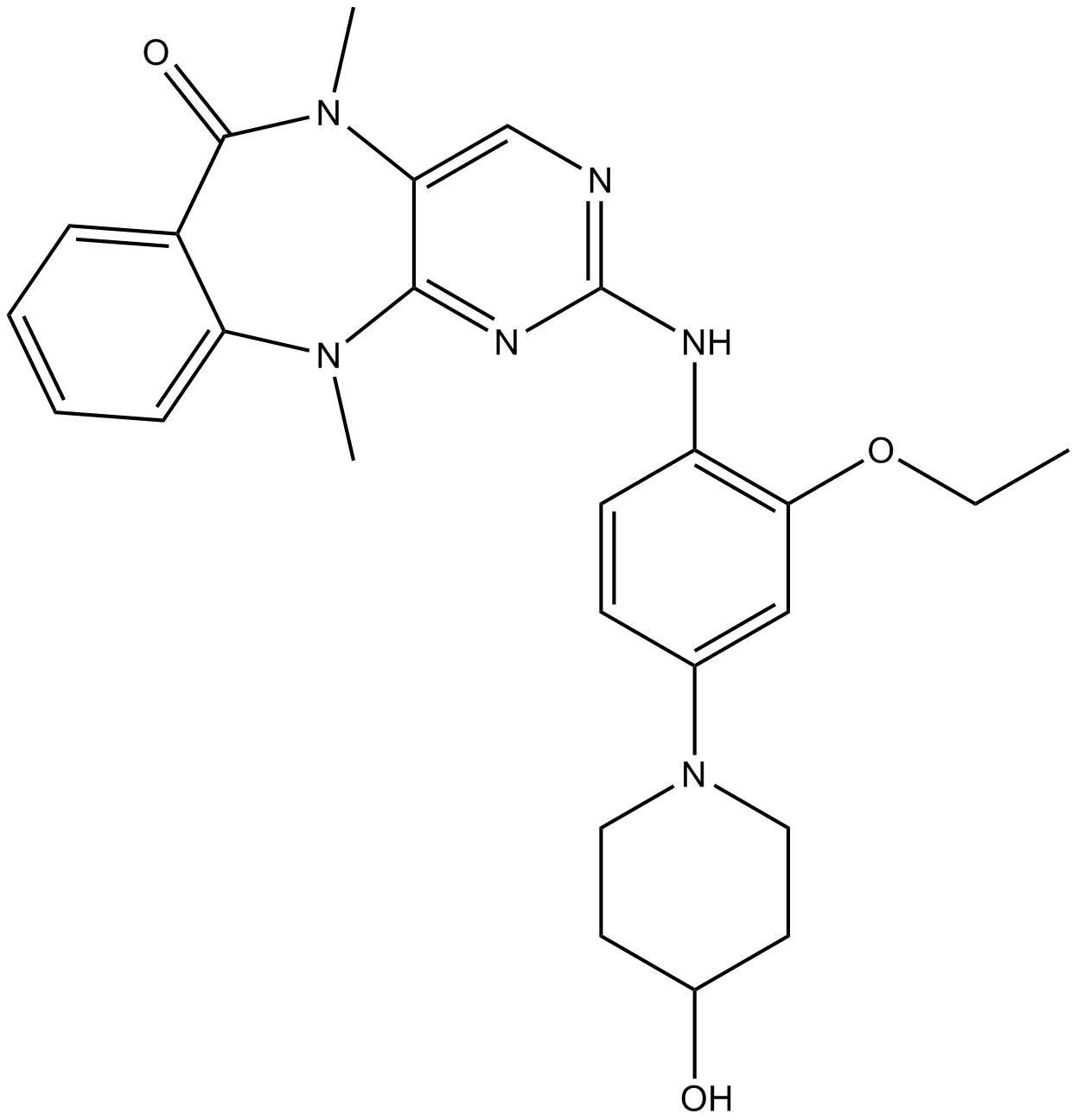
XMD8-92 is a BMK1 kinase inhibitor, with an IC50 of 1.5μM and a dissociation constant (Kd) of 80nM.
Products are for research use only. Not for human use. We do not sell to patients.
Cas No.: 1234480-50-2
Sample solution is provided at 25 µL, 10mM.
_1-3.$$$39978408@51.jpg');)
_1-9.$$$38538795@65.jpg');)
_1-9.$$$39112701@51.jpg');)
_1-7.$$$37316672@70.jpg');)
_366-372.$$$36198801@70.jpg');)
.$$$38565142@65.jpg');)
_1867-1883.$$$33248023@67.jpg');)
_eads6055.$$$39977546@45.jpg');)
_eadm9805.$$$40080571@45.jpg');)
_eadj3020.$$$39666821@45.jpg');)
_1-20.$$$39757301@28.jpg');)
_1-24.$$$38898113@28.jpg');)
_273-287.$$$36806353@46.jpg');)
_1-16.$$$37156877@44.jpg');)
_1-19.$$$37460805@44.jpg');)
_1291-1307.$$$34518654@46.jpg');)
XMD8-92 is a BMK1 kinase inhibitor, with an IC50 of 1.5μM and a dissociation constant (Kd) of 80nM[1].
In vitro, XMD8-92 (0, 0.78, 1.56, 3.13, 6.25, 12.50 and 25µM; 48h) inhibits the proliferation of AsPC-1 cancer cells in a dose-dependent manner[2]. XMD8-92 (10µM; 1h) treatment prevents epidermal growth factor (EGF) or hypoxia-induced migration of hepatocellular carcinoma (HCC) cells and induces cytoskeletal remodeling[3].
In vivo, XMD8-92 (50mg/kg/twice a day; 28 days; i.p.) significantly inhibited the growth of tumors in xenografted mice[1]. XMD8-92 (50mk/kg; 15 days; i.p.) inhibits pancreatic tumor xenograft growth via a DCLK1-dependent mechanism[2]. Treatment with XMD8-92 (10mg/kg; once per week; s.c.) significantly reduced retinal inflammation, VEGF production, and oxidative stress in diabetic mice[4].
References:
[1] Yang Q, Deng X, Lu B, et al. Pharmacological inhibition of BMK1 suppresses tumor growth through promyelocytic leukemia protein. Cancer Cell. 2010 Sep 14;18(3):258-67.
[2] Sureban SM, May R, Weygant N, et al. XMD8-92 inhibits pancreatic tumor xenograft growth via a DCLK1-dependent mechanism. Cancer Lett. 2014 Aug 28;351(1):151-61.
[3] Rovida E, Di Maira G, Tusa I, et al. The mitogen-activated protein kinase ERK5 regulates the development and growth of hepatocellular carcinoma. Gut. 2015 Sep;64(9):1454-65.
[4] Howell SJ, Lee CA, Batoki JC, et al. Retinal Inflammation, Oxidative Stress, and Vascular Impairment Is Ablated in Diabetic Mice Receiving XMD8-92 Treatment. Front Pharmacol. 2021 Aug 11;12:732630.
| Cell experiment [1]: | |
Cell lines | AsPC-1 cancer cells |
Preparation Method | AsPC-1 cancer cells were seeded into a 96-well cell culture plate at a density of 1×10⁴ cells per well, with three replicate wells per group. The cells were cultured in medium containing XMD8-92, with DMSO as the vehicle, at concentrations of 0, 0.78, 1.56, 3.13, 6.25, 12.50 and 25µM. After 48h of treatment, 10µl of TACS MTT reagent was added to each well, and the cells were incubated at 37℃ until a dark crystalline precipitate formed within the cells. Subsequently, 100µl of a 266mM NH4OH solution in DMSO was added to each well, and the plate was placed on a low-speed shaker for 1min. After shaking, the plate was incubated for 10min in the dark, and the OD550 value for each well was read using a microplate reader. The results were averaged and expressed as a percentage of the DMSO (vehicle) control group, along with the standard error of the mean. |
Reaction Conditions | 0, 0.78, 1.56, 3.13, 6.25, 12.50 and 25µM; 48h |
Applications | XMD8-92 inhibits the proliferation of AsPC-1 cancer cells in a dose-dependent manner. |
| Animal experiment [2]: | |
Animal models | 6-week-old NOD/SCID mice |
Preparation Method | Five hundred thousand (5×10⁵) HeLa cells were resuspended in DMEM medium and injected subcutaneously into the right flank of 6-week-old NOD/SCID mice on day 0. On the second day (day 1) after tumor cell injection, the mice were randomized into two groups: one group of 6 mice for the XMD8-92 (1-28 days) group and another group of 18 mice for the control group. The XMD8-92 (1-28 days) group received XMD8-92 at a dose of 50mg/kg via intraperitoneal injection twice daily. The control group received daily injections of the vehicle solution as a control. On day 7, the control group was further randomized into two groups: one group of 6 mice for the XMD8-92 (7-28 days) group and another group of 12 mice that continued as the control group. On day 14, the remaining control group was again randomized into two groups: one group of 6 mice for the XMD8-92 (14-28 days) group and another group of 6 mice that continued as the control group. Treatment with XMD8-92 for the XMD8-92 (7-28 days) and XMD8-92 (14-28 days) groups began on day 7 and day 14, respectively. Tumor size was measured using a caliper, and tumor volume was calculated using the formula: L×W²×0.52, where L is the longest diameter and W is the shortest diameter. |
Dosage form | 50mg/kg/twice a day; 28 days; i.p. |
Applications | XMD8-92 significantly inhibited the growth of tumors in xenografted mice. |
References: | |
| Cas No. | 1234480-50-2 | SDF | |
| Chemical Name | 2-[2-ethoxy-4-(4-hydroxypiperidin-1-yl)anilino]-5,11-dimethylpyrimido[4,5-b][1,4]benzodiazepin-6-one | ||
| Canonical SMILES | CCOC1=C(C=CC(=C1)N2CCC(CC2)O)NC3=NC=C4C(=N3)N(C5=CC=CC=C5C(=O)N4C)C | ||
| Formula | C26H30N6O3 | M.Wt | 474.57 |
| Löslichkeit | ≥ 23.75 mg/mL in DMSO | Storage | Store at 4°C |
| General tips | Please select the appropriate solvent to prepare the stock solution according to the
solubility of the product in different solvents; once the solution is prepared, please store it in
separate packages to avoid product failure caused by repeated freezing and thawing.Storage method
and period of the stock solution: When stored at -80°C, please use it within 6 months; when stored
at -20°C, please use it within 1 month. To increase solubility, heat the tube to 37°C and then oscillate in an ultrasonic bath for some time. |
||
| Shipping Condition | Evaluation sample solution: shipped with blue ice. All other sizes available: with RT, or with Blue Ice upon request. | ||
| Prepare stock solution | |||

|
1 mg | 5 mg | 10 mg |
| 1 mM | 2.1072 mL | 10.5359 mL | 21.0717 mL |
| 5 mM | 421.4 μL | 2.1072 mL | 4.2143 mL |
| 10 mM | 210.7 μL | 1.0536 mL | 2.1072 mL |
Step 1: Enter information below (Recommended: An additional animal making an allowance for loss during the experiment)
 g
μL
g
μL
Step 2: Enter the in vivo formulation (This is only the calculator, not formulation. Please contact us first if there is no in vivo formulation at the solubility Section.)
Calculation results:
Working concentration: mg/ml;
Method for preparing DMSO master liquid: mg drug pre-dissolved in μL DMSO ( Master liquid concentration mg/mL, Please contact us first if the concentration exceeds the DMSO solubility of the batch of drug. )
Method for preparing in vivo formulation: Take μL DMSO master liquid, next addμL PEG300, mix and clarify, next addμL Tween 80, mix and clarify, next add μL saline, mix and clarify.
Method for preparing in vivo formulation: Take μL DMSO master liquid, next add μL Corn oil, mix and clarify.
Note: 1. Please make sure the liquid is clear before adding the next solvent.
2. Be sure to add the solvent(s) in order. You must ensure that the solution obtained, in the previous addition, is a clear solution before proceeding to add the next solvent. Physical methods such as vortex, ultrasound or hot water bath can be used to aid dissolving.
3. All of the above co-solvents are available for purchase on the GlpBio website.
Quality Control & SDS
- View current batch:
- Purity: >98.00% Appearance: A solid
- COA (Certificate of Analysis)
- SDS (Safety Data Sheet)
- Datasheet
Average Rating: 5 (Based on Reviews and 30 reference(s) in Google Scholar.)