

EIPA (Synonyms: L-593,754, MH 12-43, 5-(N-ethyl-N-isopropyl)-Amiloride) |
Catalog No.GC15893
 One-Click Copy Product Info
|

EIPA a inhibé les courants activés par Ca2+médiés par TRPP3 avec des valeurs IC50 de 10.5 µM.
Products are for research use only. Not for human use. We do not sell to patients.
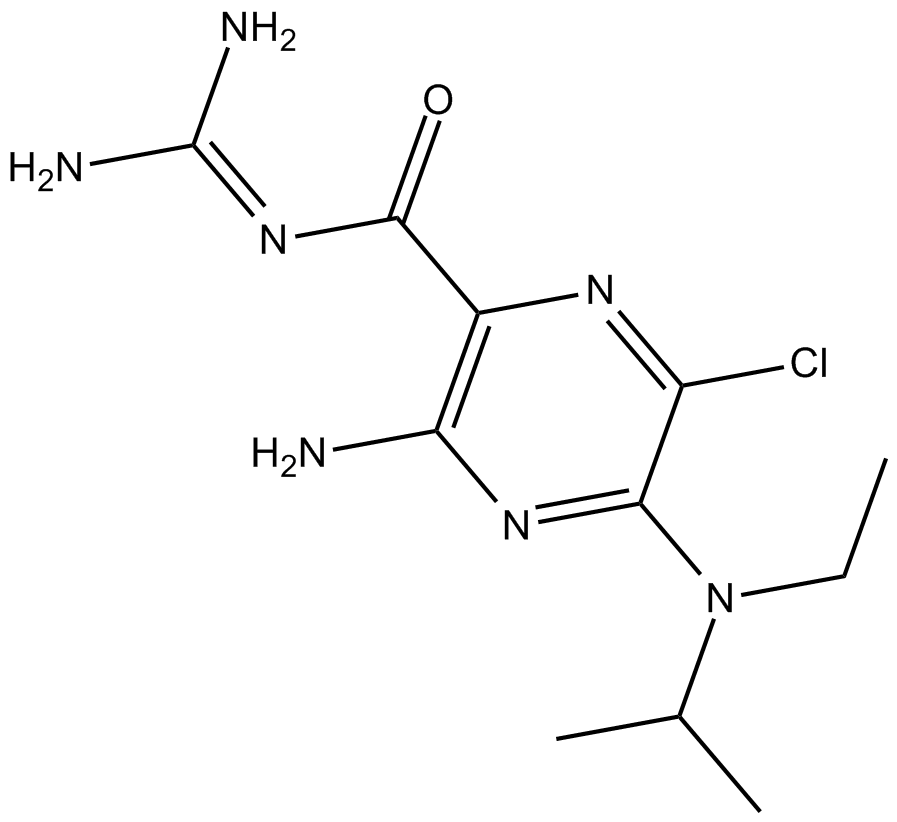
Cas No.: 1154-25-2
Sample solution is provided at 25 µL, 10mM.
EIPA a inhibé les courants activés par Ca2+médiés par TRPP3 avec des valeurs IC50 de 10.5 µM[1]. TRPP3, un membre de la superfamille des canaux cationiques TRP (récepteur potentiel transitoire), est un canal activé par Ca2+, Na+et K+ [1].EIPA (5-(N-ethyl-N-isopropyl)-amiloride) est un dérivé de l'amiloride couramment utilisé, modifié de manière similaire au MPA, et son Ki pour NHE1, NHE2 et NHE3 est respectivement de 0.3, 1.8 et 67 µM, respectively[2,3]
EIPA a supprimé la prolifération des cellules MKN28 en augmentant l'expression de p21 par la réduction du [Cl- ] c, résultant d'une compensation médiée par l'échangeur Cl- /HCO3- sensible au DIDS pour maintenir le pHc normal dans des conditions d'inhibition de NHE[4].
Un traitement préischémique à l'EIPA a surmonté la dysfonction rénale induite par I/R. L'examen histologique du rein des souris ARF traitées avec le véhicule a révélé des lésions graves, et ses lésions ont été considérablement du contenu rénal en ET-1 après la reperfusion [5]. EIPA à des doses de 3 et 9 mg/kg par jour a inhibé significativement la croissance tumorale des souris modèles HepG2 par rapport au groupe témoin[6].
References:
[1]. Dai XQ, Ramji A, Liu Y, Li Q, Karpinski E, Chen XZ (2007) Inhibition of TRPP3 channel by amiloride and analogs. Mol Pharmacol 72:1576-1585
[2]. Guffey, S.C.; Fliegel, L.; Goss, G.G. Cloning and characterization Na+/H+ Exchanger isoforms, NHE2 and, NHE3 from the gill Pacific dogfish, Squalus suckleyi. Comp. Biochem. Physiol. Part B Biochem. Mol. Biol. 2015, 188, 46-53.
[3]. Masereel, B. An overview inhibitors Na+/H+ exchanger. Eur. J. Med. Chem. 2003, 38, 547-554.
[4]. Hosogi SMH, Nakajima K, Ashihara E, Niisato N, Kusuzaki K, Marunaka Y: An inhibitor of Na(+)/H(+) exchanger (NHE), ethyl-isopropyl amiloride (EIPA), diminishes proliferation of MKN28 human gastric cancer cells by decreasing the cytosolic Cl(-) concentration via DIDS-sensitive pathways. Cell Physiol Biochem. 2012, 30: 1241-1253. 10.1159/000343315.
[5]. Yamashita J, Ohkita M, Takaoka M, Kaneshiro Y, Matsuo T,Kaneko K, Matsumura Y.Role of Na+/H+ exchanger in the pathogen-esis of ischemic acute renal failure in mice.J Cardiovasc Pharmacol49:154 -160, 2007.
[6]. X. Yang, D. Wang, W. Dong, Z. Song, K. Dou.Expression and modulation of Na+/H+ exchanger 1 gene in hepatocellular carcinoma: a potential therapeutic target. J. Gastroenterol. Hepatol., 26 (2) (2011), pp. 364-370
| Expériences cellulaires [1]: | |
Lignées cellulaires | Les cellules MCF-7 |
Méthode de préparation | Les cellules ont été ensemencées dans des plaques à 6 puits pendant 24 h avant d'être traitées pendant 48 h avec de l' EIPA (10 µM), de l'Akti (1 µM), de U0126 (10 µM) ou une combinaison de ces composés. |
Conditions de réaction | 10µM pendant 48 hours |
Domaines d'application | Les cellules MCF-7ont été soumises à un traitement avec de l'EIPA avec et sans inhibiteur de ERK et Akt. L'activité de l' ERK, mais pas celle de Akt, a été augmentée après le traitement à l'EIPA, et les deux kinases ont été efficacement inhibées par leurs inhibiteurs, U0126 et Akti, respectivement. Fait remarquable, l'hibition de l' ERK a fortement potentialisé l'upréglage de CHOP induit par l'EIPA et la clivage de PARP. |
| Expériences animales [2]: | |
Modèles animaux | Les souris femelles BALB/c Nu/Nu homozygotes ont été injectées sous-cutanément (s.c.) dans les deux flancs à l'âge de 7 semaines avec 106 cellules parentales et IKKαδ MIA PaCa-2 ou les cellules 1334 et 1444 mélangées dans un rapport de 1:1 avec BD Matrigel (BD Biosciences) dans un volume total de 100 µl. |
Méthode de préparation | Les souris ont été traitées avec le véhicule (DMSO dans du PBS),EIPA (7.5 mg/kg), MRT68921 (10 mg/kg) ou MRT68921+EIPA pendant 15 jours lorsque les tumeurs ont atteint un volume moyen de 50-100 mm3. |
Forme de dosage | s.c., 7.5 mg/kg/j pendant 7 jours |
Domaines d'application | Un mois de traitement par EIPA, initié à l'âge de 1 mois, a considérablement réduit le poids du pancréas (un substitut de la charge tumorale), inhibé la métaplasie acineuse en canalaire (ADM) et la formation avancée de PanIN tout en préservant le parenchyme pancréatique normal chez les souris KrasG12D;IkkαδPEC, tout en diminuant MP. |
References: | |
| Cas No. | 1154-25-2 | SDF | |
| Synonymes | L-593,754, MH 12-43, 5-(N-ethyl-N-isopropyl)-Amiloride | ||
| Chemical Name | 3-amino-6-chloro-N-(diaminomethylene)-5-(ethyl(isopropyl)amino)pyrazine-2-carboxamide | ||
| Canonical SMILES | ClC1=NC(C(/N=C(N)\N)=O)=C(N)N=C1N(CC)C(C)C | ||
| Formula | C11H18ClN7O | M.Wt | 299.76 |
| Solubility | 14mg/mL in DMSO, 20mg/mL in DMF, 2mg/mL in Ethanol | Storage | Store at -20°C |
| General tips | Please select the appropriate solvent to prepare the stock solution according to the
solubility of the product in different solvents; once the solution is prepared, please store it in
separate packages to avoid product failure caused by repeated freezing and thawing.Storage method
and period of the stock solution: When stored at -80°C, please use it within 6 months; when stored
at -20°C, please use it within 1 month. To increase solubility, heat the tube to 37°C and then oscillate in an ultrasonic bath for some time. |
||
| Shipping Condition | Evaluation sample solution: shipped with blue ice. All other sizes available: with RT, or with Blue Ice upon request. | ||
| Prepare stock solution | |||

|
1 mg | 5 mg | 10 mg |
| 1 mM | 3.336 mL | 16.68 mL | 33.36 mL |
| 5 mM | 667.2 μL | 3.336 mL | 6.672 mL |
| 10 mM | 333.6 μL | 1.668 mL | 3.336 mL |
Step 1: Enter information below (Recommended: An additional animal making an allowance for loss during the experiment)
 g
μL
g
μL
Step 2: Enter the in vivo formulation (This is only the calculator, not formulation. Please contact us first if there is no in vivo formulation at the solubility Section.)
Calculation results:
Working concentration: mg/ml;
Method for preparing DMSO master liquid: mg drug pre-dissolved in μL DMSO ( Master liquid concentration mg/mL, Please contact us first if the concentration exceeds the DMSO solubility of the batch of drug. )
Method for preparing in vivo formulation: Take μL DMSO master liquid, next addμL PEG300, mix and clarify, next addμL Tween 80, mix and clarify, next add μL saline, mix and clarify.
Method for preparing in vivo formulation: Take μL DMSO master liquid, next add μL Corn oil, mix and clarify.
Note: 1. Please make sure the liquid is clear before adding the next solvent.
2. Be sure to add the solvent(s) in order. You must ensure that the solution obtained, in the previous addition, is a clear solution before proceeding to add the next solvent. Physical methods such as vortex, ultrasound or hot water bath can be used to aid dissolving.
3. All of the above co-solvents are available for purchase on the GlpBio website.
Quality Control & SDS
- View current batch:
- Purity: >98.00% Appearance: A solid
- COA (Certificate of Analysis)
- SDS (Safety Data Sheet)
- Datasheet
-
Related Biological Data

Studying the cell entry pathway of Antimir21-RNP-Apt. (a) The probability of observing a force–time signal for Antimir21-RNP-Apt entry into HEK-293 cells and MDA-MB-231 cells (before and after inhibition).
After adding the inhibitors namely EIPA(GLPBIO)(10 μM), nystatin (10 μg mL−1), filipin III (1 μg mL−1), and CPZ (1 μg mL−1) and incubating for 30 min, the cells were washed with PBS and fresh medium was added to carry out the force tracing experiment.
Nanoscale 14.25 (2022): 8919-8928 PMID: 35699091 IF: 6.7 -
Related Biological Data

STAT3 is constitutively phosphorylated in NHE1 overexpressed gastric cancer cells.NHE1 overexpression induced the increase in the expression of pSTAT3, EIPA reverses the increase. Also, NHE1-siRNA transfection decrease the expression of pSTAT3 (Figure 5A, P<0.01).
NHE1 inhibitor EIPA (25 μM, GLPBIO,) was dissolved and stocked in DMSO and applied to the cells in the culture medium.
Oncotargets Ther 13 (2020): 8521-8532 PMID: 32904684 IF: 4.142
Average Rating: 5 (Based on Reviews and 13 reference(s) in Google Scholar.)