

Dehydroandrographolide |
カタログ番号GN10697
 One-Click Copy Product Info
|

Dehydroandrographolide is a natural diterpenoid lactone compound extracted from Andrographis paniculata.
Products are for research use only. Not for human use. We do not sell to patients.
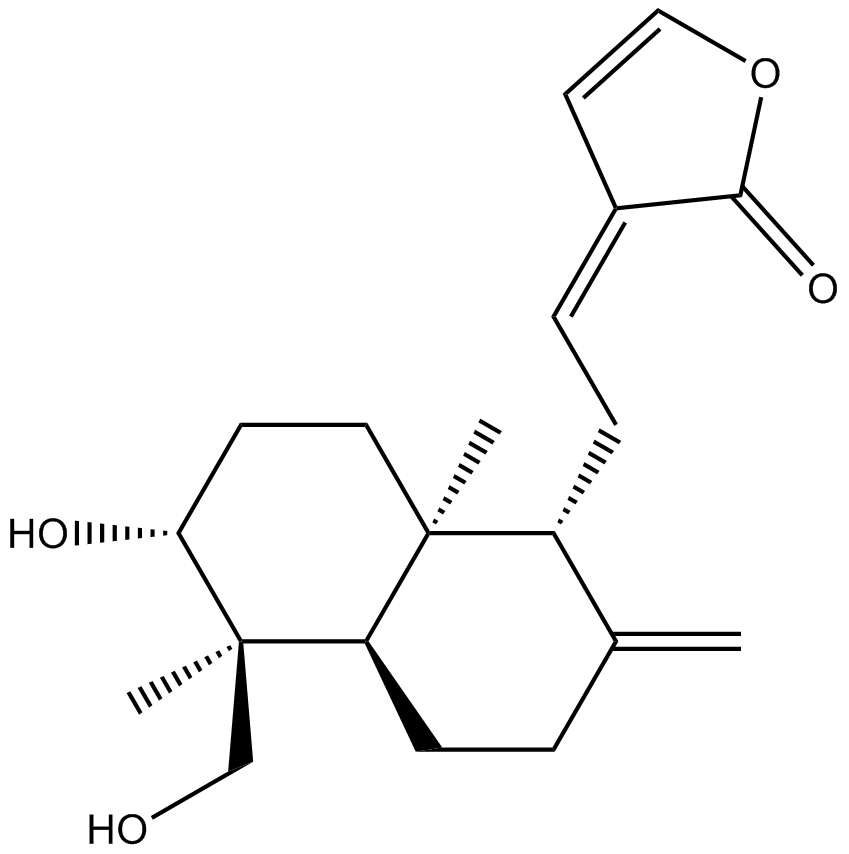
Cas No.: 134418-28-3
Sample solution is provided at 25 µL, 10mM.
_1-3.$$$39978408@51.jpg');)
_1-9.$$$38538795@65.jpg');)
_1-9.$$$39112701@51.jpg');)
_1-7.$$$37316672@70.jpg');)
_366-372.$$$36198801@70.jpg');)
.$$$38565142@65.jpg');)
_1867-1883.$$$33248023@67.jpg');)
_eads6055.$$$39977546@45.jpg');)
_eadm9805.$$$40080571@45.jpg');)
_eadj3020.$$$39666821@45.jpg');)
_1-20.$$$39757301@28.jpg');)
_1-24.$$$38898113@28.jpg');)
_273-287.$$$36806353@46.jpg');)
_1-16.$$$37156877@44.jpg');)
_1-19.$$$37460805@44.jpg');)
_1291-1307.$$$34518654@46.jpg');)
Dehydroandrographolide is a natural diterpenoid lactone compound extracted from Andrographis paniculata. Dehydroandrographolide, an iNOS inhibitor with anti-inflammatory and antiviral activities, can inhibit LPS-induced oxidative stress by inactivating iNOS[1].
In vitro, Dehydroandrographolide (25, 50, 100µM; 24-72h) inhibited the proliferation of SAS and OECM-1 cells in a dose-dependent manner, with SAS cell viability suppressed after 48h and OECM-1 cells responding within 24h[1]. Dehydroandrographolide (100µM; 48h) increased cell death through autophagy induction, rather than apoptosis, in human oral cancer cell lines[1]. Dehydroandrographolide (1-100µM; 48h) showed no obvious cytotoxicity for HCT-116 cells[2]. Dehydroandrographolide (1-100µM; 0-24h) increased hBD-2 mRNA and protein expression in HCT-116 cells in a dose- and time-dependent manner, thereby enhancing intestinal innate immunity[2].
In vivo, Dehydroandrographolide (100mg/kg; p.o.; three times per week for 24 days) suppressed tumor growth with no significant difference in body weight in BALB/c nude mice bearing SAS cell xenografts[1].
References:[1] Hsieh MJ, Lin CW, Chiou HL, Yang SF, Chen MK. Dehydroandrographolide, an iNOS inhibitor, extracted from Andrographis paniculata (Burm.f.) Nees, induces autophagy in human oral cancer cells. Oncotarget. 2015;6(31):30831-30849.
[2] Xiong WB, Shao ZJ, Xiong Y, et al. Dehydroandrographolide enhances innate immunity of intestinal tract through up-regulation the expression of hBD-2. Daru. 2015;23(1):37.
| Cell experiment [1]: | |
|
Cell lines |
SAS and OECM-1 cells |
|
Preparation Method |
0.5×10⁴ cells were cultured in 96-well plates and stimulated with different concentrations of Dehydroandrographolide (25, 50, 100µM). After 24, 48 or 72h incubation. The medium was removed, 0.5mg/ml MTT was added to each well and incubated for further 4h. The viable cell number was directly proportional to the production of formazan, reflected by the color intensity measured at 595nm, following the solubilization with isopropanol. |
|
Reaction Conditions |
25, 50, 100µM; 24, 48, 72h |
|
Applications |
Dehydroandrographolide inhibited the proliferation of SAS and OECM-1 cells in a dose-dependent manner, with SAS cell viability suppressed after 48h and OECM-1 cells responding within 24h. |
| Animal experiment [1]: | |
|
Animal models |
BALB/c nude mice bearing SAS cell xenografts |
|
Preparation Method |
Seven days after tumor cell injection, the mice were orally fed Dehydroandrographolide (40 or 100mg/kg) or vehicle three times per week. The control group received an equal volume of 0.5% carboxymethyl cellulose vehicle. Tumor volumes were determined from caliper measurements obtained every six days. At the end of the experiment, mice were animals were sacrificed and primary tumors were removed for further analysis. |
|
Dosage form |
40 or 100mg/kg; p.o.; three times per week for 24 days |
|
Applications |
Dehydroandrographolide suppressed tumor growth. In Dehydroandrographolide-treated mice receiving 100 but not 40mg/kg, the mean tumor volume on day 24 was significantly inhibited compared to vehicle-treated with no significant difference in body weight. Ki67-positive tumor cells were significantly reduced after treatment with Dehydroandrographolide compared to control mice. The expression of LC3 in tumor specimens was increased in the Dehydroandrographolide-treated group compared to the control group. |
| References: [1] Hsieh MJ, Lin CW, Chiou HL, Yang SF, Chen MK. Dehydroandrographolide, an iNOS inhibitor, extracted from Andrographis paniculata (Burm.f.) Nees, induces autophagy in human oral cancer cells. Oncotarget. 2015;6(31):30831-30849. | |
| Cas No. | 134418-28-3 | SDF | |
| Chemical Name | 3-[2-[6-hydroxy-5-(hydroxymethyl)-5,8a-dimethyl-2-methylidene-3,4,4a,6,7,8-hexahydro-1H-naphthalen-1-yl]ethylidene]furan-2-one | ||
| Canonical SMILES | CC12CCC(C(C1CCC(=C)C2CC=C3C=COC3=O)(C)CO)O | ||
| Formula | C20H28O4 | M.Wt | 332.42 |
| 溶解度 | ≥ 33.2mg/mL in DMSO | Storage | 4°C, protect from light |
| General tips | Please select the appropriate solvent to prepare the stock solution according to the
solubility of the product in different solvents; once the solution is prepared, please store it in
separate packages to avoid product failure caused by repeated freezing and thawing.Storage method
and period of the stock solution: When stored at -80°C, please use it within 6 months; when stored
at -20°C, please use it within 1 month. To increase solubility, heat the tube to 37°C and then oscillate in an ultrasonic bath for some time. |
||
| Shipping Condition | Evaluation sample solution: shipped with blue ice. All other sizes available: with RT, or with Blue Ice upon request. | ||
| Prepare stock solution | |||

|
1 mg | 5 mg | 10 mg |
| 1 mM | 3.0082 mL | 15.0412 mL | 30.0824 mL |
| 5 mM | 601.6 μL | 3.0082 mL | 6.0165 mL |
| 10 mM | 300.8 μL | 1.5041 mL | 3.0082 mL |
Step 1: Enter information below (Recommended: An additional animal making an allowance for loss during the experiment)
 g
μL
g
μL
Step 2: Enter the in vivo formulation (This is only the calculator, not formulation. Please contact us first if there is no in vivo formulation at the solubility Section.)
Calculation results:
Working concentration: mg/ml;
Method for preparing DMSO master liquid: mg drug pre-dissolved in μL DMSO ( Master liquid concentration mg/mL, Please contact us first if the concentration exceeds the DMSO solubility of the batch of drug. )
Method for preparing in vivo formulation: Take μL DMSO master liquid, next addμL PEG300, mix and clarify, next addμL Tween 80, mix and clarify, next add μL saline, mix and clarify.
Method for preparing in vivo formulation: Take μL DMSO master liquid, next add μL Corn oil, mix and clarify.
Note: 1. Please make sure the liquid is clear before adding the next solvent.
2. Be sure to add the solvent(s) in order. You must ensure that the solution obtained, in the previous addition, is a clear solution before proceeding to add the next solvent. Physical methods such as vortex, ultrasound or hot water bath can be used to aid dissolving.
3. All of the above co-solvents are available for purchase on the GlpBio website.
Quality Control & SDS
- View current batch:
- Purity: >99.50% Appearance: A solid
- COA (Certificate of Analysis)
- SDS (Safety Data Sheet)
- Datasheet
Average Rating: 5 (Based on Reviews and 30 reference(s) in Google Scholar.)