

5-(N,N-Hexamethylene)-amiloride (Synonyms: HMA) |
カタログ番号GC35147
 One-Click Copy Product Info
|

5-(N,N-Hexamethylene)-amilorideはNa+/H+交換体の有力な阻害剤であり、腫瘍細胞に毒性を持つ。
Products are for research use only. Not for human use. We do not sell to patients.
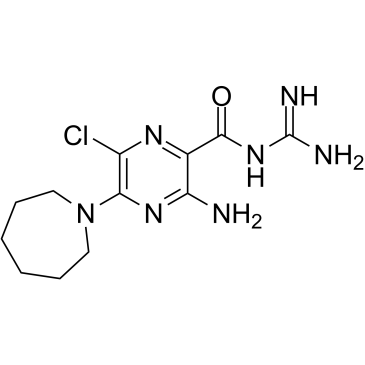
Cas No.: 1428-95-1
Sample solution is provided at 25 µL, 10mM.
5-(N,N-Hexamethylene)-amilorideはNa+/H+交換体の有力な阻害剤であり、腫瘍細胞に毒性を持つ[1]。5-(N,N-Hexamethylene)-amilorideは、再生肝臓でDNAの合成を阻害し、細胞アポトーシスを誘発でき、同時にJun N-末端キナーゼ(JNK)の活性を活性化する[2]。5-(N,N-Hexamethylene)-amilorideは広く使われ、クリプトコッカス菌株の成長を阻害し、抗真菌薬の開発の出発点として、高い抗真菌活性を持つ新規の類似体を開発する[3]。5-(N,N-Hexamethylene)-amilorideは蛍光特性を持ち、細胞内酸性度を調節し、細胞研究におけるpH変化の自己バイオマーカーとして使われることが可能である[4]。
In vitro(体外)実験で、5-(N,N-hexamethylene)-amilorideで48時間処理したところ、L929細胞で、マウス肝炎ウイルス(MHV)とヒトコロナウイルス229E(HCoV-229E)の複製が阻害され、EC50値はそれぞれ3.91μMと1.34μMであった[5]。RPMI-8226細胞を20μM 5-(N,N-hexamethylene)-amilorideで48時間処理したところ、細胞の増殖が阻害され、細胞内酸性化が起きた[6]。80µMの5-(N,N-hexamethylene)-amilorideを24時間応用し、リソソームと活性酸素種(ROS)に依存するメカニズムを通じて、培養されたMCF7細胞でプログラムされた壊死が誘発された[7]。
In vivo(体内)実験で、10mg/kg/日の5-(N,N-hexamethylene)-amilorideを14日間腹腔内注射したところ、RPMI-8226細胞異種移植マウスモデルで、体重を影響せずに、腫瘍の成長を抑制した[5]。
References:
[1] Luo J, Tannock I F. Inhibition of the regulation of intracellular pH: potential of 5-(N, N-hexamethylene) amiloride in tumour-selective therapy[J]. British journal of cancer, 1994, 70(4): 617-624.
[2] Suzuki T, Tsukamoto I. Apoptosis induced by 5-(N, N-hexamethylene)-amiloride in regenerating liver after partial hepatectomy[J]. European journal of pharmacology, 2004, 503(1-3): 1-7.
[3] Vu K, Buckley B J, Bujaroski R S, et al. Antifungal activity of 6-substituted amiloride and hexamethylene amiloride (HMA) analogs[J]. Frontiers in Cellular and Infection Microbiology, 2023, 13: 1101568.
[4] Giansanti V, Santamaria G, Torriglia A, et al. Fluorescence properties of the Na+/H+ exchanger inhibitor HMA (5-(N, N-hexamethylene) amiloride) are modulated by intracellular pH[J]. European Journal of Histochemistry: EJH, 2012, 56(1): e3.
[5] Wilson L, Gage P, Ewart G. Hexamethylene amiloride blocks E protein ion channels and inhibits coronavirus replication[J]. Virology, 2006, 353(2): 294-306.
[6] Yang N, Dong Z, Xiao W, et al. Hexamethylene amiloride induces lysosome-mediated cell death in multiple myeloma through transcription factor E3[J]. Cell Death Discovery, 2024, 10(1): 505.
[7] Rowson-Hodel A R, Berg A L, Wald J H, et al. Hexamethylene amiloride engages a novel reactive oxygen species-and lysosome-dependent programmed necrotic mechanism to selectively target breast cancer cells[J]. Cancer letters, 2016, 375(1): 62-72.
| 細胞実験[1]: | |
細胞株 | MCF-7細胞 |
準備方法 | 5% CO2、37°Cの加湿環境で、10%のウシ胎児血清、100U/mlのペニシリンと100μg/mlのストレプトマイシンを添加した高グルコースDMEM培地でMCF-7細胞を培養した。96ウェルのプレートで、5×104/mlの密度で、MCF-7細胞を播種した。細胞を、様々な濃度の5-(N,N-hexamethylene)-amiloride(0、10、20、40と80μM)で処理した。24時間後、細胞の生存率を分析した。 |
反応条件 | 0、1、2、5、10と20μM;24時間 |
アプリケーション | 5-(N,N-hexamethylene)-amilorideの処理により、MCF-7細胞の生存率が用量依存的に低下した。 |
| 動物実験 [2]: | |
動物モデル | 雌のBALB/cヌードマウス |
準備方法 | 4-6週齢で、体重が20gの雌のBALB/cヌードマウスを、24±2°Cの温度と55±5%の湿度の無特定病原体(SPF)動物飼育室で飼育し、概日リズムは12時間の昼夜循環であった。マウスには標準食と水を自由に摂取させた。RPMI-8226細胞(1×107個の細胞)をマウスの右腹部に皮下注射した。腫瘍が触知できるようになった時、マウスをランダムに二つのグループに分けた:実験群には5-(N,N-hexamethylene)-amiloride(10mg/kg;腹腔内注射)を14日間連続で、毎日単回投与した;対照群のマウスには、生理食塩水を腹腔内注射した。マウスの腫瘍体積と体重を分析した。 |
投与形態 | 10mg/kg/日、14日間;腹腔内注射 |
アプリケーション | 5-(N,N-hexamethylene)-amilorideの処理により、RPMI-8226細胞異種移植マウスモデルで、体重を影響せずに、腫瘍の成長を抑制した。 |
References: | |
| Cas No. | 1428-95-1 | SDF | |
| 同義語 | HMA | ||
| Canonical SMILES | O=C(C1=NC(Cl)=C(N2CCCCCC2)N=C1N)NC(N)=N | ||
| Formula | C12H18ClN7O | M.Wt | 311.77 |
| 溶解度 | DMSO: 100 mg/mL (320.75 mM) | Storage | Store at -20°C |
| General tips | Please select the appropriate solvent to prepare the stock solution according to the
solubility of the product in different solvents; once the solution is prepared, please store it in
separate packages to avoid product failure caused by repeated freezing and thawing.Storage method
and period of the stock solution: When stored at -80°C, please use it within 6 months; when stored
at -20°C, please use it within 1 month. To increase solubility, heat the tube to 37°C and then oscillate in an ultrasonic bath for some time. |
||
| Shipping Condition | Evaluation sample solution: shipped with blue ice. All other sizes available: with RT, or with Blue Ice upon request. | ||
| Prepare stock solution | |||

|
1 mg | 5 mg | 10 mg |
| 1 mM | 3.2075 mL | 16.0375 mL | 32.0749 mL |
| 5 mM | 641.5 μL | 3.2075 mL | 6.415 mL |
| 10 mM | 320.7 μL | 1.6037 mL | 3.2075 mL |
Step 1: Enter information below (Recommended: An additional animal making an allowance for loss during the experiment)
 g
μL
g
μL
Step 2: Enter the in vivo formulation (This is only the calculator, not formulation. Please contact us first if there is no in vivo formulation at the solubility Section.)
Calculation results:
Working concentration: mg/ml;
Method for preparing DMSO master liquid: mg drug pre-dissolved in μL DMSO ( Master liquid concentration mg/mL, Please contact us first if the concentration exceeds the DMSO solubility of the batch of drug. )
Method for preparing in vivo formulation: Take μL DMSO master liquid, next addμL PEG300, mix and clarify, next addμL Tween 80, mix and clarify, next add μL saline, mix and clarify.
Method for preparing in vivo formulation: Take μL DMSO master liquid, next add μL Corn oil, mix and clarify.
Note: 1. Please make sure the liquid is clear before adding the next solvent.
2. Be sure to add the solvent(s) in order. You must ensure that the solution obtained, in the previous addition, is a clear solution before proceeding to add the next solvent. Physical methods such as vortex, ultrasound or hot water bath can be used to aid dissolving.
3. All of the above co-solvents are available for purchase on the GlpBio website.
Quality Control & SDS
- View current batch:
- Purity: >98.00% Appearance: A solid
- COA (Certificate of Analysis)
- SDS (Safety Data Sheet)
- Datasheet
Average Rating: 5 (Based on Reviews and 40 reference(s) in Google Scholar.)