

Hispidulin (Synonyms: Dinatin, 6-Methoxyapigenin, NSC 122415) |
カタログ番号GC12359
 One-Click Copy Product Info
|

ヒスピドリンは、幅広い生物学的活性を持つ天然のフラボンです。 Hispidulin は、IC50 が 2.71 μM の Pim-1 阻害剤です。
Products are for research use only. Not for human use. We do not sell to patients.
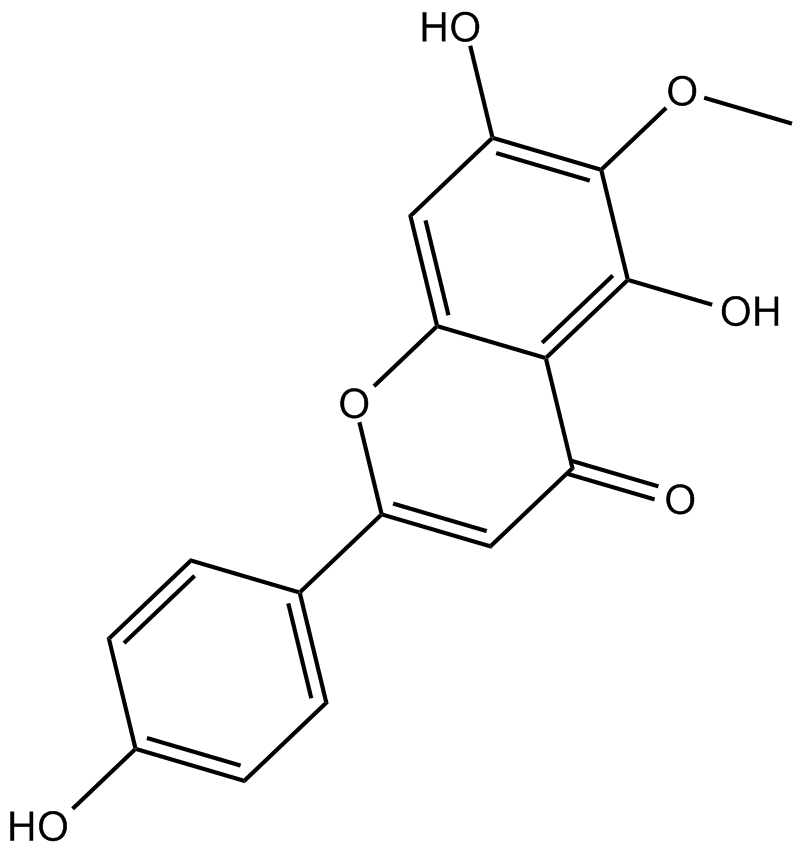
Cas No.: 1447-88-7
Sample solution is provided at 25 µL, 10mM.
_1-3.$$$39978408@51.jpg');)
_1-9.$$$38538795@65.jpg');)
_1-9.$$$39112701@51.jpg');)
_1-7.$$$37316672@70.jpg');)
_366-372.$$$36198801@70.jpg');)
.$$$38565142@65.jpg');)
_1867-1883.$$$33248023@67.jpg');)
_eads6055.$$$39977546@45.jpg');)
_eadm9805.$$$40080571@45.jpg');)
_eadj3020.$$$39666821@45.jpg');)
_1-20.$$$39757301@28.jpg');)
_1-24.$$$38898113@28.jpg');)
_273-287.$$$36806353@46.jpg');)
_1-16.$$$37156877@44.jpg');)
_1-19.$$$37460805@44.jpg');)
_1291-1307.$$$34518654@46.jpg');)
Hispidulin is a flavonoid compound that acts as a Pim-1 inhibitor (IC₅₀=2.71μM). Hispidulin can induce apoptosis through mitochondrial dysfunction and inhibit the production of inflammatory cytokines. Hispidulin is applicable for research in various cancers (including renal cancer, liver cancer, glioblastoma, acute myeloid leukemia, etc.) and inflammation-related diseases[1-4].
In vitro, MG63 and 143B human osteosarcoma cells were treated with Hispidulin (7.5–30μM) for 24–72 hours. Hispidulin significantly inhibited cell proliferation, colony formation, migration, and invasion, and induced G2/M phase arrest and apoptosis[5]. MCF-7 and HCC38 human breast cancer cells were co-treated with Hispidulin (1.25–2.5μM) and TGF-β1 (10ng/ml) for 24 hours. Hispidulin significantly increased the expression of E-cadherin and occludin, decreased vimentin expression, and inhibited TGF-β1-induced Smad2/3 phosphorylation and cell migration[6].
In vivo, C57BL/6J mice undergoing aortic banding surgery were intraperitoneally injected with Hispidulin (20mg/kg/day) starting from one day before surgery until four weeks after surgery. Hispidulin significantly alleviated pressure overload-induced cardiac hypertrophy and improved cardiac function[7]. C57BL/6 mice were intraperitoneally injected with Hispidulin (50mg/kg; single injection) one hour after endotoxin (10mg/kg) injection. Hispidulin significantly ameliorated endotoxin-induced acute kidney injury[8].
References:
[1] Chao SW, Su MY, Chiou LC, et al. Total Synthesis of Hispidulin and the Structural Basis for Its Inhibition of Proto-oncogene Kinase Pim-1. J Nat Prod. 2015 Aug 28;78(8):1969-76.
[2] Gao H, Wang H, Peng J. Hispidulin induces apoptosis through mitochondrial dysfunction and inhibition of P13k/Akt signalling pathway in HepG2 cancer cells. Cell Biochem Biophys. 2014 May;69(1):27-34.
[3] Zhou R, Wang Z, Ma C. Hispidulin exerts anti-osteoporotic activity in ovariectomized mice via activating AMPK signaling pathway. Cell Biochem Biophys. 2014 Jun;69(2):311-7.
[4] Lin TY, Lu CW, Wang SJ, et al. Protective effect of hispidulin on kainic acid-induced seizures and neurotoxicity in rats. Eur J Pharmacol. 2015 May 15;755:6-15.
[5] Yuan X, Yu S, Zeng Z, et al. Hispidulin suppresses osteosarcoma by directly targeting FABP4 to disrupt lipid metabolism and inhibit the PI3K/AKT pathway. J Transl Med. 2025 Oct 7;23(1):1062.
[6] Kim HA, Lee J. Hispidulin modulates epithelial-mesenchymal transition in breast cancer cells. Oncol Lett. 2021 Feb;21(2):155.
[7] Wang Y, Xie Z, Jiang N, et al. Hispidulin Attenuates Cardiac Hypertrophy by Improving Mitochondrial Dysfunction. Front Cardiovasc Med. 2020 Nov 26;7:582890.
[8] Kim K, Leem J. Hispidulin Ameliorates Endotoxin-Induced Acute Kidney Injury in Mice. Molecules. 2022 Mar 21;27(6):2019.
| Cell experiment [1]: | |
|
Cell lines |
MG63 and 143B human osteosarcoma cells; hFOB 1.19 normal human osteoblasts |
|
Preparation Method |
Cells were maintained in Dulbecco's Modified Eagle's Medium (DMEM) supplemented with 10% fetal bovine serum and 1% penicillin-streptomycin at 37°C with 5% CO₂. Cells were treated with Hispidulin (7.5-30μM). |
|
Reaction Conditions |
7.5–30μM; 24–72h |
|
Applications |
Hispidulin potently inhibited osteosarcoma cell proliferation, colony formation, migration, and invasion, with minimal toxicity to normal osteoblasts. Hispidulin induced G2/M phase arrest and apoptosis. Hispidulin directly targeted Fatty Acid Binding Protein 4 (FABP4), modulated lipid metabolism, and subsequently inhibited the PI3K/AKT pathway, reducing intracellular free fatty acids and fatty acid synthase activity. |
| Animal experiment [2]: | |
|
Animal models |
Male C57BL/6 mice |
|
Preparation Method |
Mice were arbitrarily divided into control, Endotoxin (LPS), and LPS+Hispidulin groups. The LPS and LPS+His groups received a single intraperitoneal injection of LPS (10mg/kg). One hour after LPS injection, the mice in the LPS+ Hispidulin group were intraperitoneally injected with Hispidulin (50mg/kg). The same volumes of vehicles were given to the mice in the control group or the LPS group. At 24h after LPS injection, all mice were anesthetized and sacrificed. Blood and kidney samples were collected for analyses. |
|
Dosage form |
50mg/kg; i.p.; single injection |
|
Applications |
Hispidulin administration ameliorated endotoxin-induced acute kidney injury. Hispidulin attenuated renal dysfunction (reduced serum creatinine and BUN levels), improved renal histological abnormalities (reduced tubular injury score, brush border loss, and NGAL upregulation), inhibited inflammation (reduced serum TNF-α and IL-6, downregulated renal TNF-α, IL-6, IL-1β, and TLR4 mRNA, suppressed NF-κB and MAPK cascades, and reduced neutrophil and macrophage infiltration), suppressed oxidative stress (reduced 4-HNE, MDA, and 8-OHdG levels, downregulated NOX4, activated catalase and SOD activities, and restored GSH levels), and attenuated tubular cell apoptosis. |
|
References: |
|
| Cas No. | 1447-88-7 | SDF | |
| 同義語 | Dinatin, 6-Methoxyapigenin, NSC 122415 | ||
| Chemical Name | 5,7-dihydroxy-2-(4-hydroxyphenyl)-6-methoxy-4H-chromen-4-one | ||
| Canonical SMILES | OC1=C2C(OC(C(C=C3)=CC=C3O)=CC2=O)=CC(O)=C1OC | ||
| Formula | C16H12O6 | M.Wt | 300.27 |
| 溶解度 | DMF: 30 mg/ml,DMSO: 30 mg/ml,DMSO:PBS (pH 7.2) (1:3): 0.25 mg/ml | Storage | Desiccate at -20°C |
| General tips | Please select the appropriate solvent to prepare the stock solution according to the
solubility of the product in different solvents; once the solution is prepared, please store it in
separate packages to avoid product failure caused by repeated freezing and thawing.Storage method
and period of the stock solution: When stored at -80°C, please use it within 6 months; when stored
at -20°C, please use it within 1 month. To increase solubility, heat the tube to 37°C and then oscillate in an ultrasonic bath for some time. |
||
| Shipping Condition | Evaluation sample solution: shipped with blue ice. All other sizes available: with RT, or with Blue Ice upon request. | ||
| Prepare stock solution | |||

|
1 mg | 5 mg | 10 mg |
| 1 mM | 3.3303 mL | 16.6517 mL | 33.3034 mL |
| 5 mM | 666.1 μL | 3.3303 mL | 6.6607 mL |
| 10 mM | 333 μL | 1.6652 mL | 3.3303 mL |
Step 1: Enter information below (Recommended: An additional animal making an allowance for loss during the experiment)
 g
μL
g
μL
Step 2: Enter the in vivo formulation (This is only the calculator, not formulation. Please contact us first if there is no in vivo formulation at the solubility Section.)
Calculation results:
Working concentration: mg/ml;
Method for preparing DMSO master liquid: mg drug pre-dissolved in μL DMSO ( Master liquid concentration mg/mL, Please contact us first if the concentration exceeds the DMSO solubility of the batch of drug. )
Method for preparing in vivo formulation: Take μL DMSO master liquid, next addμL PEG300, mix and clarify, next addμL Tween 80, mix and clarify, next add μL saline, mix and clarify.
Method for preparing in vivo formulation: Take μL DMSO master liquid, next add μL Corn oil, mix and clarify.
Note: 1. Please make sure the liquid is clear before adding the next solvent.
2. Be sure to add the solvent(s) in order. You must ensure that the solution obtained, in the previous addition, is a clear solution before proceeding to add the next solvent. Physical methods such as vortex, ultrasound or hot water bath can be used to aid dissolving.
3. All of the above co-solvents are available for purchase on the GlpBio website.
Quality Control & SDS
- View current batch:
- Purity: >98.00% Appearance: A solid
- COA (Certificate of Analysis)
- SDS (Safety Data Sheet)
- Datasheet
Average Rating: 5 (Based on Reviews and 4 reference(s) in Google Scholar.)