

ITE |
カタログ番号GC12628
 One-Click Copy Product Info
|

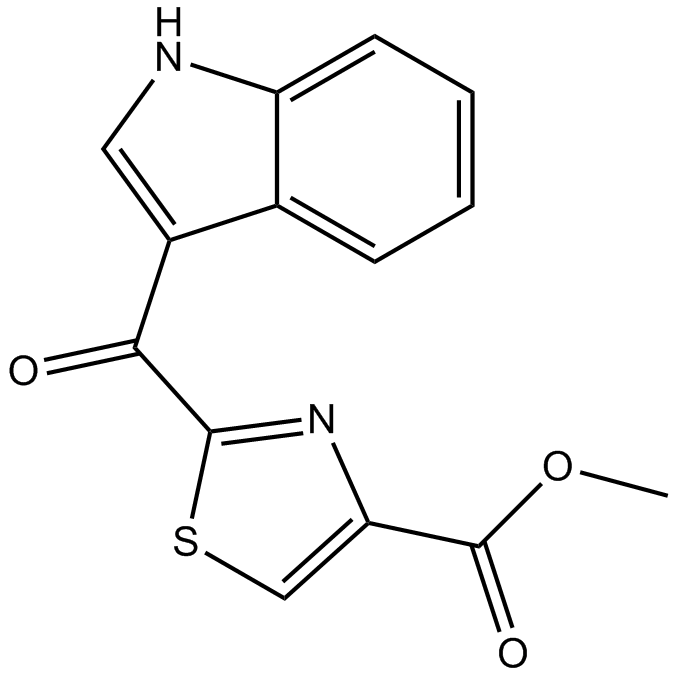
ITEは効果的な免疫抑制の内因性芳香族炭化水素受容体(AhR)作動剤であり、AHRへ結合する時のKi値は3nMである。
Products are for research use only. Not for human use. We do not sell to patients.
Cas No.: 448906-42-1
Sample solution is provided at 25 µL, 10mM.
_1-3.$$$39978408@51.jpg');)
_1-9.$$$38538795@65.jpg');)
_1-9.$$$39112701@51.jpg');)
_1-7.$$$37316672@70.jpg');)
_366-372.$$$36198801@70.jpg');)
.$$$38565142@65.jpg');)
_1867-1883.$$$33248023@67.jpg');)
_eads6055.$$$39977546@45.jpg');)
_eadm9805.$$$40080571@45.jpg');)
_eadj3020.$$$39666821@45.jpg');)
_1-20.$$$39757301@28.jpg');)
_1-24.$$$38898113@28.jpg');)
_273-287.$$$36806353@46.jpg');)
_1-16.$$$37156877@44.jpg');)
_1-19.$$$37460805@44.jpg');)
_1291-1307.$$$34518654@46.jpg');)
ITEは効果的な免疫抑制の内因性芳香族炭化水素受容体(AhR)作動剤であり、AHRへ結合する時のKi値は3nMである[1]。AhRは、リガンド依存性の転写因子であり、幾つかの異物の毒性を媒介し、分化、生殖と免疫で重要な生理学的な役割を果たしている[2]。ITEは免疫調節と抗癌作用を持つ[3-4]。
体外で、ITE (0.1–5000nM;1-6日間)の処理は、卵巣癌細胞(SKOV-3、OVCAR-3とIOSE-385)の増殖と遊離を用量と時間依存的に阻害し、AhRを減らし、CYP1A1のレベルを増やした[5]。ITE (0.01、0.1、1、5、10と20μM;2、4または6日間)は、ヒト肺動脈内皮細胞(HPAEC)の増殖を用量と時間依存的に阻害でき、AhRタンパク質のレベルを減らし、シトクロムP450 (CYP)、CYP1A1とCYP1B1のmRNAレベルを同時に増やした[6]。
体内で、ITE (200μg/0.2mL/日;14日間;腹腔内注射)の処理は、Freund'sアジュバントと結核菌による実験性自己免疫ぶどう膜炎(EAU)のマウスで、網膜剥離と眼炎症細胞浸潤を著しく阻害でき、マウスでIFN-γ、IL-17またはIL-10細胞の割合を減らし、マウスリンパ球による炎症サイトカインの分泌を阻害した[7]。ITE (80mg/kg/日;28日間;腹腔内注射)の処理は、OVCAR-3異種移植モデルのマウスで、腫瘍の成長を39%減らすことができた[5]。
References:
[1] Song J, et al. A ligand for the aryl hydrocarbon receptor isolated from lung. Proc Natl Acad Sci U S A. 2002 Nov 12;99(23):14694-9.
[2] Henry E C, Welle S L, Gasiewicz T A. TCDD and a putative endogenous AhR ligand, ITE, elicit the same immediate changes in gene expression in mouse lung fibroblasts[J]. Toxicological Sciences, 2010, 114(1): 90-100.
[3] Dolciami D, Gargaro M, Cerra B, et al. Binding mode and structure–activity relationships of ITE as an aryl hydrocarbon receptor (AhR) agonist[J]. ChemMedChem, 2018, 13(3): 270-279.
[4] Simpson S R, Middleton D D, Lukesh N R, et al. Microparticles incorporating dual apoptotic factors to inhibit inflammatory effects in macrophages[J]. Journal of Pharmaceutical Sciences, 2024, 113(11): 3196-3205.
[5] Wang K, Li Y, Jiang YZ, et al. An endogenous aryl hydrocarbon receptor ligand inhibits proliferation and migration of human ovarian cancer cells. Cancer Lett. 2013;340(1):63-71.
[6] Pang L, Li Y, Zou Q, et al. ITE inhibits growth of human pulmonary artery endothelial cells[J]. Experimental lung research, 2017, 43(8): 283-292.
[7] Nugent LF, Shi G, Vistica BP, Ogbeifun O, Hinshaw SJ, Gery I. ITE, a novel endogenous nontoxic aryl hydrocarbon receptor ligand, efficiently suppresses EAU and T-cell-mediated immunity. Invest Ophthalmol Vis Sci. 2013 Nov 13;54(12):7463-9.
| 細胞実験[1]: | |
細胞株 | SKOV-3、OVCAR-3とIOSE-385細胞 |
準備方法 | 96ウェルのプレート(SKOV-3、OVCAR-3とIOSE-385に対してそれぞれ1000、5000と5000個の細胞/ウェル;6ウェル/用量)で16時間(0日目)播種した後、完全成長培地で、様々な濃度のITE (0.1–5000nM)またはDMSO (0.1% v/v)で細胞を最大6日間処理し、ジメチルスルホキシド(DMSO、溶媒対照物)またはITEを含有する培地を毎日交換した。処理の終わりに、ウェルごとの細胞数を、記述通りに、クリスタルバイオレット法で測定した。処理後、細胞をPBS(5mMのリン酸、145mMのNaCl、5mMのKCl、pH 7.5)で濯ぎ、メタノールで15分間固定し、5分間空気乾燥し、0.1% (w/v)のクリスタルバイオレットで5分間染色した。その後、ウェルを蒸留水で濯ぎ、再び空気乾燥した。乾くなったら、細胞を2%(w/v)のデオキシコール酸ナトリウム溶液で30分間穏やかに撹拌しながら溶解した。吸光度を570nmで、マイクロプレートリーダーで測定した。 |
反応条件 | 0.1–5000nM;1-6日間 |
アプリケーション | ITEの処理は、卵巣癌細胞の増殖と遊離を用量と時間依存的に阻害した。 |
| 動物実験 [1]: | |
動物モデル | BALB/cヌードマウス |
準備方法 | 各マウスの右脇腹に、5 × 10⁶個のOVCAR-3細胞を皮下接種した。腫瘍の体積が約110mm3に達した時、腫瘍の体積に基づき、マウスを均質なブロックに分け、続いて各ブロックを、溶媒対照とITE処理群(n = 8/群)にランダムに分けた。溶媒(DMSO)またはITE(DMSOに80mg/mL)を体重1kgあたり1mLの体積で、マウスに28日間、毎日一回腹腔内注射した。最後の注射後、マウスを更に5日間、腫瘍の体積、体重とその他の臨床徴候について監視した。 |
投与形態 | 80mg/kg/日;28日間;腹腔内注射 |
アプリケーション | ITEの処理は、OVCAR-3異種移植モデルマウスで、腫瘍の成長を39%減らすことができた。 |
References: | |
| Cas No. | 448906-42-1 | SDF | |
| Chemical Name | methyl 2-(1H-indole-3-carbonyl)-1,3-thiazole-4-carboxylate | ||
| Canonical SMILES | COC(=O)C1=CSC(=N1)C(=O)C2=CNC3=CC=CC=C32 | ||
| Formula | C14H10N2O3S | M.Wt | 286.3 |
| 溶解度 | ≥ 28.6mg/mL in DMSO | Storage | Store at RT |
| General tips | Please select the appropriate solvent to prepare the stock solution according to the
solubility of the product in different solvents; once the solution is prepared, please store it in
separate packages to avoid product failure caused by repeated freezing and thawing.Storage method
and period of the stock solution: When stored at -80°C, please use it within 6 months; when stored
at -20°C, please use it within 1 month. To increase solubility, heat the tube to 37°C and then oscillate in an ultrasonic bath for some time. |
||
| Shipping Condition | Evaluation sample solution: shipped with blue ice. All other sizes available: with RT, or with Blue Ice upon request. | ||
| Prepare stock solution | |||

|
1 mg | 5 mg | 10 mg |
| 1 mM | 3.4928 mL | 17.4642 mL | 34.9284 mL |
| 5 mM | 698.6 μL | 3.4928 mL | 6.9857 mL |
| 10 mM | 349.3 μL | 1.7464 mL | 3.4928 mL |
Step 1: Enter information below (Recommended: An additional animal making an allowance for loss during the experiment)
 g
μL
g
μL
Step 2: Enter the in vivo formulation (This is only the calculator, not formulation. Please contact us first if there is no in vivo formulation at the solubility Section.)
Calculation results:
Working concentration: mg/ml;
Method for preparing DMSO master liquid: mg drug pre-dissolved in μL DMSO ( Master liquid concentration mg/mL, Please contact us first if the concentration exceeds the DMSO solubility of the batch of drug. )
Method for preparing in vivo formulation: Take μL DMSO master liquid, next addμL PEG300, mix and clarify, next addμL Tween 80, mix and clarify, next add μL saline, mix and clarify.
Method for preparing in vivo formulation: Take μL DMSO master liquid, next add μL Corn oil, mix and clarify.
Note: 1. Please make sure the liquid is clear before adding the next solvent.
2. Be sure to add the solvent(s) in order. You must ensure that the solution obtained, in the previous addition, is a clear solution before proceeding to add the next solvent. Physical methods such as vortex, ultrasound or hot water bath can be used to aid dissolving.
3. All of the above co-solvents are available for purchase on the GlpBio website.
Quality Control & SDS
- View current batch:
- Purity: >99.00% Appearance: A solid
- COA (Certificate of Analysis)
- SDS (Safety Data Sheet)
- Datasheet
Average Rating: 5 (Based on Reviews and 39 reference(s) in Google Scholar.)