


N-butyryl-L-Homoserine lactone (Synonyms: C4-HSL) |
| カタログ番号GC19519 |
N-ブチリル-L-ホモセリン ラクトン (C4-HSL) は、抗体薬物複合体 (ADC) の合成に使用される切断可能な ADC リンカーです。
Products are for research use only. Not for human use. We do not sell to patients.
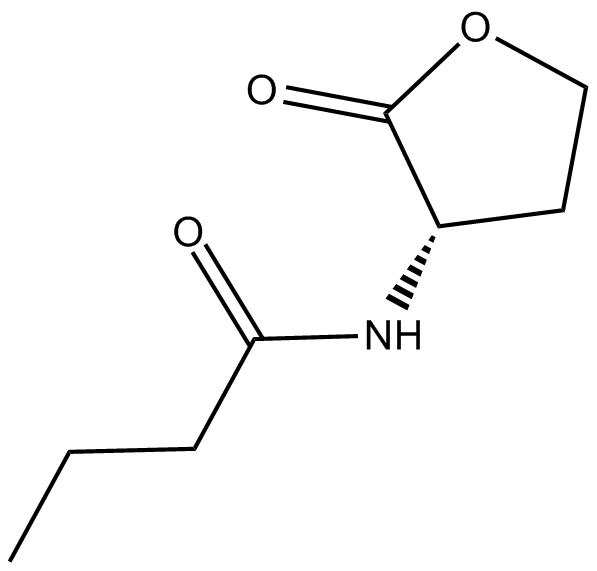
Cas No.: 67605-85-0
Sample solution is provided at 25 µL, 10mM.
;)
,-1-7$$$37316672.jpg');)
;)
;)
$$$36806353.jpg');)
;33(7)%EF%BC%9A546-561$$$37156877.jpg');)
;)
;)
;)
%201124-1138.$$$35908550.jpg');)
%20766-780.$$$37100057.jpg');)
%20418-432.$$$36893736.jpg');)
%EF%BC%9A-240-255.$$$35108512.jpg');)
533-545$$$36543525.jpg');)
%201-13.$$$36600053.jpg');)
;)
Quorum sensing is a regulatory system used by bacteria for controlling gene expression in response to increasing cell density. Controlling bacterial infections by quenching their quorum sensing systems is a promising field of study. The expression of specific target genes, such as transcriptional regulators belonging to the LuxIR family of proteins, is coordinated by synthesis of diffusible acylhomoserine lactone (AHL) molecules. N-butyryl-L-Homoserine lactone is a small diffusible signaling molecule involved in quorum sensing, controlling gene expression, and cellular metabolism.[1] The diverse applications of this molecule include regulation of virulence in general, infection prevention, and formation of biofilms.[2],[3],[4],[5],[6],[7]
Reference:
[1]. Gould, T.A., Herman, J., Krank, J., et al. Specificity of acyl-homoserine lactone syntheses examined by mass spectrometry Journal of Bacteriology 188(2), 773-783 (2006).
[2]. Henke, J.M., and Bassler, B.L. Bacterial social engagements Trends in Cell Biology 14(11), 648-656 (2004).
[3]. Diggle, S.P., Winzer, K., Lazdunski, A., et al. Advancing the quorum in pseudomonas aeruginosa: MvaT and the regulation of n-acylhomoserine lactone production and virulence gene expression Journal of Bacteriology 184(10), 2576-2586 (2002).
[4]. Pessi, G., Williams, F., Hindle, Z., et al. The global posttranscriptional regulator RsmA modulates production of virulence determinants and N-acylhomoserine lactones in pseudomonas aeruginosa Journal of Bacteriology 183(22), 6676-6683 (2001).
[5]. Hoang, T.T., and Schweizer, H.P. Characterization of pseudomonas aeruginosa enoyl-acyl carrier protein reductase (FabI): A target for the antimicrobial triclosan and its role in acylated homoserine lactone synthesis Journal of Bacteriology 181(17), 5489-5497 (1999).
[6]. Morohoshi, T., Inaba, T., Kato, N., et al. Identification of quorum-sensing signal molecules and the LuxRI homologs in fish pathogen edwardsiella tarda Journal of Bioscience and Bioengineering 98(4), 274-281 (2004).
[7]. Luo, Z.Q., Su, S., and Farrand, S.K. In situ activation of the quorum-sensing transcription factor TraR by cognate and noncognate acyl-homoserine lactone ligands: Kinetics and consequences Journal of Bacteriology 186(19), 5665-5672 (2003).


Average Rating: 5 (Based on Reviews and 33 reference(s) in Google Scholar.)
GLPBIO products are for RESEARCH USE ONLY. Please make sure your review or question is research based.
Required fields are marked with *