


Saquinavir mesylate (Synonyms: Ro 318959/003) |
| カタログ番号GC15785 |
HIVプロテアーゼ阻害剤
Products are for research use only. Not for human use. We do not sell to patients.
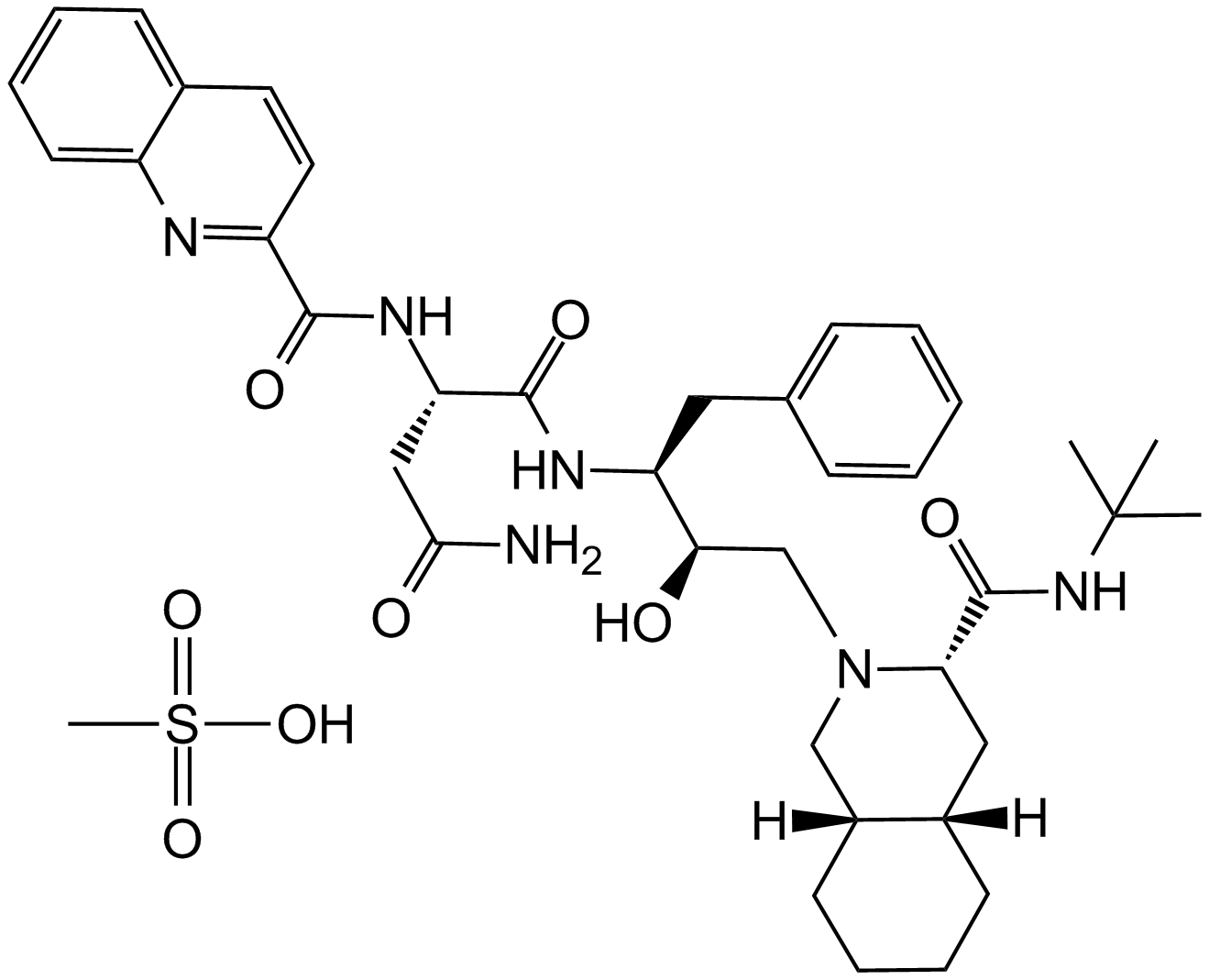
Cas No.: 149845-06-7
Sample solution is provided at 25 µL, 10mM.
;)
,-1-7$$$37316672.jpg');)
;)
;)
$$$36806353.jpg');)
;33(7)%EF%BC%9A546-561$$$37156877.jpg');)
;)
;)
;)
%201124-1138.$$$35908550.jpg');)
%20766-780.$$$37100057.jpg');)
%20418-432.$$$36893736.jpg');)
%EF%BC%9A-240-255.$$$35108512.jpg');)
533-545$$$36543525.jpg');)
%201-13.$$$36600053.jpg');)
;)
Saquinavir is a potent inhibitor HIV protease with Ki value of 0.12 and < 0.1 nM for HIV-1 and HIV-2 protease[1].
HIV protease is essential for release of mature viral and viral replication which is a retroviral aspartyl protease[2]. HIV protease cleaves the synthesized polypeptide at the appropriate places which creates the mature protein components of HIV viral. HIV-1 protease is an attractive target of AIDS.
Saquinavir is a transition-state inhibitor which binds to the active site of HIV protease, preventing cleavage of viral polyproteins [1]. Saquinavir inhibited the cleavage of p55 (the HIV-1 gag polyprotein) to p24 which is the viral structural protein in chronically infected CEM cells [2]. The bioavailability of 20 mg/kg saquinavir increased 325-fold in mice when co-administered ritonavir at the dose of 50 mg/kg. Ritonavir prevents saquinavir from metabolizing to an inactive form by CYP3A.
Saquinavir also inhibited the level of endogenous Aβ40 from primary cultured human cortical neurons. Saquinavir significantly reduced the production of the TCA-soluble extracellular fraction at 50 or 100 μM. Saquinavir reduced Aβ production in human neurons reaching 90% at 50 μM. Saquinavir showed as high as 60, 30, 32, and 48% inhibition of BACE1 activity at 300 μM as compared to control [3].
References:
1.Roberts NA, Martin JA, Kinchington D, Broadhurst AV, Craig JC, Duncan IB, Galpin SA, Handa BK, Kay J, Krohn A et al: Rational design of peptide-based HIV proteinase inhibitors. Science 1990, 248(4953):358-361.
2.Davies DR: The structure and function of the aspartic proteinases. Annu Rev Biophys Biophys Chem 1990, 19:189-215.
3.Lan X, Kiyota T, Hanamsagar R, Huang Y, Andrews S, Peng H, Zheng JC, Swindells S, Carlson GA, Ikezu T: The effect of HIV protease inhibitors on amyloid-beta peptide degradation and synthesis in human cells and Alzheimer's disease animal model. J Neuroimmune Pharmacol 2012, 7(2):412-423.


Average Rating: 5 (Based on Reviews and 30 reference(s) in Google Scholar.)
GLPBIO products are for RESEARCH USE ONLY. Please make sure your review or question is research based.
Required fields are marked with *