

4-ethylphenyl sulfate |
Catalog No.GC13203
 One-Click Copy Product Info
|

4-ethylphenyl sulfate is an orally active and blood-brain barrier-penetrating intestinal microbial metabolite.
Products are for research use only. Not for human use. We do not sell to patients.
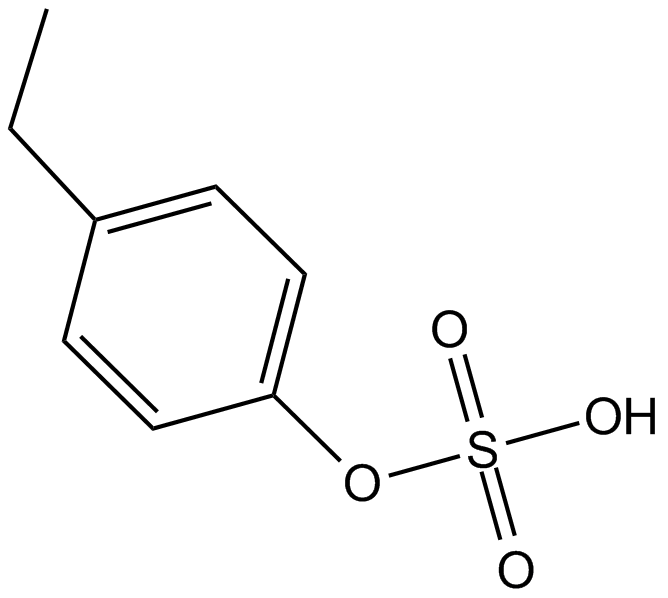
Cas No.: 85734-98-1
Sample solution is provided at 25 µL, 10mM.
_1-3.$$$39978408@51.jpg');)
_1-9.$$$38538795@65.jpg');)
_1-9.$$$39112701@51.jpg');)
_1-7.$$$37316672@70.jpg');)
_366-372.$$$36198801@70.jpg');)
.$$$38565142@65.jpg');)
_1867-1883.$$$33248023@67.jpg');)
_eads6055.$$$39977546@45.jpg');)
_eadm9805.$$$40080571@45.jpg');)
_eadj3020.$$$39666821@45.jpg');)
_1-20.$$$39757301@28.jpg');)
_1-24.$$$38898113@28.jpg');)
_273-287.$$$36806353@46.jpg');)
_1-16.$$$37156877@44.jpg');)
_1-19.$$$37460805@44.jpg');)
_1291-1307.$$$34518654@46.jpg');)
4-ethylphenyl sulfate is an orally active and blood-brain barrier-penetrating intestinal microbial metabolite [1]. N-4-Ethylphenyl sulfate acts as a protein-bound uremic toxin that causes endothelial dysfunction and leads to chronic kidney disease [2]. 4-Ethylphenyl sulfate is widely used as a diagnostic biomarker for intestinal flora imbalance and autism, and is used as a reference substance to develop liquid chromatography/electrospray ionization methods for the identification of related compounds[3].
In vitro, 4-ethylphenyl sulfate treatment (10mM) for 72 hours significantly reduced the viability of HCT-116 cells, accompanied by cell volume reduction, formation of intracellular vesicles, and damage to cell membrane integrity[4].
References:
[1] Needham B D, Funabashi M, Adame M D, et al. A gut-derived metabolite alters brain activity and anxiety behaviour in mice[J]. Nature, 2022, 602(7898): 647-653.
[2] Verma D, Hashmi S Z H, Lakshmi G, et al. Electrochemical sensor based on polydopamine-molecularly imprinted polymer for detection of 4-ethylphenyl sulfate “a novel gut metabolite”: Fabrication, characterization, and performance evaluation in human urine[J]. Microchemical Journal, 2023, 193: 108964.
[3] Sandoni L, Asta L, Giompaolo N, et al. The Role of Microbiota Metabolites Propionic Acid, p‐Cresol, and 4‐Ethylphenyl Sulfate in Autism Susceptibility: A Systematic Review[J]. Autism Research, 2026: e70237.
[4] Jaiswal J, Srivastav A K, Kushwaha M, et al. Gut Microbial Metabolite 4-Ethylphenylsulfate Is Selectively Deleterious and Anticancer to Colon Cancer Cells[J]. Journal of Medicinal Chemistry, 2025, 68(10): 10425-10438.
| Cell experiment [1]: | |
Cell lines | HCT-116 cells |
Preparation Method | HCT-116 cells were cultured at 37°C and 5% CO2 in McCoy 5A medium supplemented with 10% fetal bovine serum (FBS), 1% penicillin-streptomycin. Cells were plated at a density of 2.5×10⁴ cells/ml in a 96-well plate with growth medium for 24h, and then were incubated with the different concentrations of 4-ethylphenyl sulfate (0, 1, 2.5, 5, and 10mM) for 24, 48, and 72h, respectively, the cell viability was analyzed. |
Reaction Conditions | 0, 1, 2.5, 5, and 10mM; 24, 48, and 72h |
Applications | 4-ethylphenyl sulfate treatment significantly inhibited the cell viability of HCT-116 cells in a concentration- and time-dependent manner. |
References: | |
| Cas No. | 85734-98-1 | SDF | |
| Chemical Name | 4-ethylphenyl hydrogen sulfate | ||
| Canonical SMILES | OS(OC1=CC=C(CC)C=C1)(=O)=O | ||
| Formula | C8H10O4S | M.Wt | 202.23 |
| Solubility | ≥ 20.2mg/mL in DMSO | Storage | Store at -20°C |
| General tips | Please select the appropriate solvent to prepare the stock solution according to the
solubility of the product in different solvents; once the solution is prepared, please store it in
separate packages to avoid product failure caused by repeated freezing and thawing.Storage method
and period of the stock solution: When stored at -80°C, please use it within 6 months; when stored
at -20°C, please use it within 1 month. To increase solubility, heat the tube to 37°C and then oscillate in an ultrasonic bath for some time. |
||
| Shipping Condition | Evaluation sample solution: shipped with blue ice. All other sizes available: with RT, or with Blue Ice upon request. | ||
| Prepare stock solution | |||

|
1 mg | 5 mg | 10 mg |
| 1 mM | 4.9449 mL | 24.7243 mL | 49.4486 mL |
| 5 mM | 989 μL | 4.9449 mL | 9.8897 mL |
| 10 mM | 494.5 μL | 2.4724 mL | 4.9449 mL |
Step 1: Enter information below (Recommended: An additional animal making an allowance for loss during the experiment)
 g
μL
g
μL
Step 2: Enter the in vivo formulation (This is only the calculator, not formulation. Please contact us first if there is no in vivo formulation at the solubility Section.)
Calculation results:
Working concentration: mg/ml;
Method for preparing DMSO master liquid: mg drug pre-dissolved in μL DMSO ( Master liquid concentration mg/mL, Please contact us first if the concentration exceeds the DMSO solubility of the batch of drug. )
Method for preparing in vivo formulation: Take μL DMSO master liquid, next addμL PEG300, mix and clarify, next addμL Tween 80, mix and clarify, next add μL saline, mix and clarify.
Method for preparing in vivo formulation: Take μL DMSO master liquid, next add μL Corn oil, mix and clarify.
Note: 1. Please make sure the liquid is clear before adding the next solvent.
2. Be sure to add the solvent(s) in order. You must ensure that the solution obtained, in the previous addition, is a clear solution before proceeding to add the next solvent. Physical methods such as vortex, ultrasound or hot water bath can be used to aid dissolving.
3. All of the above co-solvents are available for purchase on the GlpBio website.
Quality Control & SDS
- View current batch:
- Purity: >97.00% Appearance: A solid
- COA (Certificate of Analysis)
- SDS (Safety Data Sheet)
- Datasheet
Average Rating: 5 (Based on Reviews and 19 reference(s) in Google Scholar.)