

CAM833 |
Catalog No.GC65935
 One-Click Copy Product Info
|

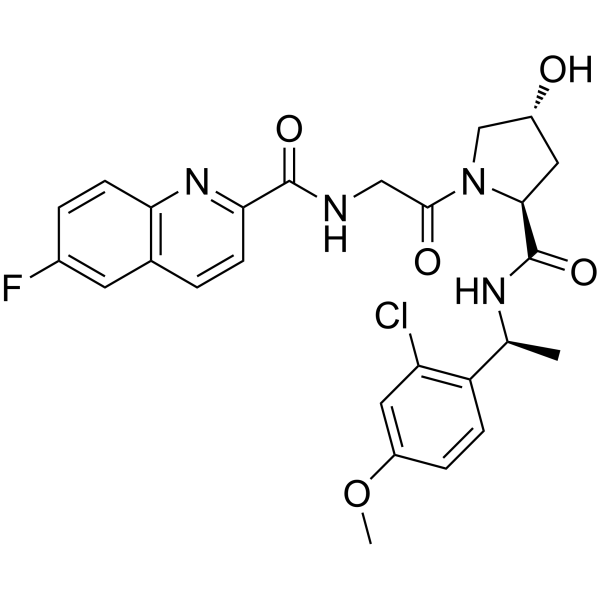
CAM833은 아미크로몰급의 화학 억제제로 RAD51 재결합효소와 종양억제단백 BRCA2의 BRC 반복 모티브 간의 조절 단백질-단백질 상호작용을 억제한다.
Products are for research use only. Not for human use. We do not sell to patients.
Cas No.: 2758364-02-0
Sample solution is provided at 25 µL, 10mM.
_1-3.$$$39978408@51.jpg');)
_1-9.$$$38538795@65.jpg');)
_1-9.$$$39112701@51.jpg');)
_1-7.$$$37316672@70.jpg');)
_366-372.$$$36198801@70.jpg');)
.$$$38565142@65.jpg');)
_1867-1883.$$$33248023@67.jpg');)
_eads6055.$$$39977546@45.jpg');)
_eadm9805.$$$40080571@45.jpg');)
_eadj3020.$$$39666821@45.jpg');)
_1-20.$$$39757301@28.jpg');)
_1-24.$$$38898113@28.jpg');)
_273-287.$$$36806353@46.jpg');)
_1-16.$$$37156877@44.jpg');)
_1-19.$$$37460805@44.jpg');)
_1291-1307.$$$34518654@46.jpg');)
CAM833은 아미크로몰급의 화학 억제제로 RAD51 재결합효소와 종양억제단백 BRCA2의 BRC 반복 모티브 간의 조절 단백질-단백질 상호작용을 억제한다. CAM833은 RAD51 표면의 두 개의 수포성 포켓과 결합하고 이 포켓은 보통 BRCA2의 BRC 반복 모티브로부터 온 보존된 수포성 사이드 체인을 수용하므로 직접 RAD51:BRCA2 상호작용과 경쟁합니다. CAM833은 RAD51을 손상 유도의 실록으로 조립하는 것을 억제하고 동형 DNA 재결합을 통한 DNA 복사를 저해한다. CAM833이 ChimRAD51을 억제하는 Kd 값은 366 nM이다[1]. CAM833은 DNA 손상으로 인한 성장 억제, 세포 주기 차단 및 세포 독성을 증폭시킨다.
CAM833(20 μM;0-72 시간)은 HCT116 세포에서 발생하는 방사선 유발의 세포 주기 차단을 강화시키고 시간이 지남에 따라 세포 사멸을 증가시켰고 CAM833은 또한 HCT116 세포에서 PARP1의 억제를 강화시켰다[1].
References:
[1]. Scott DE, Francis-Newton NJ, et,al. A small-molecule inhibitor of the BRCA2-RAD51 interaction modulates RAD51 assembly and potentiates DNA damage-induced cell death. Cell Chem Biol. 2021 Jun 17;28(6):835-847.e5. doi: 10.1016/j.chembiol.2021.02.006. Epub 2021 Mar 3. PMID: 33662256; PMCID: PMC8219027.
| 세포 실험 [1]: | |
세포 라인 | HCT116 세포 |
제조 방법 | HCT116 세포에 20 μM의 CAM833이나 DMSO를 처리하고 3Gy 노출한 후 세포 주기를 분석했습니다. |
반응 조건 | 20 μM;72시간 동안 |
응용 분야 | CAM833은 방사선 유발의 세포주기 차단을 강화시키고 G2/M 기류의 HCT116 세포에서 세포 사멸 과정에 진입을 증가시켰습니다. |
References: | |
| Cas No. | 2758364-02-0 | SDF | |
| Formula | C26H26ClFN4O5 | M.Wt | 528.96 |
| Solubility | DMSO : 100 mg/mL | Storage | Store at -20°C |
| General tips | Please select the appropriate solvent to prepare the stock solution according to the
solubility of the product in different solvents; once the solution is prepared, please store it in
separate packages to avoid product failure caused by repeated freezing and thawing.Storage method
and period of the stock solution: When stored at -80°C, please use it within 6 months; when stored
at -20°C, please use it within 1 month. To increase solubility, heat the tube to 37°C and then oscillate in an ultrasonic bath for some time. |
||
| Shipping Condition | Evaluation sample solution: shipped with blue ice. All other sizes available: with RT, or with Blue Ice upon request. | ||
| Prepare stock solution | |||

|
1 mg | 5 mg | 10 mg |
| 1 mM | 1.8905 mL | 9.4525 mL | 18.905 mL |
| 5 mM | 378.1 μL | 1.8905 mL | 3.781 mL |
| 10 mM | 189.1 μL | 945.3 μL | 1.8905 mL |
Step 1: Enter information below (Recommended: An additional animal making an allowance for loss during the experiment)
 g
μL
g
μL
Step 2: Enter the in vivo formulation (This is only the calculator, not formulation. Please contact us first if there is no in vivo formulation at the solubility Section.)
Calculation results:
Working concentration: mg/ml;
Method for preparing DMSO master liquid: mg drug pre-dissolved in μL DMSO ( Master liquid concentration mg/mL, Please contact us first if the concentration exceeds the DMSO solubility of the batch of drug. )
Method for preparing in vivo formulation: Take μL DMSO master liquid, next addμL PEG300, mix and clarify, next addμL Tween 80, mix and clarify, next add μL saline, mix and clarify.
Method for preparing in vivo formulation: Take μL DMSO master liquid, next add μL Corn oil, mix and clarify.
Note: 1. Please make sure the liquid is clear before adding the next solvent.
2. Be sure to add the solvent(s) in order. You must ensure that the solution obtained, in the previous addition, is a clear solution before proceeding to add the next solvent. Physical methods such as vortex, ultrasound or hot water bath can be used to aid dissolving.
3. All of the above co-solvents are available for purchase on the GlpBio website.
Quality Control & SDS
- View current batch:
- Purity: >98.00% Appearance: A solid
- COA (Certificate of Analysis)
- SDS (Safety Data Sheet)
- Datasheet
Average Rating: 5 (Based on Reviews and 30 reference(s) in Google Scholar.)