

Capsaicin |
Catalog No.GC14065
 One-Click Copy Product Info
|

Capsaicin은 transient receptor potential cation channel로, 세포질 V, 멤버 1(TRPV1)의 고도로 선택적인 에이전트로 문이 열리는, 선택성transient receptor potential cation channel로, 주로 소경도 감각신경세포에 우선적으로 표현된다.
Products are for research use only. Not for human use. We do not sell to patients.
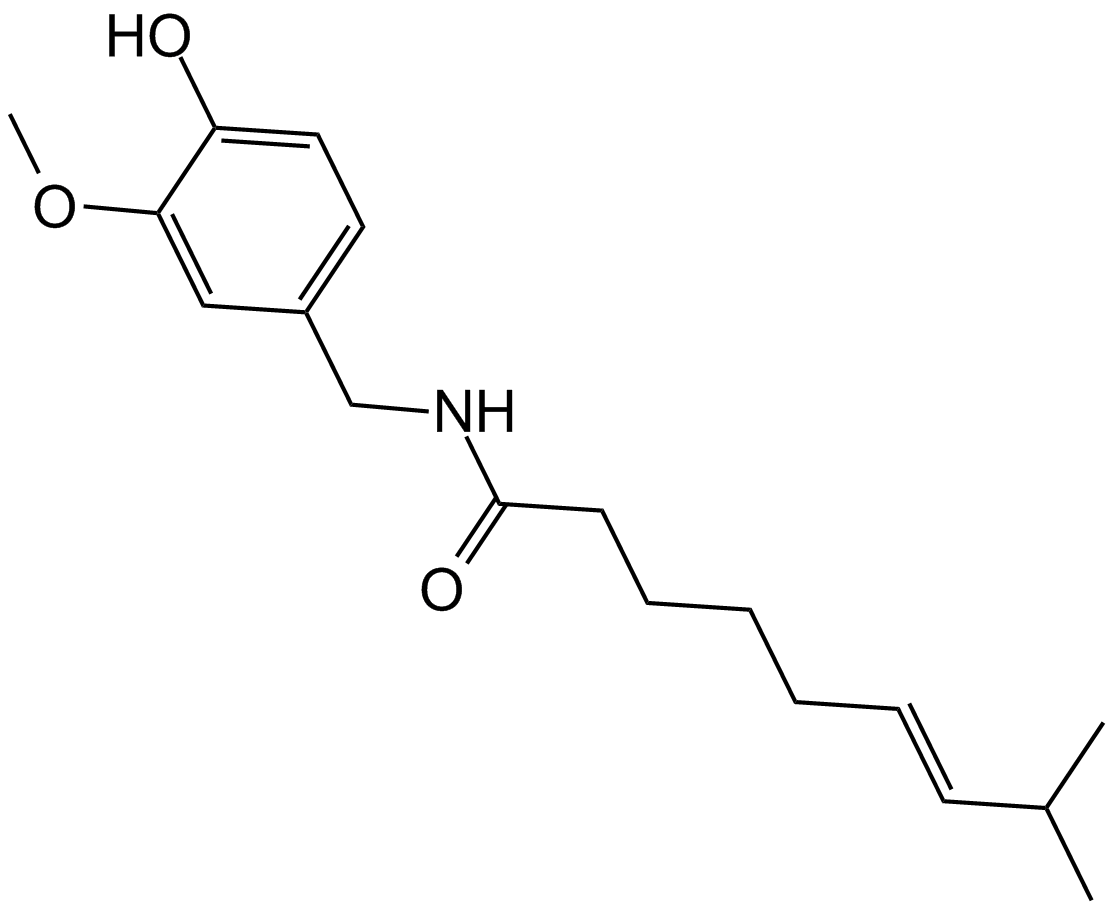
Cas No.: 404-86-4
Sample solution is provided at 25 µL, 10mM.
Capsaicin은 transient receptor potential cation channel로, 세포질 V, 멤버 1(TRPV1)의 고도로 선택적인 에이전트로 문이 열리는, 선택성transient receptor potential cation channel로, 주로 소경도 감각신경세포에 우선적으로 표현된다. Capsaicin은 CYP1A2, CYP2C9, CYP2C19를 억제하며, 그 IC50 값이 각각 2.1, 2.0, 3.2 μM이고, CYP2B6, CYP2D6, CYP3A4, CYP3A5를 억제하는 것으로 추정되는 IC50 값이 각각 24, 18, 38, 12 μM이다[2].
Capsaicin은 인간 질환 경부암 HeLa 세포의 성장을 억제했다(IC50 ~30 μM), 세포 내 칼슘 농도를 증가시켰으며, 이 효과는 Capsaicin 앙티아곤리스트인 캡사제핀에 의해 차단되었다[3]. 캡사이신은 200 μM 이상의 농도로 인간 뇌세포종양 A172 세포의 조기 세포사를 유도했으며, 이 조기 세포사는 캡사제핀이나 BAPTA/AM에 의해 억제되지 않았다. 250 μM의 BAPTA/AM은 기본ROS의 생성과 지질 과산소화를 감소시켰다. H2O2는 조기 세포사를 감소시켰고 NAC은 증가시켰다[4]. Capsaicin은 TRPV1에 의존하는 과정을 통해 인간 유모세포암 RT4 세포의 성장을 감소시켰다(IC50=80 μM), G0/G1 단계에서 세포 주기를 정지시켰으며, 조기 세포사가 발생했다[5].
Capsaicin전처리된 ICR 쥐와 CD-1 쥐에 2.5 μmol 농도로 투여하여 VC(5.8 mol)가 유도하고 TPA가 촉진하는 종양 발생률을 22주일에 62% 감소시켰다 (ICR). 1μmol의 현지 적용 캡사이신은 투여 24시간 전과 1시간 전에도 현지 BP(0.3 μmol)가 유도하고 TPA (CD-1)가 촉진하는 종양을 현저하게 억제했다[6]. Capsaicin을 구강으로 투여하면 간과 대장의 2차 단계 효소를 크게 증가시켰다. 500ppm의 Capsaicin을 4주간 구강으로 투여하여 AOM(체중당 20mg/kg, 2주에 한 번)이 유도한 ACF 형성을 현저하게 억제했다. 38주간의 연구에서 4주간의 유도 단계 동안 500ppm의 Capsaicin은 결장 선암의 발생률을 현저하게 60% 감소시켰다[7].
References:
[1]. Bley, K.; Boorman, G.; Mohammad, B.; McKenzie, D.; Babbar, S. A comprehensive review of the carcinogenic and anticarcinogenic potential of capsaicin. Toxicol. Pathol. 2012, 40, 847-873.
[2]. Babbar S., Chanda S., Bley K. (2010). Inhibition and induction of human cytochrome P450 enzymes in vitro by capsaicin. Xenobiotica 40, 807-16.
[3]. Takahata K., Chen X., Monobe K., Tada M. (1999). Growth inhibition of capsaicin on HeLa cells is not mediated by intracellular calcium mobilization. Life Sci 64, PL165-71.
[4]. Lee Y. S., Nam D. H., Kim J. A. (2000). Induction of apoptosis by capsaicin in A172 human glioblastoma cells. Cancer Lett 161, 121-30.
[5]. Amantini C., Ballarini P., Caprodossi S., Nabissi M., Morelli M. B., Lucciarini R., Cardarelli M. A., Mammana G., Santoni G. (2009). Triggering of transient receptor potential vanilloid type 1 (TRPV1) by capsaicin induces Fas/CD95-mediated apoptosis of urothelial cancer cells in an ATM-dependent manner. Carcinogenesis 30, 1320-29.
[6]. Surh Y. J., Lee R. C., Park K. K., Mayne S. T., Liem A., Miller J. A. (1995). Chemoprotective effects of capsaicin and diallyl sulfide against mutagenesis or tumorigenesis by vinyl carbamate and N-nitrosodimethylamine. Carcinogenesis 16, 2467-71.
[7]. Yoshitani S. I., Tanaka T., Kohno H., Takashima S. (2001). Chemoprevention of azoxymethane-induced rat colon carcinogenesis by dietary capsaicin and rotenone. Int J Oncol 19, 929-39.
| 세포 실험 [1]: | |
세포 라인 | 인간 대장직장 암세포 (SW480, LoVo 및 HCT-116) |
제조 방법 | 세포는 2×10⁵ 개의 세포/ml의 농도로 배양한 후 그림의 범례에 지정된 농도나 시간에 Capsaicin으로 처리되었습니다. |
반응 조건 | 0, 50 그리고 100 µM , 0, 1, 2, 또는 3 일 동안 |
응용 분야 | 세 가지 인간 대장암 세포계의 성장이 모두 Capsaicin 치료에 의해 용도 및 시간에 따라 억제되었습니다. 50µM Capsaicin 치료는 세포 성장을 어느 정도 감소시켰지만 100 µM의 Capsaicin으로 치료된 세포에서 현저한 세포 성장 저하가 관찰되었습니다. |
| 동물 실험 [2]: | |
동물 모형 | 수컷 스위스 알비노 쥐 |
제조 방법 | 1 그룹(대조군)은 실험 과정 전반에 올리브 오일을 투여받았습니다. 2 그룹은 BP(50 mg/kg 올리브 오일에 녹여서)를 오리가 매주 두 번에 구강 투여로 처리 받았으며, 4주 연속으로 진행되었습니다(1일차와 4일차). 3 그룹은 Capsaicin (10 mg/kg 오리가 오일에 녹여서)을 복강 주사로 매주 한 번, 14주 동안 처리 받아 Capsaicin이 유발하는 세포 독성을 평가하였습니다. 4 그룹(BP + Capsaicin)은 BP 처리(2 그룹과 동일)를 받는 동시에 Capsaicin (10 mg/kg 오리가 오일에 녹인)을 복강 주사로 받았습니다. Capsaicin 치료는 BP 첫 투여 1주 전부터 시작되어 14주간 지속되었습니다. |
제형 | 복강 주사, 매주 10mgkg-1, 14주 동안 |
응용 분야 | Capsaicin 전처리는 자유 기질 억제 효과를 발생시켜, 그 결과 4집단 동물의 지질 과산소화를 현저하게 예방했습니다. |
참고문헌: [1]: Lee S. H., Richardson R. L., Dashwood R. H., Baek S. J. (2011). Capsaicin represses transcriptional activity of β-catenin in human colorectal cancer cells. J Nutr Biochem.[2]: Anandakumar P., Jagan S., Kamaraj S., Ramakrishnan G., Titto A. A., Devaki T. (2008). Beneficial influence of capsaicin on lipid peroxidation, membrane-bound enzymes and glycoprotein profile during experimental lung carcinogenesis. J Pharm Pharmacol 60 803-8. | |
| Cas No. | 404-86-4 | SDF | |
| Chemical Name | (E)-N-[(4-hydroxy-3-methoxyphenyl)methyl]-8-methylnon-6-enamide | ||
| Canonical SMILES | CC(C)C=CCCCCC(=O)NCC1=CC(=C(C=C1)O)OC | ||
| Formula | C18H27NO3 | M.Wt | 305.41 |
| Solubility | ≥ 15.27 mg/mL in DMSO, ≥ 52.3 mg/mL in EtOH with gentle warming | Storage | 4°C, protect from light |
| General tips | Please select the appropriate solvent to prepare the stock solution according to the
solubility of the product in different solvents; once the solution is prepared, please store it in
separate packages to avoid product failure caused by repeated freezing and thawing.Storage method
and period of the stock solution: When stored at -80°C, please use it within 6 months; when stored
at -20°C, please use it within 1 month. To increase solubility, heat the tube to 37°C and then oscillate in an ultrasonic bath for some time. |
||
| Shipping Condition | Evaluation sample solution: shipped with blue ice. All other sizes available: with RT, or with Blue Ice upon request. | ||
| Prepare stock solution | |||

|
1 mg | 5 mg | 10 mg |
| 1 mM | 3.2743 mL | 16.3714 mL | 32.7429 mL |
| 5 mM | 654.9 μL | 3.2743 mL | 6.5486 mL |
| 10 mM | 327.4 μL | 1.6371 mL | 3.2743 mL |
Step 1: Enter information below (Recommended: An additional animal making an allowance for loss during the experiment)
 g
μL
g
μL
Step 2: Enter the in vivo formulation (This is only the calculator, not formulation. Please contact us first if there is no in vivo formulation at the solubility Section.)
Calculation results:
Working concentration: mg/ml;
Method for preparing DMSO master liquid: mg drug pre-dissolved in μL DMSO ( Master liquid concentration mg/mL, Please contact us first if the concentration exceeds the DMSO solubility of the batch of drug. )
Method for preparing in vivo formulation: Take μL DMSO master liquid, next addμL PEG300, mix and clarify, next addμL Tween 80, mix and clarify, next add μL saline, mix and clarify.
Method for preparing in vivo formulation: Take μL DMSO master liquid, next add μL Corn oil, mix and clarify.
Note: 1. Please make sure the liquid is clear before adding the next solvent.
2. Be sure to add the solvent(s) in order. You must ensure that the solution obtained, in the previous addition, is a clear solution before proceeding to add the next solvent. Physical methods such as vortex, ultrasound or hot water bath can be used to aid dissolving.
3. All of the above co-solvents are available for purchase on the GlpBio website.
Quality Control & SDS
- View current batch:
- Purity: >99.50% Appearance: A solid
- COA (Certificate of Analysis)
- SDS (Safety Data Sheet)
- Datasheet
Average Rating: 5 (Based on Reviews and 30 reference(s) in Google Scholar.)